

In 2025, two key stories shaped the markets. In the first half, tariffs dominated, influencing global trade. Then, as their effects became clearer, AI took center stage in the back half of the year.
As we enter 2026, we find ourselves propelled by a potent blend of supportive policies, rapid technological advancements, and a mix of optimism, skepticism, and frustration in both the economy and markets. The echoes of the dot-com era are unmistakable—in AI capital allocation, investor expectations, and workflows. Yet, beneath the surface, the contours of the cycle remain distinct.
From a macroeconomic standpoint, our views are fairly aligned with consensus. While we’re a touch more concerned about the labor market—and by extension, see room for more cuts from the Fed—a January pause seems quite likely, in our view. We’re also more attuned to the potential impact of the Supreme Court striking down IEEPA tariffs at the beginning of next year.
When it comes to AI, we recognize the boom-bust risks. But for the moment, we’re more focused on the supply-side constraints and the potential for air pockets—either within the AI ecosystem or the broad US market. We’re fairly optimistic about the industry’s revenue potential but have lingering questions about monetization and commoditization risks.
In the stock market, we concede that multiples are high across the board, which could affect longer-term returns. However, we also see a wide range of prospects within the market, suggesting that performance will vary significantly going forward. It’s not just a matter of AI versus non-AI, Magnificent Seven versus the “Other 493,” or even large-caps versus small-caps—the distinctions run through categories, not just between them.
To a large extent, the current environment reminds us of the late 1990s, with a major tech wave and the possibility of a loose interest rate backdrop. Yet history rhymes, rather than repeats. This raises two important questions: What year are we really in? And what will make this cycle different from the past?[i]
Macroeconomic Backdrop
United States
Overall, the range of outcomes has narrowed over the course of 2025. Early in the year, some extreme economic scenarios appeared more likely due to excessive tariff proposals, but those risky policies were dialed back just in time. As a result—and with the passage of the OBBBA—we now have a clearer view of the macro backdrop compared to a year ago. Yet we remain aware that life is filled with uncertainty, and both upside and downside risks could arise from unexpected sources.
Our base case sees growth improving as the year progresses, starting out on the lower end of its recent range and pivoting higher, with GDP growth ending the year somewhere in the 1.75%–2% range.
In the coming months, some tariff-driven price increases should continue to filter into year-over-year inflation data. But we may encounter turbulence if the Supreme Court deems the IEEPA-justified tariffs unconstitutional, forcing the White House to implement tariffs via more limited authorities. Despite this, we expect inflation to moderate over the year for three key reasons:
- The economy will adapt to the new policy environment, which should include lower tariffs if the Supreme Court rules as anticipated.
- We will start comparing prices to last year’s levels, which already reflect tariff-driven increases.
- Recent declines in housing prices will gradually bring down shelter inflation, which has been the stickiest source of overall inflation since the pandemic.
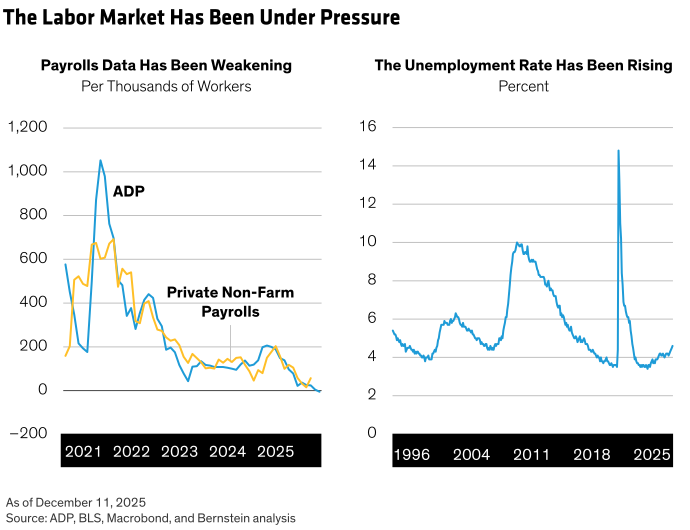
The labor market is our main concern in the US economy. The recent government shutdown has made it difficult to get a clear picture of the current labor situation. But catch-up data appears to confirm some softening, even after adjusting for supply constraints (Display). If that softening accelerates, it could significantly threaten economic and earnings growth. This is a key reason why the Federal Reserve is targeting ongoing rate cuts, even with inflation inching upward.
If the labor market deteriorates further, we expect the Fed to respond with cuts to support the economy. We also see an increase in unemployment as a potential risk—both as a natural part of the economic cycle, and as a possible result of AI productivity gains, though we have yet to see clear evidence of this in the macro data.
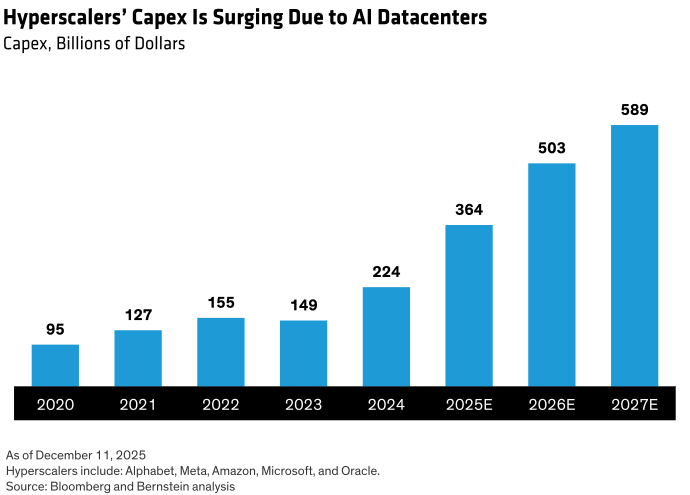
Assuming the labor market holds up, aggregate consumer spending should remain resilient. What’s more, capex (especially around AI), has become a key driver of economic growth. Based on guidance from major tech companies, we expect that to accelerate in 2026.
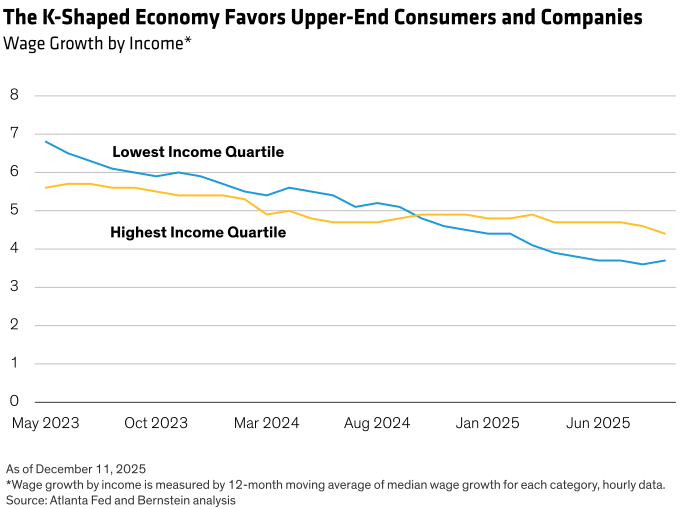
Under the surface, much has been made of the K-shaped nature of the economy, a phenomenon we expect to continue next year. Lower-income households are increasingly struggling, while those at the higher end have benefited from stock market gains and a hotter labor market (Display). The K-shaped analogy applies to the corporate sector, too. Larger, multinational businesses are generally finding it easier to navigate today’s challenges, including tariffs, while smaller companies have had greater difficulty shifting their operations. Notably, the higher end of each of these segments drives more consumption and activity for the economy overall. Yet as the midterm elections come into view, those who aren’t benefiting or are just plain struggling may make their voices heard, with possible market implications.
While we focus heavily on macro data, companies’ earnings commentaries have emerged as a major qualitative source of expected strength in 2026. Put simply, companies were scared at the end of Q1, with uncertainty and anxiety permeating their outlooks. Yet we took some comfort that despite dusting off their recession playbooks, companies didn’t feel the need to execute on them, which could have sparked a downward economic spiral. Since then, Corporate America’s tone has become much more confident—almost no one is focused on recession, and in general, they see a resilient economic backdrop supporting revenue growth and margin expansion in the coming quarters.[ii]
Speaking of growth, AI has been the elephant in the room over the past few months—a trend that’s likely to continue. Corporate commentary on AI has been overwhelmingly and increasingly positive. Google cited capacity constraints in meeting demand and Nvidia sees over $300 billion in revenue in 2027. [iii] In terms of uptake, corporate pilot programs have turned into fuller implementations over the course of 2026, with increasing evidence of both cost savings and revenue opportunities coming into view. As 2026 progresses, we believe investors will look for more tangible evidence of AI monetization and benefits accruing to non-tech companies who have implemented it. To highlight some of what we heard this earnings season:
- Microsoft Copilot saved its users millions of employee hours
- Meta has seen an uptick in time spent on its services as well as ad spend, with year-on-year revenues surging 26% in the most recent quarter
- Kraft Heinz reduced added sugars and sodium while PPG minimized input costs in their new product formulations
- Over 40% of Walmart’s new code is now AI-generated and automation/AI has reduced their shipping costs by over 30%
- Siemens Healthineers now has over 100 AI-supported products and reports over 300 million AI-powered magnetic resonance scans since 2022
The AI infrastructure buildout looks like it could be one of the largest and fastest in history—a compelling opportunity that has understandably captured investors’ attention. Consensus capex expectations for the five major hyperscalers[iv] sit at over $500 billion in 2026 and around $600 billion in 2027 (Display).
We expect supply-side constraints on chips, and especially power, to continue to bind the industry. Investors should be more concerned about those impediments than an overall AI demand shortfall, in our view. That said, we do have questions about monetization and commoditization of AI models. And we’re thinking carefully about where in the value chain and the capital structure we want to position ourselves to best ride this massive wave.
Ultimately, here’s how we’d parse a range of possible scenarios for the US economy:
- Optimistic: Substantial tariff easing, fiscal support remains strong, AI buildout continues apace
- Baseline: Modest tariff easing (as IEEPA authority falls and is replaced by other, more restricted authorities), resilient consumer, and robust AI
- Market downturn: AI disappointment and questions of economic drag from negative wealth effects
- Recession: Labor market weakness becomes consumer weakness in real economy and market’s risk appetite vanishes;[v] or exogenous shock
Europe
We see opportunities for Europe to awaken from a period of slumber. Depending on how well political leaders can organize, fiscal stimulus—especially in defense spending—should support economic growth. That said, political fragmentation may temper stimulus, stifling how quickly it makes its way into the economy. European defense is in a secular upcycle, creating an ongoing theme for investors in our view. In addition, with steeper yield curves working their way through banks’ balance sheets, we consider them clear beneficiaries in the region.
Geopolitically, the war in Ukraine and any potential peace process to bring about its end remains pivotal for the region.
Asian Leaders—Japan and China
While the US and Europe are broadly on the same economic cycle, Japan and China move to the beat of their own drums.
Japanese inflation remains on the higher side by their standards, giving the Bank of Japan fuel to hike one or two more times. Meanwhile, growth is expected to be mild. One risk we’ll be watching? Capital market hiccups stemming from higher Japanese rates. Japanese investors have historically been major exporters of capital to other countries, especially to US markets. As their rates continue to climb, we’ll see if more capital stays at home or if any levered investors using the yen as a cheap source of funds have to sharply adjust their portfolios.
Meanwhile, China continues its deflationary trajectory due to an overbuild of real estate, infrastructure, and industrial capacity. Stimulative policy can soften the landing to some degree, but we expect growth to continue slowing and come in below government targets.
Asset Allocation Implications
Fixed Income
Higher yields, steeper yield curves, and relatively tight credit spreads favor roll- and carry-oriented strategies in the bond markets.
While we expect rate cuts in the US to further steepen the yield curve, we think the 10-year yield around 4% looks generally fair. We like duration (interest rate exposure) but are being strategic about which maturities merit it. For instance, in the municipal bond space—where the yield curve remains disconnected from the US Treasury curve—we continue to see excess returns available in 20- and 30-year bonds. Interest rates are much higher relative to history for those maturities versus others, but we anchor that with shorter maturities to manage our overall interest rate exposure.
Across the credit markets, we’re paying careful attention to protective covenants. After some slippage in market standards, we’re noticing more investor push-back on new deals, though we’re also passing entirely on deals that don’t meet our requirements.
Alternative Credit
“Private credit” has been in the spotlight due to several high-profile bankruptcies and frauds in the second half of 2025. As a result, precise lexicon matters more than ever. Traditional “private credit,” more commonly known as direct lending, has not seen these issues. Instead, they’ve emerged in other areas of the alternative credit universe. To be clear, direct lending occurs when investment firms with long-term capital (like us) play a role similar to the one historically played by banks. We lend directly to companies—generally, as a single lender to a lone borrower. That space has grown in recent years as banks have become hamstrung by more restrictive regulatory capital requirements enacted since the Global Financial Crisis.
As our Chief Investment Officer, Alex Chaloff, pointed out in his 2Q24 quarterly letter, we were starting to see “ripples below the surface” in direct lending, with capital inflows beginning to impact the supply of capital, yields, and lending standards in the space. Despite those undercurrents, the absolute and relative yields have remained attractive, a trend that’s persisted even as capital continues to enter the market. Strong lending standards will be an increasingly critical differentiator when it comes to performance, and we feel confident in our team and approach in that space.
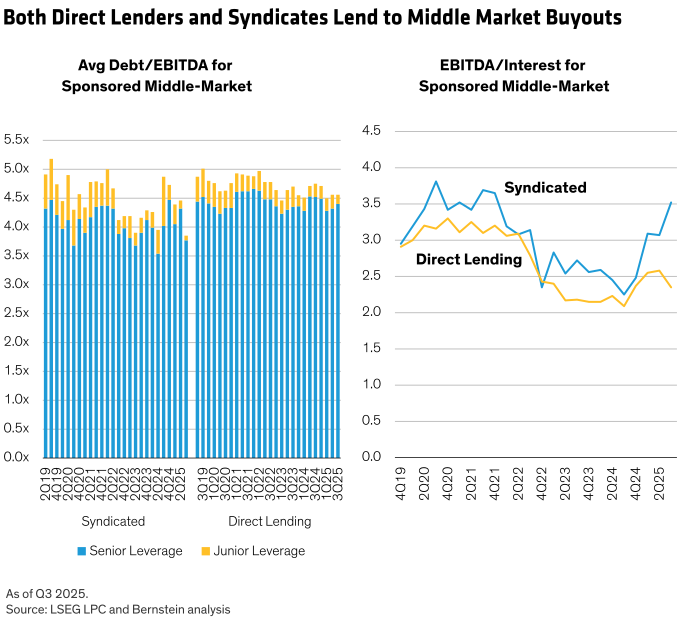
Similarly, we’re taking a careful approach in the broadly syndicated loan (BSL) market, where larger loans are arranged by banks and divided up among a wide cohort of lenders (Display). While defaults remain low, liability management exercises (LMEs)—which aim to exchange or adjust the terms of debt while avoiding an outright default and court battle—have blossomed in the leveraged loan market.
We also continue to find attractive opportunities in the asset-backed markets, with tangible collateral securing the loans at reasonable loan-to-value ratios, and in the securitized asset markets, especially the investment-grade segment.
Public Equities
Given the positive economic backdrop, market participants are feeling optimistic about riskier asset classes like US stocks. This has raised some questions about whether such optimism seems overdone, and if we might be in an AI bubble. Consensus forecasts suggest that investment returns will broaden from AI leaders to the wider market, with a focus on the beneficiaries of fiscal stimulus. Notably, we’ve seen only one bearish Wall Street strategist heading into next year.
Yet that hopefulness, combined with US market multiples nearing levels only seen twice in the past 35 years, gives us some pause.
We may all think we recall the dot-com bubble. Yet some of the finer details may have gotten lost in the intervening years:
- Multiples reached around their current levels two years before the market peaked and remained there as earnings grew. It took a year from multiples hitting north of 21x before they topped out at 23.7x in April 1999.
- While the NASDAQ peaked in March 2000, the S&P 500 didn’t crest until roughly six months later.
- Earnings maxed out just before the broad market did and declined by around one-third over the ensuing two-and-a-half years as a recession worked its way through the economy.
Needless to say, the last time we traded at multiples like these didn’t end well.
On the other hand, the other occasion we saw multiples this high was in August 2020, during the pandemic. The market stumbled in the following two months, then rebounded completely the month after and has not revisited those price levels again since—a much better experience.
What does this mean for the AI wave? We still believe we’re in the early innings of both development and adoption. It’s very tough to foresee a rational, near-term conclusion to this theme given what companies are saying and doing. Use cases are becoming clearer, implementations are on the rise, and based on our experiences and those of other firms, we expect productivity gains to follow. We simply can’t envision a world with less demand for these tools than we see today. Meanwhile, workloads are becoming more compute- and memory-intensive, and that growing demand is coming up against constrained capacity for chips and especially for power.
Given that backdrop, what could be a catalyst for a steep drop in the market’s earnings per share? A recession? Something else? To halt the AI wave, we’d suddenly need to do way less computing than expected, impacting the demand for chips. A market correction could come from a shortfall versus expectations, but a deeper market or economic retrenchment would require sales to fall or impairment charges on capital invested.
With that said, we’re not completely confident about the AI ecosystem. We worry about air pockets, or one piece of the ecosystem scaling faster than others, requiring a sharp adjustment. In fact, we’d be surprised to avoid some form of unfolding capital cycle, whether in chips, datacenters, or elsewhere.
Our other primary concern involves the monetization and commoditization of LLMs, the linchpin of the ecosystem. Training these models accounts for a large portion of the total AI compute. Plus, investors and society at large are looking for further technological advancements from LLMs to enhance AI’s value-add. If they stumble, the ripple effects would be dramatic, in our view. That said, these businesses also face the tantalizing prospect of forming an oligopoly fueled by a legion of human-equivalent labor. Consider that as we put the final touches on this outlook, Meta’s Mark Zuckerberg—who has pivoted through two decades at the forefront of internet software—is turning Meta’s AI focus to a model emphasizing control and access, similar to Google and OpenAI’s approaches. Overall, that corner of the industry is becoming more concentrated, which suggests it may end up with rational competition where the players don’t compete on price, thus preserving their pricing power.
Another concern—less for the market going into 2026, and more for developments over the course of the year—comes from megacompanies going public and changing the market’s composition. Companies like OpenAI and SpaceX, with tens of billions in sales, going public with enterprise values of around a trillion dollars won’t change the quality or the prospects of the other constituents in the index. But it will change what investors who buy the index get for their money.
Our portfolio managers would also distinguish between an “AI bubble” and a “stock market bubble,” with the latter being much more sizable and pervasive than the former.
Investors can place a lot of faith in multiples, as they’re one of the clearest quantitative metrics we have to decipher the stock market. They’re salient, and because they move faster than economic fundamentals, they ironically account for a greater portion of near-term moves. Yet their predictive power in the short-run remains low. Meanwhile, they have less influence on medium- to long-term stock moves, despite their predictive power being higher over those horizons (Display). For investors like us who are generally more focused on longer-term horizons for clients’ strategic asset allocations, their relevance comes into play as long-term equity returns may be capped by today’s high starting multiples.
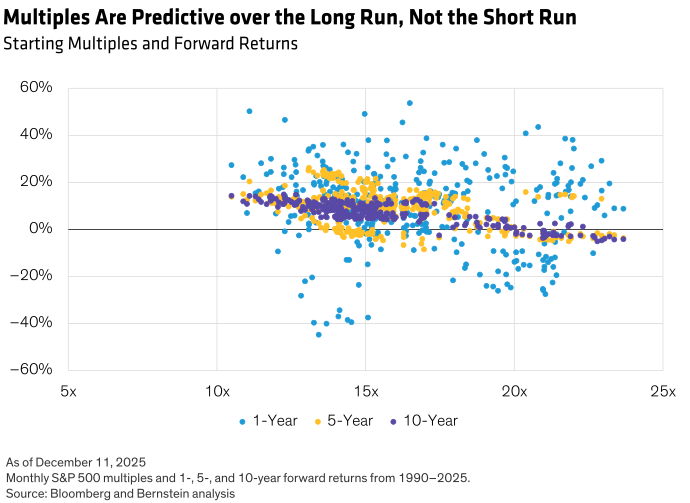
Ultimately, multiples often come down to the balance of supply and demand in the public markets, along with sentiment. What’s more, despite Wall Street persistently comparing multiples to historic averages, they don’t actually revert to the mean over time. So, while we can use those historical ranges as a reference when viewing today’s multiples in the context of long-term returns, we generally consider valuation as the final (rather than determinative) step in our analysis.
Inside the stock market, we see numerous opportunities and risks. Even the Magnificent Seven are not a monolith. Several stand out as quite attractive relative to the broad market, while others look less appealing.
Financials and healthcare have both caught our teams’ attention recently. They’re relatively cheap despite having equally attractive growth prospects compared to most other sectors, and we’ve found select stocks in the space that stand out. Energy and utilities names may also benefit from economic growth and the AI wave, though we have some questions about the near-term direction of oil prices. Industrial companies have become more upbeat in recent quarters depending on their end markets, yet a fair amount of that optimism already appears reflected in their prices. In particular, we’re looking at names that are attractively levered to AI or other secular themes such as electrification or defense, but which still offer compelling value.
In addition, as AI technology penetrates more industries and adoption grows, we expect its impact will show up in corporate margins before it will show up from a macro productivity standpoint. Assuming AI technology delivers an attractive return on investment—our base case given our experience and a growing number of stories from companies—margin expansion should be relatively widespread. Competitive forces should eventually erode that edge, but we expect to see evidence of corporate benefits before they’re competed away.
Recent market dynamics have also created selective openings across sectors and market caps. Large-caps still look attractive, but even inside of SMID-caps, a lot of low-quality names have floated recently. Whenever that corrects, fundamental-driven investors should reap the benefits, in our view.
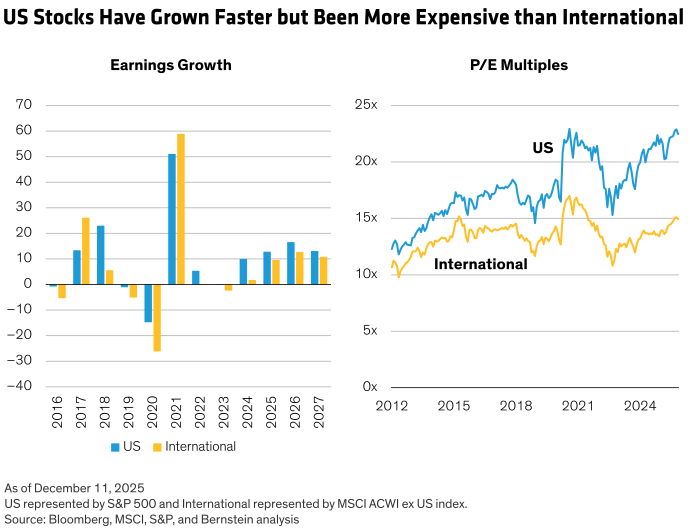
Outside the US, certain prospects are also notable. After years of underperforming, international stocks outperformed in 2025. Assuming the AI trade persists, that would create a strong tailwind for the US. However, overseas multiples are generally lower, as are fundamental expectations (Display). We’ll see which of those drivers wins out in 2026 and beyond.
In international markets, two major sectors in Europe stand out—defense and financials. On a secular basis, defense companies are benefiting from a changing world order along with the fiscal spending that European governments are bringing to bear. On a more cyclical basis, financials are becoming more profitable as the European economy finds its legs and yield curve steepening flows through to their balance sheets.
Slowly but surely, we also see transformations among international companies—from Japan and Korea to Scandinavia—as they become more shareholder-friendly and take notes from US counterparts who have outcompeted them in recent years. That creates opportunities for self-help stories, buybacks, and activist or constructivist investor involvement.
We’re still cautious on China, where low multiples are creating opportunities. Yet the economy continues to rebalance as the government slowly lets the air out of its real estate and infrastructure bubble—all while trying to maintain a high pace of growth and development. As a result, China has been exporting a deflationary impulse to trade partners like Europe. We expect that economic trend to persist.
We remain constructive on Japanese markets and will be watching for the BOJ’s policies to spark potential global capital issues that temporarily disrupt other countries’ markets. In Latin America, we see idiosyncratic opportunities and are keeping our eye on trade talks with the US, as well as the US’s new national security strategy toward its neighbors. A positive and stable economic backdrop in developed markets should also favor risk assets in emerging markets.
Private Equity and Venture/Growth Equity
The leveraged buyout space continues to digest past deals, pressuring funds to exit investments in aging portfolios and distribute cash to investors. That dynamic has also affected investors’ abilities to deploy capital into new vintages, as they await a return of their cash. In recent years, that has created two attractive opportunities for us. We’ve taken advantage of the dearth of capital to commit to higher-quality funds while securing attractive deals on continuation funds in the market for secondaries, as some investors seek accelerated liquidity. Given where sentiment and liquidity stand today, exits could potentially pick up next year, driving new fundraising and deals.
The venture and growth capital arenas have encountered a similar dynamic lately. With some major privately held companies planning to go public in 2026, we may see more capital flowing through this ecosystem as well. Importantly, we see three AI-related offshoots impacting this arena:
- If workers displaced by AI redeploy into new ventures, they’ll need funding to get off the ground.
- AI technology may alter the capital requirements for startups, lowering upfront investment barriers and enabling faster scaling.
- According to Crunchbase data, AI investments now account for about half to two-thirds of VC and growth deal value (Display). This can be viewed as either an opportunity or a risk for the current vintages of these funds.
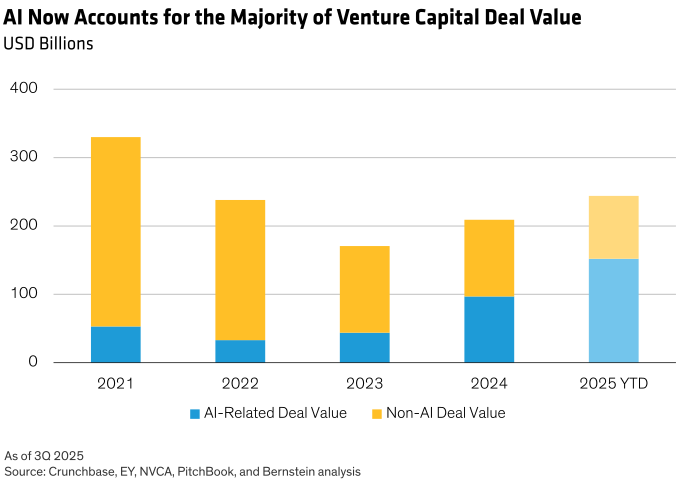
Overall, we’re witnessing a shift in innovation and capital growth toward private markets. In the past, much of this activity occurred among mid-cap companies in the public markets. However, as companies remain private longer and more funds with lower overhead become available, this capital formation and appreciation is increasingly out of reach for public market investors.
Real Estate, Hedge Funds, Real Assets, Crypto, and More
We continue to see attractive real estate equity deals come through our pipeline at different points on the risk spectrum. Bid-ask spreads remain wide in much of the market, but are converging more often, with transaction volumes improving. Within that mix, we’ve found attractive opportunities in multifamily housing, retail, and hotels.
Geopolitical turmoil, selective market trends, and divergence in relative values created a solid opportunity set for diversified hedge funds in 2025. As we enter 2026, they remain a valuable diversifying element in portfolios, in our view. We favor their ability to offer returns surpassing fixed income with risk levels more akin to fixed income along with relatively low correlations to other major asset classes.
With inflation on the rise at least temporarily, real assets strategies continue to play a solid role in portfolios.
What’s more, gold and crypto both captured investors’ attention and animal spirits in 2025—gold is up 112% since February 2024 and bitcoin is up 227% since late 2023, even including recent weakness (Display).
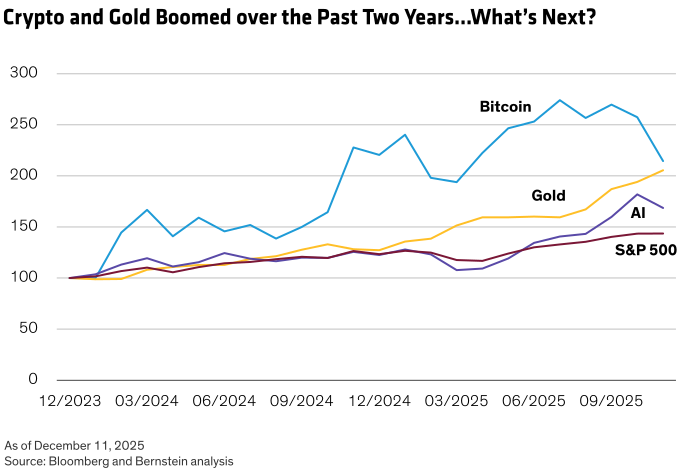
We think of gold as a hedge against global disasters—over the long term, it can drag on returns, yet in periods of geopolitical turbulence or other fears, it can provide material upside. It’s hard to ascribe a fundamental value to it, as it doesn’t yield cash flows (technically, it has negative cash flows since you have to pay to store it). Yet with geopolitical volatility on the rise, whatever value investors ascribed to it in the past, it’s arguably worth more now.
We continue to view bitcoin as a VC-like bet on investors eventually treating it the way they’ve historically treated gold—as the ultimate risk-off asset. Yet its recent fade and rising correlation with risk assets casts that narrative back in doubt. It did have one notable moment in 2025, as it fell less than other risk assets during the market’s reaction to tariffs in April. However, one flickering moment isn’t enough to establish a credible trend, and so the world waits. Outside of bitcoin, we see the rest of the crypto space as similar to early-stage software venture capital—high-risk, potentially high-reward, dependent on product-market fit, and the creation and capture of economic value.
Welcome to the Party, Pal
As we look ahead to 2026, markets are currently buoyed by supportive policy, rapid AI adoption, and a general sense of optimism. While there are clear parallels to the tech wave of the late 1990s, today’s cycle presents its own unique uncertainties. The macroeconomic environment appears resilient, but investors should remain vigilant for changing risks and the possibility that what seems healthy today could turn unhealthy tomorrow.
Across regions, the US stands out for its resilience and its leverage to the AI theme, Europe is poised for its own resurgence, and Asia presents divergent paths with Japan hiking rates and China managing deflation.
Our current asset allocation perspective calls for diversification and discernment—favoring selective duration in interest rates, maintaining high lending standards in public and private credit, and being judicious in equities given elevated multiples and growing dispersion.
AI remains the central theme, dangling the promise of productivity gains and new opportunities, but also presenting risks to the economy and markets. Investors should be mindful of potential turbulence within the AI ecosystem and distinguish between genuine innovation and speculative excess.
In this environment, disciplined research and risk management are essential. Flexibility and vigilance, too, will help investors capture upside while navigating uncertainty. With these elements in mind, we aim to position portfolios for both durability and growth as the cycle evolves.
- Alexander Chaloff
- Chief Investment Officer & Head of Investment & Wealth Strategies
- Christopher Brigham
- Senior Research Analyst—Investment Strategy Group
- Matthew D. Palazzolo
- Senior National Director, Investment Insights—Investment Strategy Group
[i] Furthermore, just because the 1990s cycle is relatively recent and appears to align nicely with the current one doesn’t mean it’s the only cycle worth considering as an analogy for today.
[ii] This does become a little worrying if they all become so optimistic that they expand supply into an eventual demand shortfall, but we think that would take time to play out from here and see no signs of it at present. Cyclical goods companies have been facing a negative outlook for years and we haven’t seen an abundance of capacity emerging on the services side either. AI is the big cycle to watch, as we discuss more fully throughout this outlook and in our upcoming overview of the AI ecosystem.
[iii] For reference, Nvidia’s revenue in calendar year 2022 was roughly $27 billion.
[iv] We include Amazon, Microsoft, Google, Meta, and Oracle as the five main hyperscalers.
[v] In hindsight, we’d expect history to look back on that with two explanations: either tariffs, the Federal Reserve, or both will be named as culprits.