

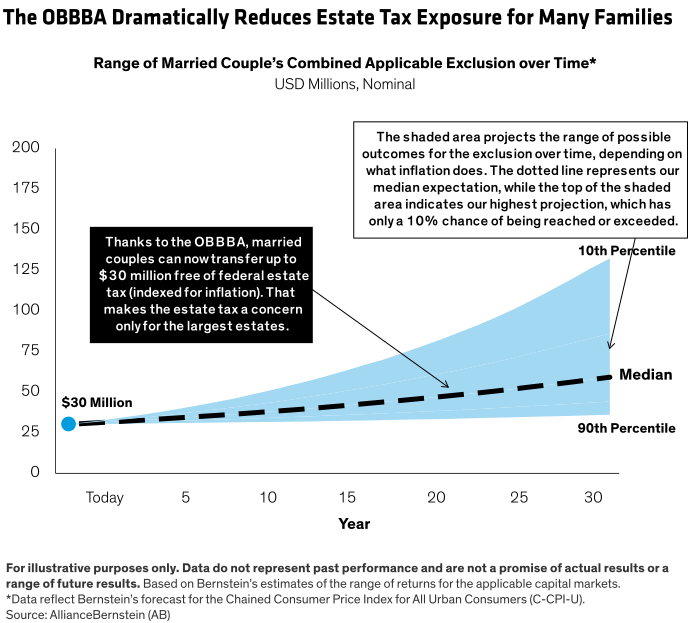
The One Big Beautiful Bill Act (OBBBA) has revolutionized estate planning by permanently raising the federal estate, gift, and generation-skipping transfer (GST) tax exemption to $15 million per person (indexed for inflation) and eliminating the scheduled 2026 sunset provision. This change dramatically reduces estate tax exposure for many high-net-worth families. Now, married couples can transfer up to $30 million free of federal estate tax, making estate tax a concern only for the largest estates.
Keep in mind, because the exclusion is indexed for inflation, the limit will likely grow over time (Display). For instance, what starts for a married couple at $30 million today could eclipse $50 million 15 years from now, based on our most optimistic estimates. For that reason, the shaded area projects the range of possible outcomes for the exclusion depending on what inflation does. The dotted line represents our median expectation, while the top of the shaded area indicates our highest projection, which has only a 10% chance of being reached or exceeded. This range skews to the upside because even if inflation remains low and stable, it’s unlikely to turn negative. When inflation spikes, it may slow down in the following years, but it typically doesn’t decline, so the value is likely to keep rising over time.
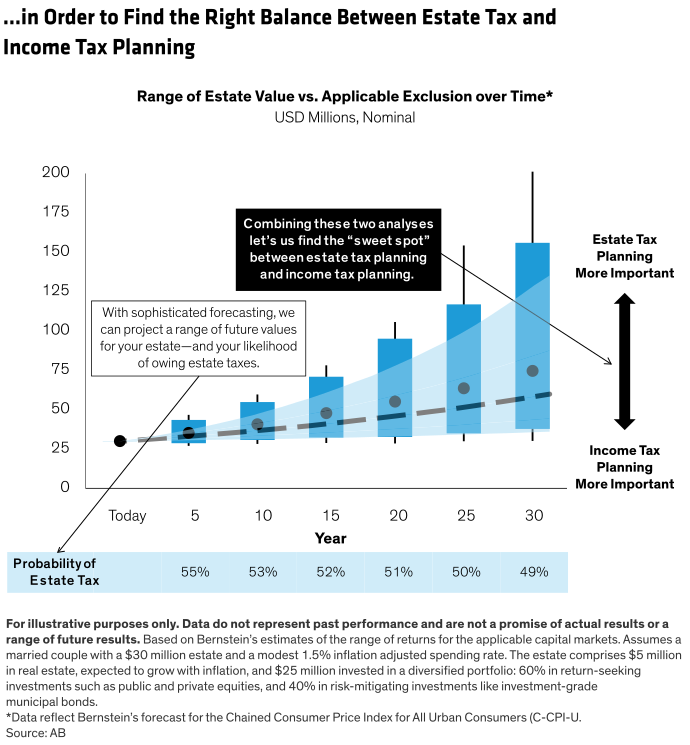
Does this mean your family can stop worrying about estate tax? Maybe. The answer largely depends on the future value of your estate. This value can be estimated using a dynamic forecasting model, which considers crucial factors like asset growth, spending, and inflation. By analyzing these projections, we can evaluate the likelihood of your estate eventually exceeding the exclusion and estimate any potential estate tax liability (Display).

But there’s a catch.
Keeping assets until death has an advantage: If your heirs sell, they won’t owe capital gains tax on past appreciation because the cost basis resets to the asset’s fair market value on the date of death. This is commonly known as the “step-up” in basis. Imagine leaving a vacation home that you initially purchased for $3.2 million to your children. By the time you pass away, the property is worth $4.0 million. When your heirs inherit the home, its cost basis is stepped up to $4.0 million. If they ultimately sell it down the road for $4.5 million, they only owe capital gains tax on the $500,000 in appreciation since they inherited it.
What if you keep the vacation home, or other assets, in your estate and end up triggering an estate tax because your estate’s value ultimately exceeds the $15 million threshold? In other words, how do you give away just enough to balance estate tax planning and income tax planning?
By combining our analyses, we can answer two key questions:
- What is the likelihood the estate will exceed the future exclusion limit?
- What is the cost of losing the basis step-up if we gift assets today?
This approach highlights the trade-offs between facing estate taxes and benefiting from income tax savings through a step-up in basis at death (Display). The chart does not suggest that income tax planning is more important in low inflation or poor market conditions; rather, it emphasizes the gap between the estate’s value and the estate exclusion. In this case, with around a 50% chance of estate tax exposure in 30 years—but with significant potential upside in estate value shown by the wider gap between the median and the top 10th percentile—strategies that boost wealth transfer in strong markets (while ensuring more moderate transfers in less favorable conditions) make the most sense.
Time to Revisit Your Plan
For estates likely to exceed the exclusion, the focus becomes lifetime wealth transfer strategies. These include annual exclusion gifts, utilizing the lifetime gift tax exclusion, and other advanced methods to help lower your taxable estate.
On the other hand, if your estate tax exposure is only likely in “upside” scenarios, you can consider conditional strategies that transfer excess appreciation like grantor retained annuity trusts (GRATs), installment sales, and loans. And if your estate is projected to remain below the exclusion, you can scale back on wealth transfers to preserve the step-up in basis instead.
With the increased lifetime estate and gift tax exclusion, many families feel less compelled to pursue complex strategies. But now isn’t the time for complacency. It’s essential to evaluate your potential estate tax risks and understand the long-term consequences of inaction. With clear data and forward-looking analysis, you can explore various outcomes across different scenarios, turning abstract planning concepts into real-world impacts for future generations.
- Robert Dietz, CFA
- National Director, Tax Research—Investment & Wealth Strategies
- Ashley Velategui, CFA
- SVP/National Director, Planning Research—Wealth Strategies Group