

New tax legislation is always a bit of a puzzle, especially for those short on time and focus. Yet sometimes it’s worth reading the fine print for valuable provisions that may be tucked away. Case in point? A fascinating opportunity that could change the way investors think about their income tax basis.
Understanding QOF 1.0: The Original Framework
Buried within the Tax Cuts and Jobs Act (TCJA) was a new statute designed to encourage real estate and commercial development in struggling areas of the US, known as “opportunity zones.” To facilitate these qualifying investments, a vehicle called “qualified opportunity funds” (QOFs) was created.
The specific provision—which became Section 1400Z-2 of the Internal Revenue Code—is disarmingly simple. It states that if a taxpayer sells or exchanges property with an unrelated person, they can choose to exclude from their gross income any capital gain up to the amount they invest in a qualified opportunity fund (QOF) within 180 days of that sale. However, this deferred gain must be recognized when either the taxpayer sells or exchanges their interest in the QOF, or by December 31, 2026, whichever comes first.
What makes this even more enticing is that if the taxpayer holds their investment in the QOF for at least five years, their basis in that investment increases from zero to 10% of the deferred gain. If they hold it for at least seven years, that basis jumps to 15%. And if they keep it for a full 10 years, their basis will equal the fair market value of the QOF when they eventually sell or exchange it. It’s a refreshing alternative to traditional methods of gaining basis, making it an appealing option for savvy investors.
The Limitations of QOF 1.0
The problem with the original QOF statute—let’s call it “version 1.0”—is that it ran out of gas. Deferral of capital gain under the statute ends on December 31, 2026, and for several years now, new investments couldn’t qualify for the 10% and 15% basis adjustments because they couldn’t satisfy the five- or seven-year holding period before the statute’s expiration date. As a practical matter, all that remained was the ability to invest in and hold a QOF for 10 years and avoid tax on any appreciation.
Then came the One Big Beautiful Bill Act (OBBBA). Some had hoped that the new tax law would extend and revitalize version 1.0 of Section 1400Z-2. Instead, it created an entirely new iteration—let’s call it “version 2.0.” This new incarnation addresses a key limitation of the original statute: under version 2.0, QOF investors enjoy five years of tax deferral, no matter when they make their investment, rather than being tied to a fixed expiration date. In addition, if investors hold their QOF for at least five years, they receive a 10% basis adjustment. And if the QOF operates a qualifying project in a rural area, the basis adjustment triples to 30%.
Seizing the Opportunity by Timing Your Investment
But there’s a problem. Version 2.0 is effective only for QOF investments on or after January 1, 2027. That means investors who realize a capital gain in early 2026 cannot qualify due to the 180-day investment period limitation … or can they?
Typically, the 180-day countdown for investing in a QOF begins when a taxpayer realizes a capital gain. But if a pass-through entity, like a partnership or S corporation, incurs that gain and does not invest the proceeds of sale in a QOF, Treasury regulations allow partners or shareholders to choose when to start their 180-day period. They can select from three options: the date the gain is realized, the end of the entity’s taxable year, or the due date for the entity’s income return tax, without extensions.
Now, consider a scenario where an individual—for legitimate, nontax business reasons—creates a limited liability company (LLC) taxed as a partnership and contributes an appreciated asset to it. If the LLC sells that asset and opts not to invest the proceeds in a QOF, the current regulations offer a strategic advantage. Each member of the LLC could elect to invest their share of the gain in a QOF as late as 180 days after the due date for the LLC’s 2026 income tax return, which would be March 15, 2027, for a calendar year entity. If this “bridge” strategy works, members would have until September 11, 2027, to invest in a QOF and unlock all the benefits of version 2.0, including five years of tax deferral on the original gain.[i]
The Financial Advantage of QOFs
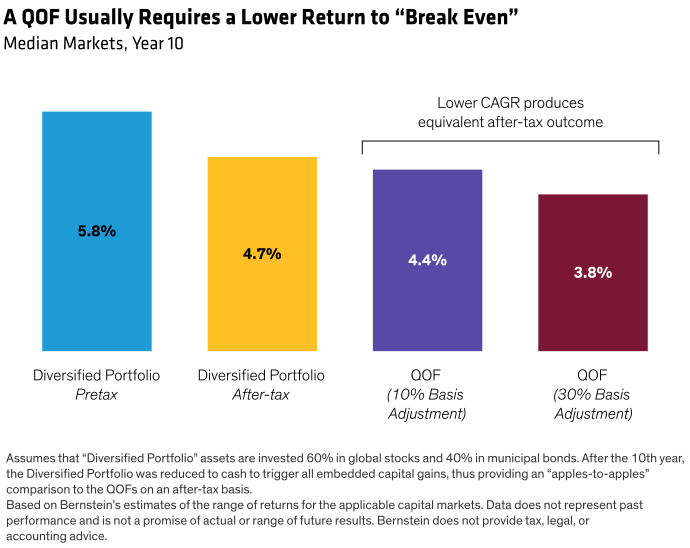
Investing in a qualified opportunity fund (QOF) can be particularly appealing when considering the reduced rate of return needed to break even compared to a fully taxable investment. To illustrate this, let’s look at two scenarios.
In the first scenario, an investor incurs a long-term capital gain of $1, pays an immediate 23.8% tax, and invests the proceeds for 10 years in a diversified, taxable portfolio. In the second scenario, an investor similarly incurs a $1 gain but pays no immediate tax. Instead, they invest that dollar in a version 2.0 QOF, benefiting from a 10% basis adjustment. After five years, they pay tax on 90% of the deferred gain, hold the QOF for a total of 10 years, and then sell it with no additional gain.
Assuming a 60%/40% portfolio of stocks and municipal bonds will grow at a pretax rate of 5.8 percent per year, a QOF with a 10% basis adjustment would only need to grow by 4.4% annually to match that portfolio’s 10-year after-tax return. For a rural QOF project that offers a 30% basis adjustment, the required growth rate drops to just 3.8% per year (Display).
Any investment that attracts tax-motivated investors is subject to mispricing, so your Bernstein Advisor can guide you to funds that provide the greatest potential for future appreciation, regardless of the tax benefits. Your advisor can also help you explore a range of strategies to minimize income taxes, not just QOFs.
- Robert Dietz, CFA
- National Director, Tax Research—Investment & Wealth Strategies
- Eric Leightner
- Director—Wealth Strategies
- Jordan Brake
- Analyst
[i] See Treas. Reg. § 1.1400Z-2(a)-1(c)(8)(iii).