

Imagine spending years building a real estate portfolio that provides steady income while significantly appreciating in value. Now you’re ready to cash out and move on from the day-to-day management of the properties. Then reality hits—what about the looming tax bill that comes with selling?
For many investors, this moment can feel like a double-edged sword. On one hand, you’ve successfully navigated the world of multifamily units, industrial spaces, and other lucrative real estate assets. On the other, the prospect of a substantial capital gains tax and depreciation recapture can be daunting. Take, for example, an investor who bought a property for $1 million and is now poised to sell it for $2.5 million. After claiming $500,000 in depreciation over the years, they could face a staggering capital gains tax of $1.5 million and $500,000 in depreciation recapture, resulting in a total tax liability of approximately $500,000.
But don’t let the fear of taxes overshadow your success. The good news is that several real estate tax strategies can help defer these obligations and keep more of your hard-earned wealth. Real estate tax-deferral strategies like the 1031 exchange, Delaware Statutory Trust (DST), and 721 UPREIT transactions can be game-changers for savvy investors looking for a smooth transition.
What Is a 1031 Exchange?
A 1031 exchange lets investors exchange one property for another “like-kind” property, deferring any taxes from the sale of the original property. This means you can sell a property and acquire a new one without incurring taxes, while remaining an owner-operator of the asset. What’s more, if the property is owned in your name or that of an entity in your estate, your heirs can still benefit from a step-up in cost basis when you pass away.
- What qualifies as “like kind”? According to the Internal Revenue Code (IRC), like-kind properties are real estate assets held for business, investment, or trade purposes that share a similar nature or character, regardless of grade or quality. For instance, this means you could exchange a single-family rental for a duplex, or a retail shopping center for an office building.
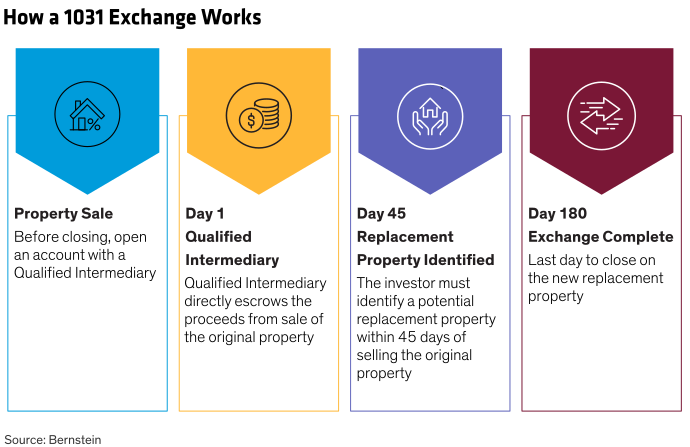
- To satisfy the IRS’ 1031 exchange requirements, you must identify a replacement property within 45 days of selling your original property, and close on the new property within 180 days. To maintain an “arms-length” position, investors must also use a Qualified Intermediary in these transactions for any funds changing hands.
Delaware Statutory Trust Pros and Cons
While a 1031 exchange is a valuable strategy for investors active in property management, what if an investor prefers to take a more passive role?
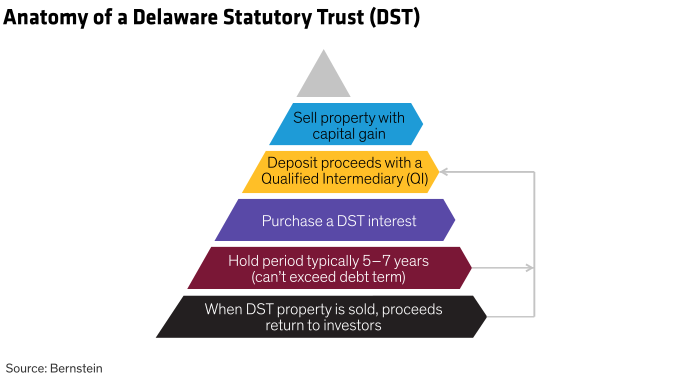
A Delaware Statutory Trust (DST) is another real estate tax-deferral strategy that allows multiple investors to co-own real estate property managed by a sponsor. Each investor holds a beneficial interest in the property equal to the value of the original property sold. A DST can be used as replacement property in a 1031 exchange, but to satisfy 1031 rules, you must identify a DST within 45 days and close on the DST investment within 180 days.
Why invest in a Delaware Statutory Trust in a 1031? There are several advantages: you can defer taxes, secure passive ownership in a property, earn income from the asset, and potentially benefit from a future step-up in basis. Plus, you have the flexibility to 1031 exchange into another DST down the road or return to active ownership and property management when you’re ready.
While Delaware Statutory Trusts (DSTs) offer several advantages, they also come with some notable drawbacks:
- Lack of diversification: DSTs typically represent a single property, which means investors selling a single property may not achieve the diversification they desire.
- Hold period: The average investment period for a DST investment ranges from 5 to 7 years, requiring investors to engage in another DST transaction down the line.
- High fees: Fees vary widely from sponsor to sponsor and can be quite high.
What’s more, there are other problems with Delaware Statutory Trusts. In fact, some have coined them as the “Seven Deadly Sins”:
- Once a DST offering has closed, no additional contributions can be made.
- Loan terms cannot be renegotiated by the DST trustee and new loans can only be made in very specific circumstances.
- Proceeds from the sale of real estate cannot be reinvested by the trustee.
- Property improvements are limited to normal repairs and maintenance, minor upgrades, and those required by law.
- Assets held for distribution can only be in cash or short-term debt obligations.
- The DST must distribute all cash beyond necessary reserves.
- A DST trustee cannot make new leases or renegotiate current ones unless the tenant is insolvent or bankrupt.
On the Up—721 UPREIT
Given that most transactions involve one or only a handful of properties, the limited diversification of a DST is a major stumbling block when it comes to real estate tax strategies. But some DSTs offer a potential solution. After satisfying investment intent—typically two years—investors can contribute their DST interest via IRC Section 721 and receive operating units of a diversified REIT (known as an UPREIT).
Section 721 allows for a tax-deferred contribution of property to a partnership in exchange for a partnership interest. As an operating unitholder, you can later convert your operating units into REIT shares and sell them for cash, at which point any previously deferred gains would be realized. This option allows investors to achieve full diversification within the REIT after two years, maintain passive ownership of real estate, and potentially benefit from a step-up in cost basis as long as operating units are not converted to shares.
While this structure addresses the shortcomings of a traditional DST through the continual deferral of gain, it still has a few disadvantages.
- Loss of 1031 Exchange Options: Once you convert to a REIT through Section 721, you can no longer use those funds for future 1031 exchanges.
- Lack of Control: Investors have no sway over the underlying investments in the REIT.
- Conflicting Objectives: Occasionally, tensions may arise between operating unitholders and REIT shareholders. For instance, the sale of a property inside the REIT could trigger a gain for the operating unitholders, while certain deductions may benefit operating unitholders and not shareholders.
Understanding these limitations is essential for investors looking for real estate tax-deferral strategies who are considering the transition to a REIT through a UPREIT structure.
Leaning into an LLC Structure
A relative newcomer to the list of tax-deferral strategies for real estate owners? An LLC that is taxed as a partnership allows for direct contributions of property or partnership interests (under Section 721) in exchange for units in a fund. This structure meets the primary goals of diversification, passive ownership, tax deferral, and recurring income. Plus, the pass-through nature of an LLC allows for any depreciation to be passed through to fund investors—providing potential estate tax savings and the chance for a minority partner discount. This makes it an attractive choice for real estate owners looking to optimize their investment strategy.
The world of real estate investment requires a solid understanding of the various tax deferral options available. From 1031 exchanges to Delaware Statutory Trusts (DSTs), UPREITs, and LLC structures, each real estate tax strategy offers unique benefits that can help you preserve your wealth and optimize your returns. The best option for one investor may not be suitable for another. If you’re seeking tax-deferred real estate solutions, your Bernstein Advisor can help you determine which options are appropriate for you.
- Andrew Bishop, CFA
- Director—Wealth Strategies Group
- Greg Young, CFA
- Senior Investment Strategist