

The charitable giving landscape is on the brink of a major shift driven by the One Big Beautiful Bill Act (OBBBA)[1]. The new law changes the game for traditional giving strategies—especially for those who typically donate appreciated stock and cash. For philanthropically minded individuals, especially those who itemize deductions, this means rethinking how and when to give.
Amid these changes, one strategy remains remarkably resilient: Qualified Charitable Distributions (QCDs) from IRAs. Untouched by OBBBA’s most restrictive provisions, QCDs continue to provide significant benefits for donors age 70½ and older, even as other giving methods face new constraints. Put simply, now is the time to explore accelerating or bundling your charitable contributions in 2025 to take full advantage of current tax laws, while also leveraging QCDs to enhance your philanthropic impact.
How OBBBA Changes the Game for Charitable Giving
Before diving in, let’s look at how the OBBBA reshapes charitable deductions for itemizers. Beginning in 2026, under the new law, only contributions exceeding 0.5% of adjusted gross income (AGI) will be deductible. So, if a donor’s AGI is $200,000, the first $1,000 in donations won’t count toward their deduction that year. What’s more, high-income taxpayers in the 37% marginal tax bracket will see the tax value of their itemized deductions capped at 35%, reducing the benefits of giving.
For those who don’t itemize, OBBBA offers some relief starting in 2026, allowing an "above-the-line" deduction of $1,000 for single and $2,000 for joint filers for cash gifts made to public charities. However, these donations cannot be made to donor-advised funds (DAFs) or private nonoperating foundations.
With these changes on the horizon, donors may need to adapt their giving strategy to balance generosity with financial savvy. Let’s compare three different charitable giving techniques—and discover why QCDs may outshine the rest in the post-OBBBA era.
Charitable Gifts of Appreciated Stock: We’ll start with gifts of appreciated stock, a long-standing favorite among donors. What makes them so popular? By donating long-term appreciated securities directly to a charity, donors avoid paying capital gains tax on the appreciation while claiming a charitable deduction for the fair market value of the shares. This “double win” has made stock gifts a tax-efficient way to support charitable causes.
Charitable Gifts of Cash: Donors who view cash gifts as the simplest route should know that the 60% AGI limit on cash contributions has been made permanent under the OBBBA. For non-itemizers, the new above-the-line deduction offers a potential sweetener, but it is limited to $1,000 for single filers and $2,000 for joint filers and only applies to gifts to public charities—not to DAFs or private foundations. In short, for high-income donors, the tax efficiency of cash gifts will fade under the new rules as the 0.5% AGI floor and 35% cap on the tax benefit become effective in 2026.
Where Do QCDs Fit In?
Qualified Charitable Distributions offer donors aged 70½ or older the chance to transfer up to $108,000 annually (adjusted for inflation) directly from their IRA to a public charity[2]. In return, the donated amount is excluded from taxable income—rather than being claimed as an itemized deduction. In other words, the exclusion directly reduces your adjusted gross income (AGI) and in turn, your modified adjusted gross income (MAGI). Doing so factors favorably into various tax calculations, including reduced Medicare premiums, lower taxation of Social Security benefits, and enhanced state and local tax (SALT).
Reducing your MAGI is especially beneficial for higher-income taxpayers who fall within or near the $500,000 to $600,000 MAGI phaseout range for the enhanced $40,000 SALT deduction limitation beginning in 2025. By making a QCD, you may be able to qualify for the full SALT deduction, which is available through 2029. And even if you already fall within the phaseout range, a QCD can blunt the impact by increasing the portion of the deduction you’re allowed to claim.
What’s more, because QCDs are excluded from income (rather than deducted), they are not subject to the new limitations on itemized deductions. This makes QCDs even more attractive to eligible donors—especially those who are facing the SALT deduction phaseout, do not itemize, or wish to sidestep recent restrictions on charitable contributions.
Why QCDs May Now Be Your Best Bet
To illustrate QCDs’ distinct advantage, imagine Kent, a retired executive with a $2.65 million traditional IRA who turns 73 in 2026. Beginning next year, Kent must distribute $100,000 from his IRA, which will push his annual adjusted gross income (AGI) to $600,000.
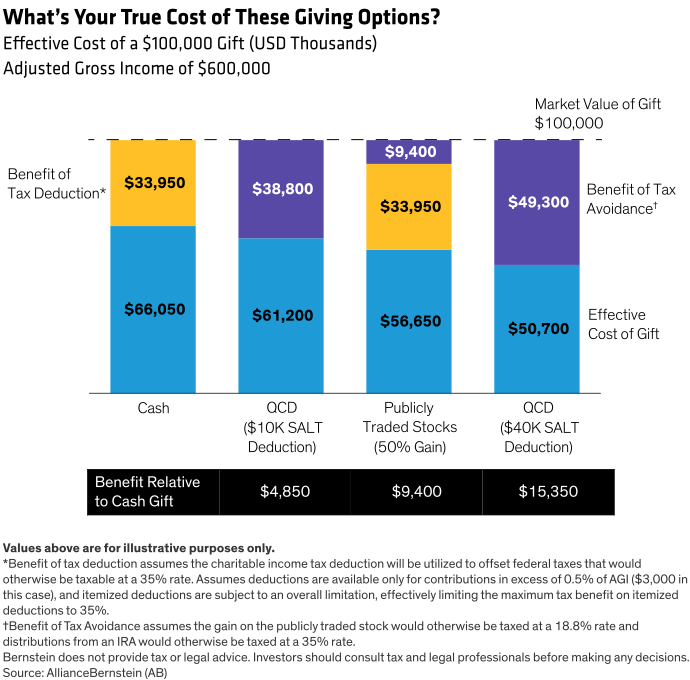
While Kent typically donates $100,000 to charity each year—using either cash or appreciated stock—he may want to reconsider. That’s because under the new rules, if Kent donates $100,000 in cash, he will encounter a $3,000 AGI floor, making only $97,000 of his donation deductible. This limits his tax benefit to $33,950.
In contrast, if Kent directs $100,000 from his IRA directly to qualified charities as a QCD, the entire amount is excluded from his taxable income, effectively lowering his AGI to $500,000. This strategy not only satisfies his required minimum distribution (RMD) for the year but also avoids the new deduction floor. Plus, the QCD decreases the amount by which Kent’s AGI exceeds the $200,000 threshold for the 3.8% net investment income tax cutting it from $400,000 to $300,000. This results in total tax savings of $38,800—an increase of $4,850 or 14.3% over the cash gift (Display).
Now let’s explore the impact on Kent’s state and local taxes. If he lives in a state with a 10% income tax rate, taking an additional $100,000 from his IRA next year would hurt him when it comes to the state and local tax (SALT) deduction. Under the OBBBA, the SALT deduction cap was increased to $40,000 through 2029 for taxpayers with modified adjusted gross incomes (MAGI) of $500,000 or lower. But the enhanced deduction phases out to $10,000 for taxpayers with MAGI between $500,000 and $600,000—where Kent will land once his RMDs kick in. By taking his $100,000 RMD as a Qualified Charitable Distribution instead, Kent retains the full $40,000 deduction, saving an additional $10,500 in federal income taxes. That brings the QCD’s edge over the cash gift to $15,350—an increase of 45.2%.
What if Kent gifts appreciated stock that has risen in value by 50%? He’d save an extra $9,400 compared to the cash gift. However, the total savings of $43,350 would still fall short of the $49,300 savings produced by the combined QCD and SALT strategy.
Smart Giving Strategies for 2025 and Beyond
As we near the end of the year, take a moment to review and refine your charitable giving strategy. Consider accelerating or bunching your gifts into 2025 to take full advantage of the current, more favorable deduction rules. If you are age 70½ or older and have an IRA, Qualified Charitable Distributions (QCDs) should be considered in your charitable giving plan this year. Thoughtful planning today allows you to support the causes you care about while optimizing your tax benefits in this evolving landscape. Don’t wait for the new rules to take effect; take proactive steps now to ensure your charitable giving remains impactful and tax efficient. By making informed choices today, you can enhance your philanthropic efforts and truly make a meaningful difference in the lives of others.
- Christopher Clarkson, CFA
- National Director, Planning | Foundation & Institutional Advisory
- Robert Dietz, CFA
- National Director, Tax Research—Investment & Wealth Strategies
[1] Pub. L. 119-21. An Act to provide for reconciliation pursuant to title II of H. Con. Res. 14.
[2] Donor advised funds and private foundations are not eligible recipients of QCDs.