

Many investors with taxable accounts find themselves in a bind: their portfolios have grown substantially over time, leaving them with highly appreciated securities. While that growth is clearly welcome, it also comes with a tax cost if they want to reposition their portfolio for the future. Selling these appreciated holdings to rebalance or shift strategies can trigger hefty capital gains taxes, discouraging investors from moving out of concentrated positions into more diversified portfolios that maintain the value while reducing risk. In effect, the portfolio feels “locked up.”
One innovative solution to this challenge is the Section 351 ETF exchange. This tax-deferred strategy allows investors to reposition portfolios without immediately realizing taxable gains.
What Is a Section 351 Exchange?
Section 351 of the tax code was originally designed to let business owners contribute appreciated assets to a corporation in exchange for stock, without triggering a taxable event. It is important to note that the original cost basis is preserved, meaning taxes are deferred, not avoided. This approach serves three main purposes:
i. to help with corporate formation and restructuring
ii. to promote capital investment, and
iii. to ensure continuity of investment.
The same principle can be applied to creating an ETF to benefit holders of highly appreciated securities. In a Section 351 Conversion ETF, investors contribute appreciated securities into a newly created ETF. The contribution is a tax-free event, and the investor’s original basis and holding period carry over to their shares of the ETF. But not everyone is eligible. The IRS imposes some restrictions—specifically, the “25/50” diversification test. Under this rule, no single security can make up more than 25% of an investor’s contribution, and the top five holdings cannot exceed 50% of their contribution (Display). Lastly, contributions must match the ETF’s investment strategy (for example, putting US equities into a US Equity ETF).
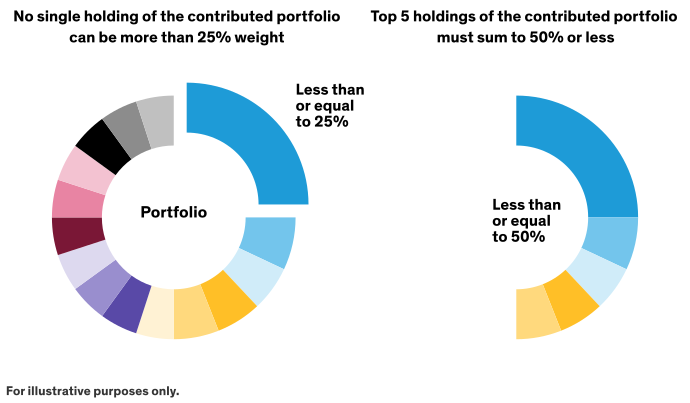
What else should you keep in mind? Investors must contribute individual holdings—not mutual funds, cryptocurrency, options, private investments, or restricted stock. Plus, the tax deferral benefit is only available at the ETF’s launch when assets are initially contributed. Subsequent investments in the ETF do not enjoy the same tax advantage.
How a Section 351 Exchange Works
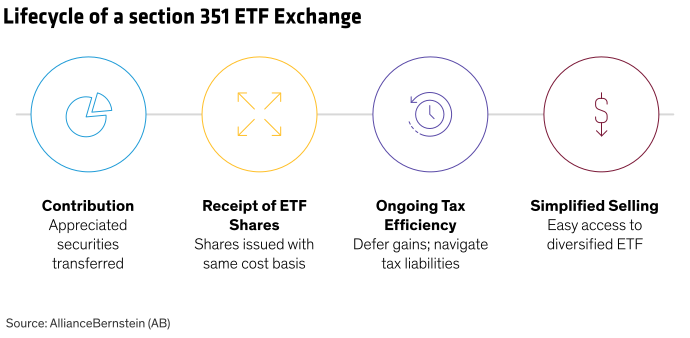
1. Contribution: The investor transfers securities in-kind to a newly formed ETF.
2. Receipt of ETF Shares: The investor receives ETF shares that carry the same cost basis and holding periods as the original securities.
3. Tax Efficiency Going Forward: The ETF structure allows ongoing rebalancing and adjustments, often without triggering capital gains distributions.
4. Reduce Complexity: Future sales are easier to manage. All ETF shares represent the same diversified exposure, so selling becomes a matter of selecting tax lots rather than choosing which risk exposure to reduce.
Key Benefits of a Section 351 Exchange
- Tax Deferral: Move to a new ETF strategy without immediately realizing gains.
- Diversification and Flexibility: Convert concentrated holdings into broader exposure while benefiting from a professionally managed ETF strategy.
- Ongoing Tax Efficiency: ETFs can actively manage and rebalance holdings, keeping capital gains distributions to a minimum.
- Simplified Exposure: Each share of the ETF reflects the same diversified portfolio, making future redemptions cleaner.
Jane’s Dilemma: Balancing Gains and Growth
Consider Jane, a 45-year-old attorney with a portfolio of 15 stocks worth over $1 million. The securities have performed well historically, but they lack diversification and are currently underperforming the market. Yet since the shares were acquired years ago for $200,000, selling them could trigger hundreds of thousands of dollars in taxable gains, leaving less capital to invest in new opportunities.
Instead, Jane decides to contribute her $1 million holdings to a newly launched ETF via a Section 351 exchange. She receives ETF shares worth $1 million, spread across 15 lots, with each lot equivalent to that of her original stocks' cost basis and holding period. This process allows Jane to avoid any taxable event on the contribution. The ETF structure then enables more efficient rebalancing and diversification over time, helping her achieve greater after-tax growth compared to simply selling and reinvesting. If she needs to access this capital in the future, she can strategically choose which shares to sell while maintaining diversified exposure with the remaining shares. At that point, when she sells a position, her capital gains will be calculated based on her original cost basis and holding period, adjusted for any gains, losses, or other factors that occurred while invested in the ETF. And for any shares that she does not liquidate in her lifetime, her beneficiaries receive a stepped-up basis just like any other security held at death.
Unlocking Investment Flexibility with Section 351 ETFs
Since their launch, Section 351 ETFs have gained momentum as investors grappling with highly appreciated taxable portfolios look for compelling ways to regain flexibility. By deferring capital gains taxes and harnessing the inherent efficiency of ETFs, this strategy opens up an innovative route to reposition your investments—without the typical tax hit.