

Looking back over the last three years, the stock market has clearly staged an impressive rebound, with many equity investors reaping substantial rewards since 2022. With over 150 public companies boasting returns of 300% or more, including familiar names like Palantir, Nvidia, and DoorDash, it’s no wonder investors are feeling upbeat.[i]
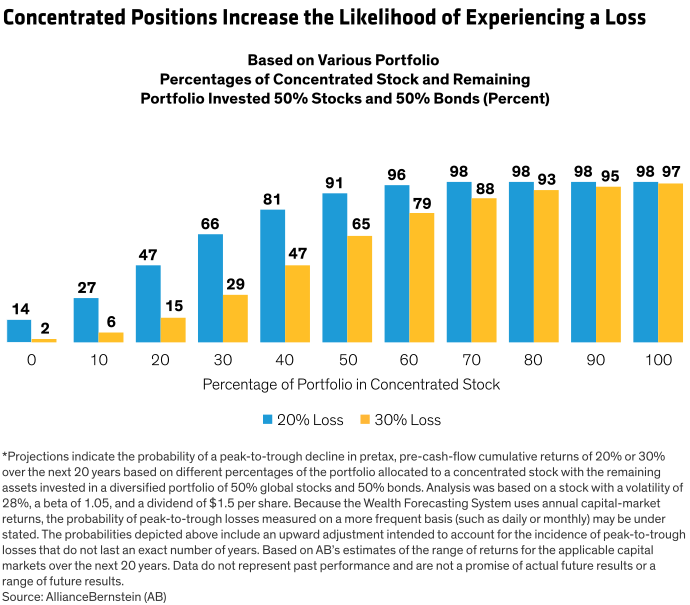
But this surge has left many grappling with a critical question: how much is too much when it comes to concentrated stock positions? As portfolios swell with low-cost-basis holdings, the dilemma of whether to hold or diversify intensifies. And while the answer hinges on individual goals, our analysis shows that concentrated positions tend to heighten portfolio volatility.
Consider that the likelihood of experiencing a peak-to-trough loss of 20% or 30% increases significantly once stock represents more than 20% of a portfolio—even if the remainder is split equally between stocks and bonds (Display). Some investors may be comfortable assuming this risk, but many others find it difficult to swallow.
To Sell or Not to Sell Stock
Some investors may take comfort in a staggered approach to selling a concentrated position, rather than feeling the tax bite all at once or missing out on near-term upside potential. But there’s a trade-off in keeping the concentrated position long enough to capture any upside without risking a potential decline in value (Display). To illustrate, we analyzed the impact of several different approaches to selling a $5 million stock position with a cost basis of $0[ii]:
- Sell 100% of the stock now
- Sell 50% of the stock now and the remaining 50% in equal portions annually in the following 4 years
- Sell equal portions annually for 5 years
- Sell 100% of the stock at the end of 5 years
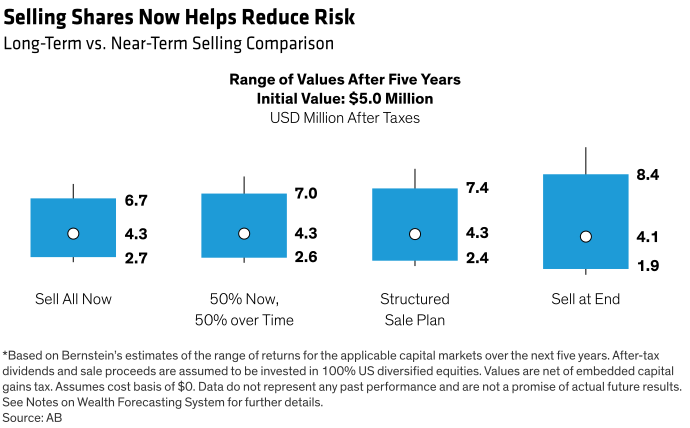
The results were helpful in quantifying the upside versus downside risk over the given time period. Holding the position for the full five years offers the highest upside potential, but it also carries the lowest downside (shown at the bottom of the box) and drags down the portfolio in median markets. In contrast, selling all of the stock now delivers the opposite outcome (lowest upside and least downside). Since we can’t predict when the stock will peak, we typically recommend a different tactic: sell enough stock in one fell swoop to guarantee meeting your core capital needs, or the amount of capital you need today to meet your lifetime spending with a high degree of confidence. Once you satisfy your core capital requirement, you can afford to take more risk with the surplus capital.
How to Reduce the Tax Burden When Selling
While selling helps investors reach their core capital target, it comes with a tax cost. Fortunately, there are several ways to minimize that burden. One of the simplest and most popular strategies is donating appreciated stock to a charity or donor-advised fund (DAF).
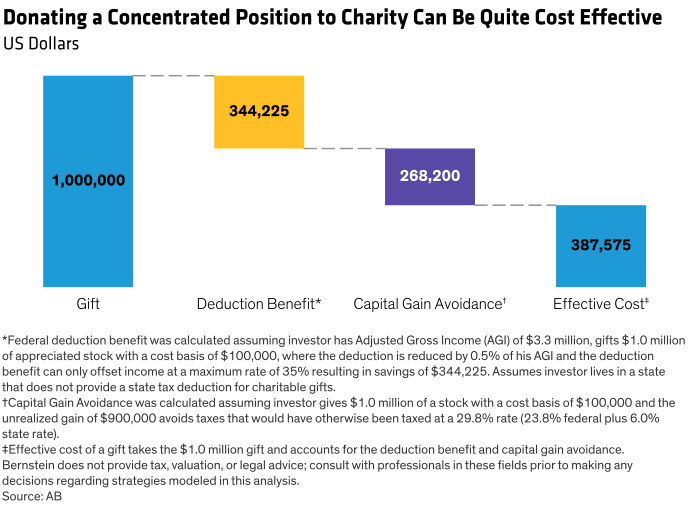
As a public charity, DAFs don’t pay taxes. That means an investor can contribute stock and diversify immediately without tax consequences. In exchange, the investor receives an upfront tax deduction equal to the fair market value of the gift—subject to AGI limitations as well as the new cap and floor established by recent tax legislation—while avoiding the embedded gain.[iii] The investor then makes grants from the DAF to various charities at their own pace as opportunities arise.
Imagine a charitably inclined investor with a $1 million concentrated position whose cost basis is $100,000 (Display). By donating to charity, they receive a $983,500 tax deduction, which translates to a $344,225 tax deduction benefit. Plus, in gifting stock with a $900,000 embedded gain, they save an additional $268,200. Taken together, those savings reduce the total effective cost of the $1 million gift to just $387,575.
While donating to charity isn’t the only option for managing concentrated stock positions, it’s a powerful strategy that can help you diversify your portfolio while supporting causes you care about. Whether you choose to sell, donate, or a combination of both, the key is to make informed decisions that align with your financial goals and risk tolerance. Remember, the right approach can not only protect your investments but also create a positive impact in your community.
[i]Returns for companies whose market caps exceed $1 billion over the last three years through 2025. Source: AB and Bloomberg
[ii]Based on Bernstein’s estimates of the range of returns for applicable capital markets over the next five years. After-tax dividends and sale proceeds are assumed to be invested in 100% US diversified equities. Values are net of embedded capital gains tax. Assumes cost basis of $0. Data do not represent any past performance and are not a promise of actual future results. Source: AB
[iii]The One Big Beautiful Bill Act established a floor of 0.5% of AGI for charitable deductions. The value of itemized charitable deductions is capped at 35%.