

As private markets have matured, family offices are facing a pressing challenge: how to access capital without disrupting their long-term investment strategies. Traditional methods like credit lines and asset sales are no longer enough, especially as private equity allocations grow and exit timelines lengthen.
Enter NAV lending, a powerful solution that allows family offices to borrow against the net asset value of their portfolios. Once used almost exclusively by institutional private equity funds, NAV loans are now increasingly being considered by sophisticated family offices and holding companies (especially those with illiquid portfolios).
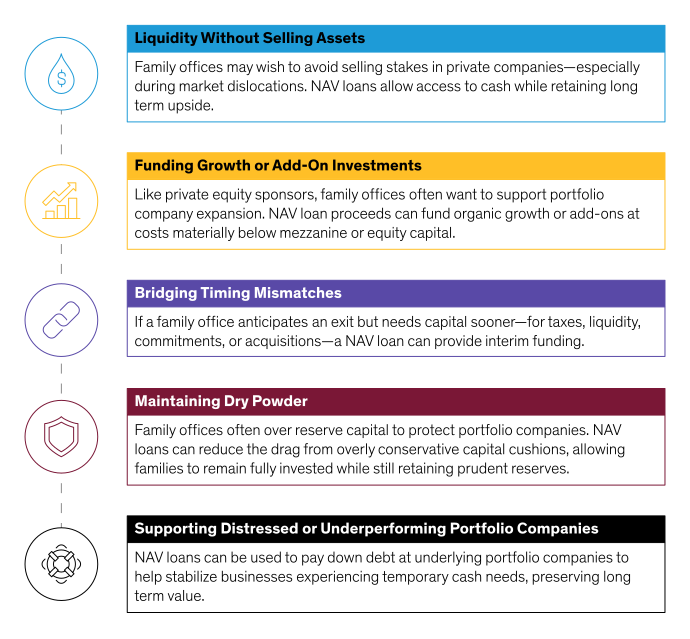
When a Family Office Should Consider NAV Lending
While NAV loans aren't one size fits all, they align well with several common family office objectives:
Case Study: Deployment Optimization for a Diversified Portfolio
Consider a family office managing a diverse portfolio that included six operating company investments totaling $240 million—with a current NAV value of $340 million—and eight limited partner (LP) investments in private equity and private credit funds. Initially funded with $55 million, the latter were now worth $80 million. With a total NAV of $440 million, the family wanted to make a new acquisition and fund incremental LP investments, all while preserving their liquidity.
To achieve this, they secured a $50 million NAV loan with a loan-to-value (LTV) ratio of 11.4% and a five-year term. The loan allowed them to invest in a new operating company and make five new commitments as an LP in private equity funds. By using the NAV facility, the family office efficiently managed their liquidity without needing to sell any existing investments.
The outcome benefited both the family and the family office investment team. For the family, it eliminated the risk of under-deployment while positioning them for higher long-term returns and preserving liquidity for unforeseen needs. Meanwhile, the family office investment team enhanced their ability to pursue growth, reduced the drag from over-reserving, and improved the alignment of their capital structure with their strategic goals.
[1] Source: Fund Finance Partners, LLC. (2025). FFP NAV Lending Index: Q4 2025 (2nd ed.). Fund Finance Partners.