

The economy has spent the first half of 2026 under pressure and still hasn’t cracked—despite an energy shock, mature labor cycle, and persistent inflation risk. AI has helped prolong the expansion, but it has also concentrated market leadership and raised the bar for investors. Now, the next phase will depend less on how much is spent and more on where productivity gains, profits, and durable value ultimately accrue.
Where the 2026 Economy Stands Now
Six months ago, we were slightly concerned by a cooling labor market. Yet in the past quarter, we’ve seen signs of outright strength as an AI wave and other stimulus have breathed new life into what was supposed to be a late-stage economic cycle. With plentiful jobs and solid wage growth, it’s no wonder the markets have been optimistically inclined. While we wouldn’t quite coin this a “Goldilocks” economy, it’s closer to that moniker than too hot or too cold (Display).
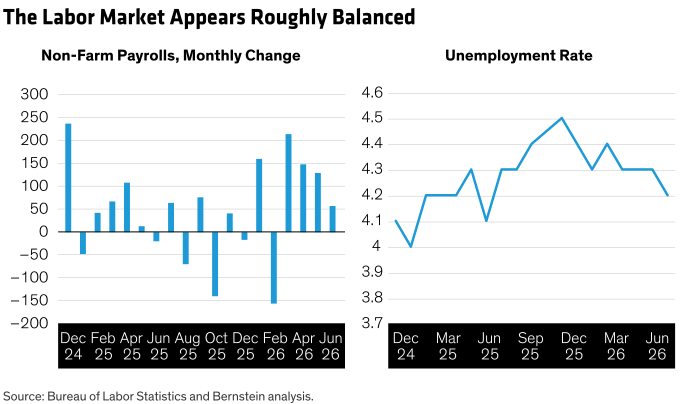
Much of what we’re seeing is driven by a two-sided economy. AI-related investment activity has carried the lion’s share in keeping the cycle moving with respectable figures for both earnings growth and headline GDP. Strip out AI and the picture looks more like a classic late-cycle economy. Given the importance of the AI wave, it’s garnering an outsized share of attention from both our portfolio managers and the Investment Strategy team.
Like us, the Federal Reserve sits in the middle, looking for signs of acceleration or deceleration. Based on Chair Warsh’s first meeting a few weeks ago, it appears the FOMC will stay put for a while. Warsh’s moves to eliminate the Fed’s forward guidance should give them more leeway to navigate any sharp turns but may also heighten volatility by not conveying changes as clearly in advance.
With the labor side of the economy holding steady for the time being, inflation becomes the swing variable. As with the first six months, its path in the back half is less likely to be driven by the Fed and AI and more by Iran and oil. While the situation in Iran has cooled and the market is pricing it as if fully resolved, the war remains the greatest risk to the global economy and markets over the next quarter or two. If permanently settled, the Fed may be able to hold rates steady as the oil shock reverses. Otherwise, hikes may come.
Oil Prices, Iran, and Global Growth Risk
The war in Iran has been the most significant economic shock of the year—and whether it’s over remains to be seen. We, and the market, lean toward yes. Perhaps not truly over, but nearing a new equilibrium, even if that’s just constant kick-of-the-can on a longer-term deal.
Any new state of affairs would follow an on-again/off-again pattern of escalation and negotiation that’s been difficult for the markets to price. Although by looking through daily headlines and government pronouncements, investors seem to have moved on. That stance is likely warranted, in our view, though we’re still mindful of the risks should the conflict reescalate.
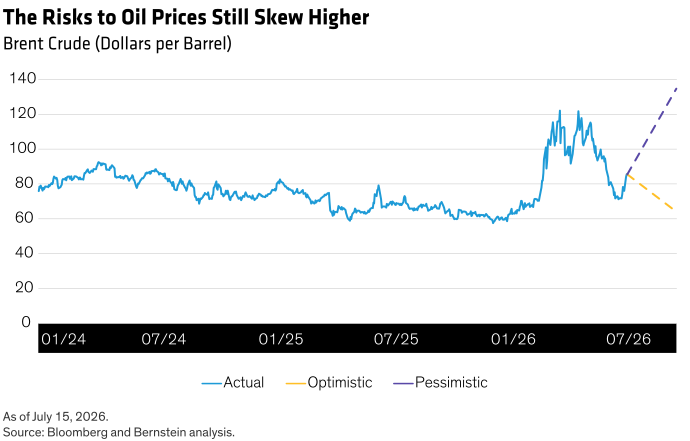
At this point, only about one-third of the normal volume of daily ship traffic has resumed through the Strait of Hormuz. Since roughly 20% of the world’s pre-war oil and gas supply moved through the strait, that still leaves the global economy in a deficit if this becomes steady state. We and the market expect a higher-throughput agreement to be reached by year-end, allowing petroleum flows to normalize.
Yet the distribution of outcomes is highly asymmetric. A faster- and stronger-than-expected normalization could bring oil prices down by nearly $10/barrel. On the other hand, a meaningful reescalation could send them back up by $20–$50/barrel, possibly more (Display). Much as they have been earlier this year, our portfolios must remain durable given that range of possibilities.
Perhaps the most important lesson we have learned so far about energy markets (and the world overall) is that the global economy is far more resilient than you might think. It can absorb sizable shocks without rolling over. That dawning is fueling a fair amount of optimism from here.
In the case of the Iran war, the economic damage has been real, just less severe than feared. Approximately 7 million barrels per day were rerouted through the Yanbu and Fujairah bypass pipelines, cushioning the physical shock in the developed world. Strategic petroleum reserves—including the largest coordinated IEA release in history, at 400 million barrels—filled much of the remaining gap.
At the same time, the cost of that resilience has been the erosion of some of the cushion that allowed the economy to weather the oil shock so far. Going forward, that shock absorber will be thinner until the world is able to refill its oil reserves. Similarly, household savings have been slowly declining in the past few years. They’re currently at a seasonal peak due to tax refunds, but the buffer remains on a downward trajectory, especially among lower-income cohorts. While we’re fairly sanguine overall, we’re mindful that the economy may not be as resilient in the face of the next shock as it was this one.
AI Capex: What Comes After the Buildout
Artificial intelligence remains one of the most important forces behind the economy and markets. AI-related spending alone is big enough to matter. The five largest hyperscalers are expected to increase capex from $438 billion in 2025 to more than $1 trillion in 2027, with a possible path toward $1.6 trillion by 2030 (Display). That buildout is rippling through semiconductors, data centers, power, construction, networking equipment, and credit markets. In an economy where many traditional growth drivers remain uneven, AI investment has become a meaningful source of incremental demand.
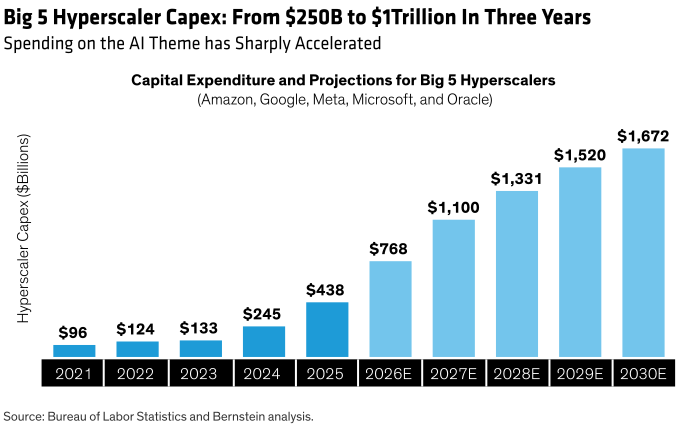
At the same time, the scale of spending raises the obvious question: what return justifies it? The early evidence is improving, particularly as agentic AI and coding-related use cases have accelerated. But the math remains challenging. If the industry spends roughly $1 trillion on capex and ultimately needs capital intensity to normalize toward 40%, that implies nearly $2.5 trillion of revenue to support the investment. Current software spending hovers around $1 trillion, while online advertising and other digital services add roughly another $1 trillion. In other words, the existing digital economy is sizable, but insufficient to validate every dollar being committed.
That’s why the bigger opportunity lies beyond today’s software and advertising markets. The global labor market is more than $40 trillion. If AI can raise productivity by even 10%, the potential annual value creation could reach roughly $4 trillion; at 20%, it could exceed $8 trillion. Those numbers should not be treated as forecasts. They’re simply a way of framing the magnitude of potential revenues and justified capex.
The macroeconomic implications could be substantial, though they’re unlikely to show up cleanly or immediately. AI capex is already supporting growth, but the rate of spending growth may be near its peak. From an investment perspective, that should appear in valuation multiples in the next year or so.
If AI is to remain a durable tailwind for global economic growth, productivity gains will need to fill in as the contribution from capex wanes. Estimates of the potential productivity effect vary widely—from roughly 0.1% in more cautious academic research to 2.5% in more optimistic scenarios and the average of recent studies settling at around 1%. That range captures the central challenge: there’s immense upside, but the timing and magnitude remain uncertain. Major technological shifts like this take years to digest and scaffold in order to achieve their full economic and societal potential.
Given that long runway, it would be completely normal for markets to experience some sort of air pocket or capital cycle in one or more areas of the AI ecosystem. This leaves valuation and risk management as the central investment questions. AI may well prove to be a general-purpose technology with tentacles extending across the economy. But the benefits will not be distributed evenly, and the path from capex to revenue to margins and productivity will not be linear. Some stocks already reflect much of this super cycle, in our view. Others appear undervalued, either because the market fails to fully appreciate their role or due to disruption in other sectors. As a result, our focus is less on whether AI matters—it clearly does—and more on where the economics accrue. We’re also parsing which businesses can compound over time as a result, and whether current valuations provide enough margin given the inherent uncertainty at this stage.
2026 Global Economy: Regional Divergence
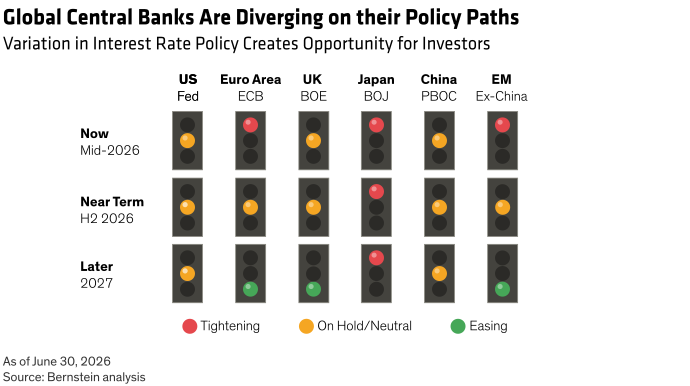
Our focus so far has been largely on the US, which reflects both the scale of the American economy and the footprint of AI-related investment. The picture outside the US is more varied. Growth in the rest of the developed world is running well below the American pace, inflation dynamics differ across regions, and for the first time in a couple of years, major central banks are moving in different directions.
United States
The most notable shift over the past six months has been in the composition of growth rather than its pace. AI-related capex has taken on an outsized role in headline GDP, while the labor market has regained some momentum after softening late last year. There is not much evidence, at least in the aggregate, that AI adoption is destroying jobs, though certain sectors and demographic cohorts do appear under pressure.
One development worth flagging? The real economy’s increasing sensitivity to financial conditions. Consumption is more concentrated among wealthier households than at any point in the past century, and both the level and rate of spending growth have diverged sharply across wealth distribution. Consider that the top 10% of households by income now account for roughly 36% of discretionary spending—nearly matching the bottom 70% combined. With asset prices and high-end consumption now more tightly linked, a meaningful market drawdown could hit growth faster than it has in past cycles. Put simply, wealth effects usually lurk in the back of our minds as risks, but now they’ve moved to the forefront.
Europe
Growth in the euro area is barely positive. First-quarter activity contracted, industrial production momentum has weakened further, and household purchasing power is being squeezed as nominal wage growth eases while energy inflation climbs.
The more important question is whether we’ll see a resurgence of the kinds of second-order inflation effects that took hold in 2022. On balance, we find that unlikely. Services inflation has ticked up and warrants monitoring, but wage growth is on a downward slope and labor market slack is meaningfully greater, weakening employee bargaining power. That combination suggests a shorter and milder ECB tightening cycle than markets currently anticipate.
The UK story is similar in character but milder. Absent the energy shock, headline inflation would likely hover near target already. Plus, the labor market is weak, and the Bank of England has indicated a tolerance for a temporary overshoot rather than tightening further into softness. Political uncertainty is a modest additional risk, as Andy Burnham appears set to take over as prime minister.
Japan
Japan is quietly getting back to normal. Domestic demand is carrying growth of around 1%, wage gains are running solidly ahead of prices, and inflation is finally sitting above target in a real way. That combination has allowed the Bank of Japan to continue the gradual tightening cycle it began a few quarters ago, and we expect more of the same—modest, measured, and constrained by politics rather than by economics.
The days of deflation appear more convincingly in the past, and Japanese policy is drifting toward something more typical, globally. The yen remains weak and is likely to stay soft while the BOJ moves more slowly than its peers.
China
China’s economy increasingly looks like two economies stitched together. The externally facing side, particularly technology and manufacturing tied to global supply chains, is holding up well. But the domestic side—consumption, real estate, and private investment—remains mired down.
Retail sales have been particularly weak, and soft internal demand is keeping inflation near zero. Deflation, which the country has been exporting to its trading partners, is a more pressing concern. We don’t expect aggressive stimulus from here, which should leave the economy stable, if unexciting, over the next few quarters.
Emerging Markets
Emerging markets ex-China have been more resilient than the oil shock would have suggested. Growth has been supported both by spillovers from a strong US economy and by the role these countries play in the electronics and capital investment supply chains. That positioning favors places like Korea, Taiwan, India, and parts of Southeast Asia.
The offset is that inflation risks remain tilted to the upside, and monetary tightening has become the dominant policy response across the emerging universe, with much of the hiking already priced in (Display). From here, the variable we’re watching most closely is the US dollar: it’s been a tailwind for emerging-market assets over most of the past year, but a more hawkish Fed could quickly flip that to a headwind.
Asset Allocation: Stay Selective
Much like at the start of the year, the cross-asset outlook generally seems strong across the board, driven by relatively attractive interest rates in fixed income and a positive earnings backdrop for credit and equities.
Fixed Income and Credit
With the 10-year Treasury yield hovering around 4.5%, interest rates are sitting at a solid starting point for investors. We also find attractive yields in other countries, with the added bonus of diversifying away from the US rate cycle.
Inside the US, flexibility remains key in municipal bonds. We continue to recommend a barbell structure which favors Treasuries at shorter maturities and municipals at longer ones, where the tax-equivalent yield advantage is much more pronounced. Muni credit quality continues to excel, with idiosyncratic events—wildfires, budget standoffs, headline city stress—being cleanly absorbed. Yet under the surface, the municipal market is evolving. A growing share of municipal debt issuance now originates via ongoing dialogue between borrowers and lenders and is structured more like private credit, offering appealing risk-adjusted returns.
In traditional corporate credit, high yield appears more attractive than investment grade, with more of a yield pickup after incorporating potential defaults. Meanwhile, we continue to see opportunities in our neck of the private credit market despite headlines over the past year causing some stress. Importantly, conditions have improved markedly in the past three months. As recently as March, sentiment had swung toward the “broad brush” view that every loan was suspect, and every fund troubled. Since then, bulge bracket funds’ redemption requests have eased slightly, while the pace of default announcements has slowed to a trickle—a sign that the worst of the fears were overdone.
Meanwhile, the floating rate structure proves its worth in a balanced portfolio with sensitivity to interest rate shocks. On top of that, the premium in like-for-like credit spreads remains in place over bonds or syndicated loans. Underwriting will matter in the coming years more than it has in recent ones; it’s essential to ensure your capital is in the hands of managers with a track record and process demonstrating real discipline.
US Equities
The AI theme has dominated US stock performance all year—a development we expect to continue. Market-wide, the outlook for stocks looks moderate. Wall Street analysts are expecting S&P 500 earnings to rise by over 28% this year, and forecasts call for mid-teens growth in each of the following two years. While that’s quite high, it could come to pass if AI’s benefits materialize in that time frame. Plus, that optimism may still leave room for error: historically, the market has often advanced even when earnings estimates were too high by roughly five percentage points.
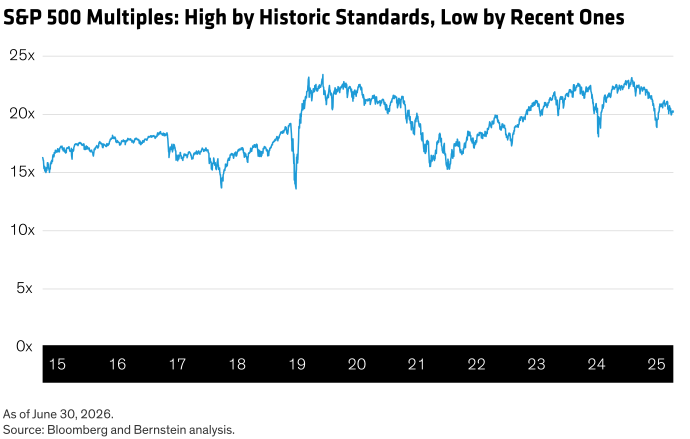
Likewise, stock multiples have made headlines for being high over the past few years. At 20.3x expected earnings over the next 12 months, the market is currently trading at the lower end of its range over the past two and a half years, which spans the current regime of AI-driven growth and elevated interest rates (Display). The only time we’ve seen multiples lower since the pandemic was during the rates shock of 2022–2023. Now, investors face a worthy question: what regime is likely to come next, and will it arrive in 2026, 2027, or further down the road?
Inside the market, we see attractive opportunities in the healthcare sector, where estimates are reasonable and multiples seem undemanding. The technology and communications sectors catch our eye as well, but selectivity is key—the AI capex cycle is real, but the wide dispersion to date will likely persist. Even inside the Magnificent Seven, we see most of the stocks as well positioned, with Apple and Tesla being the two exceptions where our portfolio managers are generally underweight. On the opposite end from a sector perspective sit consumer and industrial names, where we believe investors need to be more careful in positioning.
We also have an eye on potential index changes due to new mega-IPOs. Those stocks are likely to intensify market concentration and further shift the exposures and valuations that passive index investors take on.
Further down the size spectrum, the small- and mid-cap indices have rallied this year. Investors usually view that arena as somewhat diversifying to their large-cap exposure. Yet our analysis suggests that their moves tend to revolve around the same fundamental drivers we’re seeing in US large-caps and around the world, namely AI capex and banks benefiting from higher post-COVID interest rates. Accordingly, our expectations for strength in smaller companies connect directly back to our broader market view—as long as those trends remain intact, strong performance will likely continue.
International Equities
We continue to emphasize global diversification in our portfolios. We think the US can and should continue to outperform if our base case for AI plays out, but there are plenty of scenarios that could benefit international stocks more over various time horizons.
Europe screens attractively, particularly for defense contractors benefiting from a multiyear rearmament cycle, banks with cleaner balance sheets and shareholder-friendly capital return policies, and industrials tied to the AI/electrification buildout. Japan is a quieter story—a normalizing rate environment, ongoing corporate governance reform, and reasonable valuations relative to earnings power.
Emerging markets have delivered strong absolute returns, up 14% year to date. Much of the leadership has come from Korea and Taiwan, on the back of the AI memory and semiconductor cycle serving as both a catalyst and a concentration risk. We’re comfortable with a routine level of emerging-markets exposure, but we expect that an active approach and thoughtful position sizing should serve investors well in that region.
Real Estate
In real estate, we continue to see attractive opportunities across the capital structure as the market digests shifting demand dynamics and capital structures established before the post-pandemic rise in interest rates. Multifamily and industrial have seen new developments ease, office remains bifurcated between Class A properties and the rest, and data centers are experiencing overwhelming demand. Meanwhile, retail has been trending upwards and senior housing continues to enjoy constrained supply.
In real estate equity, strong fundamentals still prevail, particularly in multifamily housing. Our private strategies have robust pipelines and foresee a strong environment to deploy capital for the rest of the year.
In real estate debt, activity has accelerated. We’re also noticing equity investors crossing over to the credit side to repair broken capital structures. While there are opportunities across both debt and equity, the debt side has an edge when it comes to risk-adjusted returns while the equity side has the upper hand for absolute returns at the moment.
Private Equity
For us, private equity is much more of a strategic asset allocation than a tactical one. Overall, though, we see the current environment as quite supportive of the private space. As large institutions contended with the denominator effect and limited capital returns from 2010s-era investments, many stepped back from the market and have yet to fully reenter—creating an opportunity for us to upgrade our manager quality. Meanwhile, the rally in public markets over the past year, and reopening of the capital markets as Iran stabilizes, is providing more compelling exit opportunities for both buyouts and venture/growth investments.
The most notable VC/growth arena trend, in our view? Not only are AI companies growing their revenues well above non-AI companies, but all startups are benefiting from the new technology and finding ways to run leaner from the outset. Taken together, those developments should deliver more value to early investors.
Hedge Funds
While hedge funds as a whole have had their share of struggles in the first half of 2026, we’re constructive on the space going forward. Dislocations in rates and energy driven by the war in Iran, credit dispersing after years of being compressed, and loads of corporate actions create opportunities for skilled managers to earn solid returns. We’re seeing a lot of activity beneath the surface of the markets, exactly the environment that can generate reward potential. Beyond the market backdrop, we’re also finding meaningful ways for investors to utilize certain hedge fund strategies to generate higher after-tax returns.
Gold
Gold came into the year on a tear, having risen from $3,500/oz at the end of August to $4,300 to close out the year. Then, after peaking at $5,500 in January, it slowly ceded those gains and touched back to $4,000 by the end of June.
We consider gold a useful diversifying asset, though its sharp declines and long languishing periods often drag on returns over time. What’s more, it often fails to precisely hedge the real-world events investors buy it for—inflation after the pandemic or this year’s war in Iran.
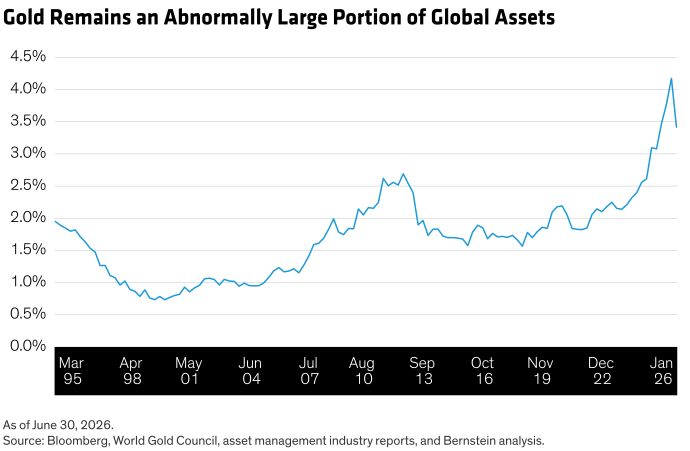
When we wrote about gold in February, we noted that it had reached over 4% of global investable assets, a level which we had difficulty envisioning as sustainable over the medium term. That level has now fallen back closer to 3%—still elevated, but arguably easier to support (Display).
Crypto
The Trump presidency created a major set of catalysts for the crypto-asset complex in 2024 and 2025, with bitcoin surging 50% to over $100,000 in the weeks after the 2024 election. Yet after peaking at roughly $125,000 late last year, it has since suffered a series of declines, falling back to around $63,000. Some of that decline has followed the announcement of a US government Strategic Bitcoin Reserve that underwhelmed speculators’ hopes. More recently, a momentum unwind, and doubts about whether one of bitcoin’s largest corporate buyers will continue to hold and accumulate the asset have also weighed on prices.
As with gold, we don’t make tactical calls on bitcoin. Earlier this year, we noticed more interest in “buying the dip” from our UHNW clients than we’d seen during the crypto winter of 2022. But that has dried up more recently.
Outside of bitcoin, we continue to see intriguing innovations and uptake in the crypto/blockchain world, with tokenization and prediction markets increasingly integrated in real-world scenarios.
A Resurgent Economy, But Not Without Risks
The first half of 2026 served as another reminder that economies and markets rarely move in straight lines. A war that threatened global energy supplies, persistent inflation concerns, shifting central bank leadership, and questions surrounding the sustainability of the AI investment cycle all had the potential to derail growth. Yet the economy has remained remarkably resilient. That resilience is arguably the most important observation of the year so far.
At the same time, resilience should not be mistaken for invulnerability. The cycle is mature, savings cushions have eroded, and the economy has become more sensitive to both energy prices and financial markets. While our base case remains positive, the world is not without risks.
For investors, the implication is straightforward. Broadly speaking, the opportunity set remains favorable across fixed income, equities, private markets, and select alternatives. But a rising tide is unlikely to lift all boats equally. The most important investment questions are increasingly about selectivity, valuation, and identifying where economic value ultimately accrues as technological and geopolitical forces reshape the landscape.
As always, our focus is less on predicting the next headline than on building portfolios capable of navigating the whole range of outcomes. The economy hasn’t cracked, but uncertainty remains—and that’s where long-term opportunities lie. Maintaining discipline, diversification, and a long-term perspective is the best way to capitalize on them.