

Most investors spend their time thinking about what they own and who manages their money, whether active or passive, stocks or bonds, public or private. But few stop to consider how those assets are held.
That “how”—the investment’s structure or “wrapper”—can meaningfully impact taxes, flexibility, and ultimately, your returns. Two investors with identical strategies and managers can experience very different outcomes simply because of the wrapper they use.
What’s in a Wrapper?
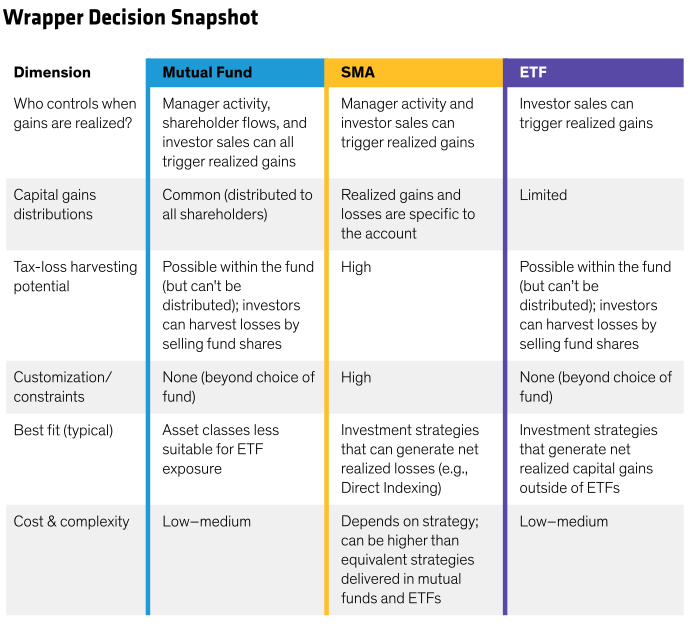
By taking the same assets and putting them in a different vehicle, you can materially alter the taxes you incur. The shift shows up immediately in your after-tax returns, but it also affects how investment decisions are handled for different investors. For instance, the wrapper determines who controls when capital gains are realized, how much flexibility a portfolio manager has to reposition (and how evenly those changes are felt by different investors), along with the cost and complexity of the portfolio.
Here’s a quick way to compare three common wrappers at a glance.
Why Mutual Funds Are the Industry’s Esteemed Elder
In the early days of the investment industry, mutual funds became the primary vehicle of choice. Investors valued their professional management, diversification, administrative simplicity, and liquidity in world where those attributes were hard to find elsewhere.
For decades, mutual funds were the most practical way for most investors to access the markets. But in taxable accounts, they come with an unavoidable drawback: shareholders have no control over when taxes are realized. Capital gains generated inside the fund must be distributed to all shareholders in the year that the gain is realized. That happens whether you bought in days before or years before, and even if you didn’t sell a single share.
This design allows investors to pool their capital, diversify, and access regular liquidity. But it also leaves fund investors sharing tax burdens with a broad pool of shareholders whose time horizons, tax situations, and goals may look nothing like their own.
For tax-sensitive investors, that loss of control can be costly over time. It often means paying taxes sooner than you’d like, shrinking the amount left over to compound.
With that said, mutual funds still have their place. They provide access to certain asset classes that are too difficult to reach operationally via other structures. And for non-taxable or tax-exempt accounts, these tax challenges simply don’t apply.
SMAs: Sophisticated, But Not an All-Purpose Tool
Over the past decade or so, separately managed accounts (SMAs) have come into vogue, thanks to their greater control over taxes and customization. This control is especially attractive for investors with significant concentrated wealth, specific constraints, or large embedded capital gains. Because SMAs involve ownership of individual securities, they also allow for tailored tax-loss harvesting. The more you value these benefits, the more likely an SMA will be the right choice for you.
Keep in mind, an SMA’s effectiveness depends heavily on the nature of the underlying investment strategy. Passive strategies based around an index tend to have an inherently low turnover. With relatively few realized gains to manage, the tax focus shifts toward systematically harvesting losses, which an SMA can make immediately available—while mutual funds and ETFs cannot. In many cases, it’s often possible to generate net capital losses that investors can immediately put to use.
In contrast, active strategies typically involve higher turnover. Here, the tax challenge revolves around controlling the timing and character of realized gains: deferring them where possible and favoring long‑term over short‑term gains. In practice, tax managing a highly active strategy in an SMA—while remaining faithful to the investment approach—often involves trade-offs between realizing gains and increasingly deviating from the manager’s ideal portfolio.
Those trade-offs become more pronounced when investors withdraw cash. Raising liquidity inside an SMA can force additional realized gains and push the portfolio away from its intended targets. While managers can skew sales toward lots with losses or smaller gains—often improving tax outcomes relative to a simple pro‑rata sale—that flexibility may come at the cost of higher tracking error. For some investors, the compromise is worthwhile; for others, the calculus may look very different.
ETFs Offer Efficiency and Scale
Exchange-traded funds (ETFs) were designed to avoid many of the structural inefficiencies investors had previously deemed unavoidable.
Most ETFs can manage portfolio turnover without triggering capital gains distributions to remaining investors, thanks to an in-kind creation and redemption process. As a result, taxes are primarily driven by an investor’s own buying and selling decisions, rather than from ongoing activity inside the portfolio or decisions made by other shareholders.
For portfolio managers, this means they can focus on building and maintaining their target portfolio without worrying about generating taxable gains for ETF holders. Positions can be adjusted or exited without causing gains or losses for investors, allowing the portfolio to more accurately reflect the manager’s best insights and strategy.
For many diversified, active equity strategies, ETFs often deliver equal or even better tax efficiency than SMAs, while letting managers keep portfolios aligned with their views. Add in lower costs, daily liquidity, and operational simplicity, and ETFs become a very compelling option indeed.
That said, ETFs aren’t the perfect fit for everyone or every situation. Sometimes, an SMA is still the best option. But for many investors we work with, ETFs often offer smarter, more convenient packaging.
Epic Wrap Battle?
This is less of a good, better, or best story. It’s more about how finance has evolved and how different investment structures fit different needs.
Each wrapper comes with its own set of trade-offs, making it better suited for certain situations, whether that’s existing portfolios, tax implications, varying degrees of market liquidity, or more. In practice, ETFs tend to suit a wide range of client needs. Yet SMAs can be especially valuable for investors facing specific tax challenges or concentrated stock positions. Even mutual funds have their place, offering exposure to strategies that might not be available through other vehicles. Our role is to ensure the right investors are matched with the right allocations, inside the right wrappers. That’s how we help ensure your portfolio delivers specifically for you.
Talk to Us About Your Tax Situation
Connect with our specialists for customized solutions.