

We’ve been fielding queries lately from our clients about the opportunities and risks associated with private credit, so we decided it was time to dig a little deeper into what private credit really is, what it isn’t, and how it fits into a diversified investment portfolio.
1) The media is filled with coverage of private credit, and lately, its perceived risk. What is Bernstein’s view on the asset class?
We consider private market investments—private credit in particular—a core building block of a diversified asset allocation. Our modeling shows that for most investors, adding private credit to their investment portfolio increases returns and lowers volatility. But recent media coverage has sparked some concern, with headlines warning of hidden risks.
That might hold true for some parts of the market, but not every part. Let me start at the beginning.
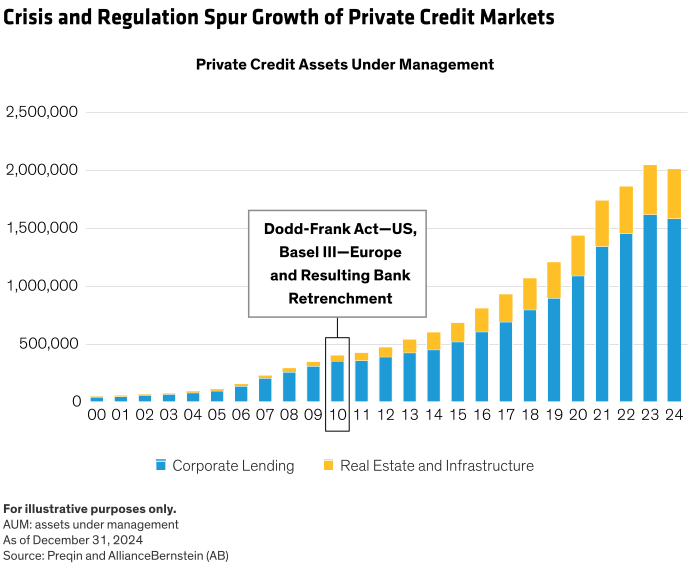
In simple terms, private credit is lending outside the banking system. At one time, it represented a small portion of the total credit extended to nonfinancial companies. But that started to change after the global financial crisis as regulators around the world increased restrictions on the risk banks were permitted. When the Dodd-Frank Act in the US and global Basel III bank capital requirements took effect, banks pulled back while asset managers, insurance companies and other private lenders filled the void (Display).
Of course, banks still lend, but they’ve become more selective. For instance, a bank might refuse to make a loan that exceeds a certain multiple of a company’s earnings before interest, taxes, depreciation and amortization (EBITDA). These restrictions are often applied universally, artificially limiting credit access for strong borrowers with steady cash flows. In other words, a profitable tech firm with predictable revenues might face the same borrowing limits as an oil-field services provider subject to oil price fluctuations as well as regulatory and geopolitical risk.
2) How should investors decide which types of private credit to invest in?
The most important decision, as we see it, is to be invested. We believe portfolios with little or no exposure to private credit are missing out on a large and growing slice of the US economy. More than two-thirds of US companies with $100 million or more in revenue are private, with no plans to go public, and the ranks are growing. Public markets, meanwhile, are shrinking. According to Bloomberg Intelligence, there were about 4,000 public US companies at the end of 2024, roughly half as many as in 1996.
For many investors, we believe the natural place to start is direct corporate lending, as it tends to be the most diversified of all private lending. Here’s how it usually works: A private equity fund buys a company and provides 60% of the purchase price, financing the rest with private debt. That 40% from a private credit provider typically comes with a loan that puts a lien on all assets, placing the private lender first in line to be repaid if the company is sold. That legal structure provides important protection for lenders.
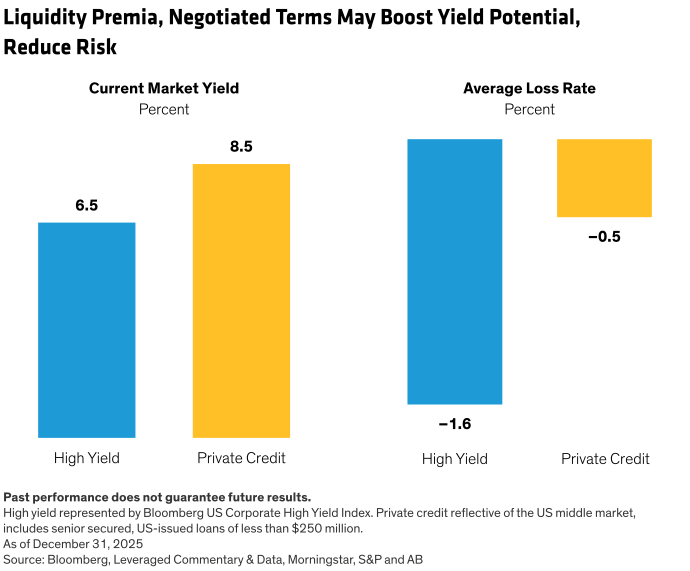
Keep in mind, private credit investments are less liquid than public high-yield corporate bonds or syndicated bank loans. To compensate investors for leaving their money at work for longer, they offer a floating interest rate and higher yields—usually the cost of borrowing cash overnight, plus a fixed-price coupon and upfront fee.
3) How do Bernstein’s private credit managers decide which companies to lend to?
We see the most attractive opportunities in core middle market companies—those with enterprise values between $100 million and $1.5 billion. In the US, that covers about 200,000 companies accounting for nearly 48 million jobs—roughly one-third of total private-sector employment. In fact, if the middle market were a country, it would have the world’s third-largest GDP (Display).

Individually, these companies are usually not large enough to access the broadly syndicated loan market, so there is less competition for deals. That can mean more attractive pricing and better terms for lenders—and investors. This can include protective covenants such as caps on the amount of leverage a borrower can have, which may improve downside risk mitigation. This makes the private credit space less volatile than the broadly syndicated loan market.
Over time, defaults among middle market borrowers have been lower than those among public companies that borrow in the high-yield bond market (Display). Meanwhile, a surge in merger-and-acquisition activity last year points to more potential opportunities for investors in 2026.
That’s in line with the massive growth of middle market direct lending over the last 15 years. Preqin, a data provider, projects the size of the direct corporate lending market to reach $4.5 trillion by 2030, up from about $2 trillion today.
4) That’s a very big pool to fish in. What should investors look for when choosing a manager?
It’s a good question. Strong capital inflows over the past five years have made for a more crowded market and raised questions about underwriting quality and lending discipline.
But it’s equally important to acknowledge that not all direct lenders are alike. When it comes to minimizing defaults, experience and disciplined asset selection matter. We see the strongest opportunities in lending to companies with strong and repeatable revenue streams that provide “mission critical” services in stable, defensive sectors, such as digital infrastructure or healthcare. A thoughtful focus on sectors is important because it allows experienced investors to select and manage risk more effectively than managers of more generalist strategies.
And we like to lend to smaller companies where there is less competition and lenders aren’t forced to bend to the will of the company to win the deal.
And keep in mind that middle market direct lending is private credit, but not all private credit is middle market direct lending. There are many different flavors of private credit, with varying levels of return potential and risk.
5) Are there other corners of the private credit market that look attractive today?
Yes. Private credit is bigger than direct lending. Much of the spending done by consumers or small businesses is also financed privately, and we think investment strategies that focus on this also have the potential to generate attractive returns and diversify portfolios.
The $6 trillion-and-growing asset-based finance market provides opportunities for lenders to finance consumer, residential and small-business lending that fuels the real economy. Financing is usually provided through purchases of existing loans—for autos, residential and commercial property, credit cards, and more. Or financing can come from agreements to buy pools of future loans from the non-bank financial institutions that make them. Sometimes, loans are backed by income-generating hard assets, such as energy infrastructure or leased airplanes.
Careful asset selection and underwriting are important, as is the quality of the underlying collateral. But the self-amortizing nature of asset-backed loans means that they repay their principal gradually over time, becoming less risky as they do. And in a default, the asset backing generally provides strong and more predictable recoveries. We see this strategy as an attractive complement to direct corporate lending.
What’s more, the massive amount of capital needed to finance the energy transition and the digital infrastructure and data centers that power AI relies heavily on private credit. Many companies are turning to private lenders, because they can customize loans and provide other benefits. This increasingly includes companies that also issue debt in public markets.
6) There were a few bankruptcies last year at companies partly financed by private credit. Is this reason for concern?
It can be, if you aren’t careful about who you invest with. The companies that attracted attention in the press face allegations of fraud and misappropriating collateral. As we see it, these don’t appear to be cases of typical market-driven distress. What’s more, their long list of creditors also included major banks.
Of course, it’s important to remember that defaults are natural in credit investing—public or private. And they’re more likely in the later stages of an economic cycle.
But the real question isn’t whether defaults happen. It’s how they’re handled when they do—and whether they translate into losses.
Minimizing losses starts with strong underwriting. This involves carefully selecting the companies to lend to and then structuring the loans in a way that can reduce losses if a default occurs.
For example, private credit lenders have the ability to negotiate covenants and reporting obligations that allow them to be proactive if a borrower gets into trouble. That might mean forcing asset sales or requiring an injection of additional equity capital—steps that may help to reduce risk for the lender.
7) Is private credit inherently riskier than other fixed-income strategies?
We disagree with suggestions that private credit is inherently riskier. In direct lending, for instance:
- Loans are executed at the senior levels of a firm’s capital structure; the funding source that’s first in line to get fully or partially repaid should the borrower default. A private loan to a middle market company typically benefits from a large equity cushion below it to absorb losses tied to declines in a borrower’s value.
- Lenders, borrowers and private equity sponsors interact frequently, giving lenders insight into borrowers’ performance. This type of influence simply isn’t possible in broadly syndicated loans, which can often involve 50 to 80 participants, and sometimes even more.
- In rare cases where all avenues of redress have been exhausted, private lenders can seize assets, including real estate and equipment, to pay off the debt.
As the ranks of private lenders increase, so will variation in performance. That, too, is a natural development as markets mature. We expect the most effective lenders to be those with deep expertise in structuring loans and solving problems for borrowers.
Private credit, like the public variant, isn’t immune to economic cycles, which can bring stress and potential defaults. Different parts of the market will go in and out of favor.
But we believe that experienced managers with a track record of identifying, executing and managing attractive private credit investments have the potential to uncover real value for investors while providing robust downside mitigation potential.
That’s something a public-only approach may not be able to provide.
- Alexander Chaloff
- Chief Investment Officer & Head of Investment & Wealth Strategies