

As we march further into 2026, most working individuals are fine-tuning their professional and personal goals for the year. Amid this recalibration, saving for retirement is often relegated to the back burner. That’s an unfortunate oversight—especially in the wake of new provisions introduced on January 1, 2026, that radically change the retirement savings landscape.
How the SECURE Act 2.0 Impacts Retirement Contributions
In 2026, the IRS increased the annual 401(k) contribution limit to $24,500, up from $23,500 the year prior. It similarly boosted the catch-up contribution limit for those aged 50 and older, from $7,500 in 2025 to $8,000 in 2026. These increases go a long way—and could go even further with the “super catch-up” contribution, which allows employees aged 60 to 63 to contribute $11,250.
Are Roth Catch-Up Contributions Worth It?
But there’s a twist.
Beginning January 1, 2026, the SECURE Act 2.0 folded in IRC Section 414(v)(7), which mandates that individuals must designate these catch-up contributions as Roth contributions if their wages from the employer sponsoring the retirement plan exceeded $150,000 in the previous calendar year.
Roth contributions, of course, are made with after-tax dollars and are therefore ineligible for up-front tax deductions. While it’s true that these funds can later be distributed tax-free, the Roth requirement may prompt high earners to question whether their catch-up contributions are worthwhile. They may ask: “Should I forgo the catch-up contribution and instead invest those dollars in my taxable brokerage account?”
Studying the numbers over time, the answer becomes clear.
To illustrate, we evaluated the impact of making annual $8,000 Roth catch-up contributions for 15 years versus investing $8,000 annually in a taxable portfolio containing 70% global growth stocks and 30% bonds. To account for the impact of different tax brackets on saving in a taxable account, we modeled both low- and high-tax bracket scenarios (Display).
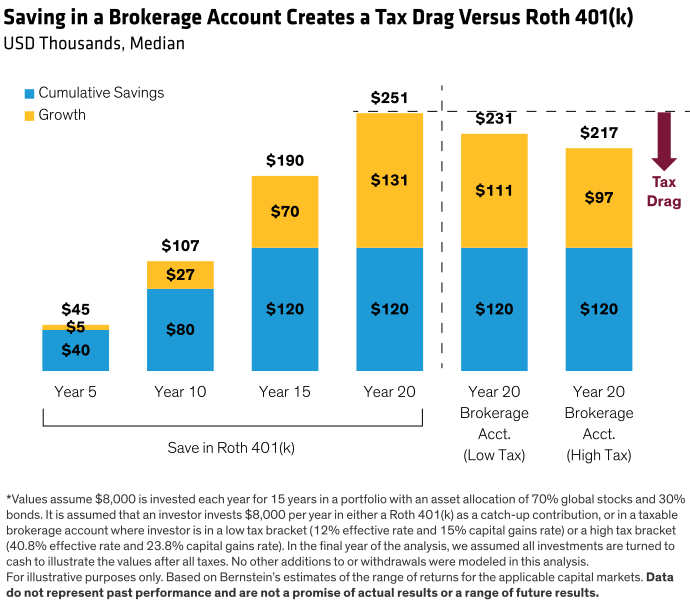
As displayed above, saving $8,000 per year equates to $120,000 of cumulative savings over 15 years, whether it’s saved in a Roth or a taxable account. The difference lies in the taxes generated by the portfolio each year—or in the case of the Roth, no taxes at all.
Investing $8,000 in the Roth would result in $131,000 in tax-free growth or $251,000 in total. Even if an investor was in the low tax bracket scenario, on an after-tax basis, saving in a Roth 401(k) creates approximately $20,000 in further wealth, because a taxable portfolio is still subject to annual taxes on interest, dividends and realized capital gains while a Roth is not.
How High-Income Earners Should Handle Catch-Ups
While many investors may be frustrated that they can no longer get pretax deductions for their catch-up contributions, a Roth can be a powerful savings vehicle—especially compared to their next-best option: a taxable account. As previously illustrated, Roth 401(k) contributions provide more after-tax wealth over time, without considering the other benefits of Roth planning, such as managing taxable versus nontaxable income in retirement. What’s more, children can inherit those assets in an income-tax-free manner. Those individuals who earn more than $150,000 can rest assured that they are not “missing out” on benefits in retirement due to this new rule.
If Roths are starting to sound a bit more intriguing, you’re not alone. Not surprisingly, “Rothifying” your retirement savings has become an attractive strategy as of late. But a host of considerations must be analyzed before taking the plunge. Time horizons, how you’ll cover your tax bill, and future tax rates all factor into final outcomes. Ask for a personal consultation with your Bernstein Advisor to see if this is the right approach for you.
Talk to Us About Your Tax Situation
Connect with our specialists for customized solutions.