

Headlines about the Social Security Trust Fund “running out of money” understandably unsettle retirees and high‑earners alike. But the situation is more nuanced than the sound bites suggest. Let’s explore what projected depletion actually means, what reforms are most likely, and how affluent families should incorporate Social Security into broader retirement and wealth transfer planning.
How Should High-Net-Worth Families Think About Benefits?
1. Don’t Dismiss Social Security as Irrelevant or “Ancillary”
Even for affluent retirees, Social Security is a uniquely valuable asset, offering:
- Longevity insurance: Lifetime, inflation‑adjusted income
- Spousal and survivor protection: Often exceeding private‑market alternatives
- Exceptional return for delaying: An 8% annual credit from full retirement age to 70, plus compounding COLAs
Viewed through a portfolio‑construction lens, Social Security resembles a risk‑free, inflation‑protected bond—one private markets cannot replicate at a comparable cost.
2. Plan Under Multiple Scenarios—Not a Single Assumption
A robust plan models Social Security not as a fixed number but as a range. Here’s a simple framework:
- Conservative: 20%–25% benefit reduction around 2034
- Base case: On‑time benefits but higher taxation for affluent retirees
- Optimistic: Modest reforms with scheduled benefits largely intact
This framework will help validate whether spending, gifting, and long‑term capital allocation remain resilient under evolving policy conditions.
3. Delay Benefits When Possible—Even Under Reform Scenarios
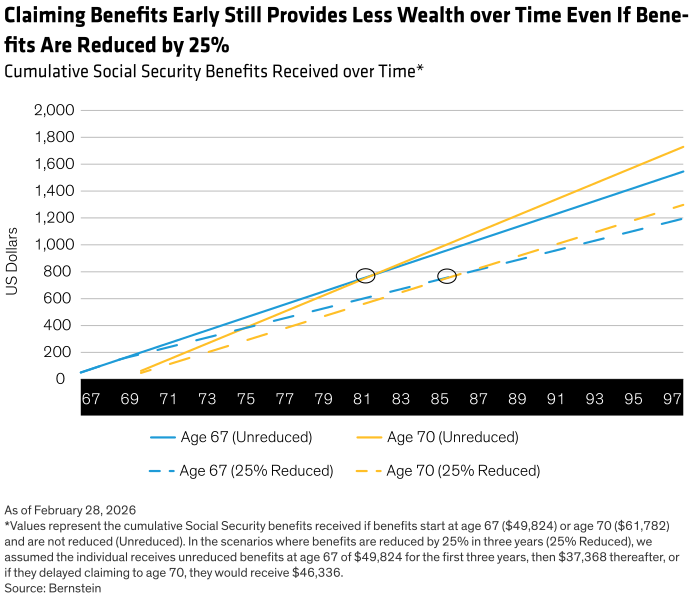
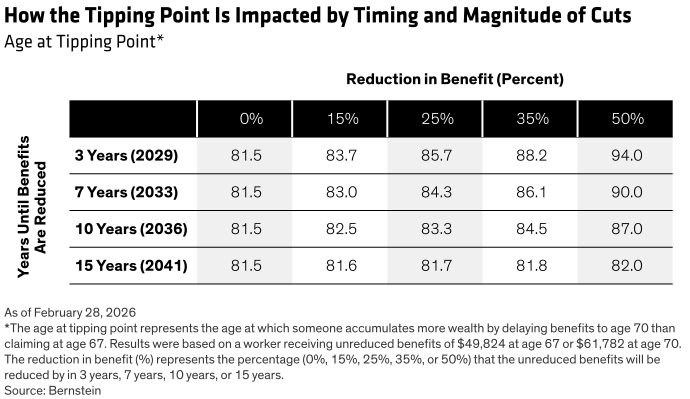
One of the most common questions among high‑earning households is: “If benefits may be cut, shouldn’t I claim earlier?” Surprisingly, the answer is still usually no. In each case, our goal is to find the “tipping points”—the age at which delaying until 70 produces more cumulative wealth than claiming at 67 (Display).[4]
- Baseline Case (No Benefit Reduction)
A 67‑year‑old eligible for $49,824 per year could instead receive $61,782 per year at age 70.[5] If the retiree chooses to wait until then, the higher annual benefit allows them to break even in 12.5 years. In other words, living beyond age 81.5 favors delaying.
- Stress Test: 25% Benefit Reduction at Age 70
Assume the retiree delays to 70—and in the very year they claim, benefits are slashed 25%. Even when the retiree misses out on three full years of benefits and collects reduced benefits of $46,336 per year:
o The tipping point merely shifts to age 85.7. And if cuts come later (5–10 years after claiming), the tipping point barely moves because the retiree collects several years of intact benefits before the reductions apply.
- More Drastic, Targeted Cuts
If Congress enacts deeper reductions for certain beneficiaries, such as means‑tested formula changes, the tipping point moves further. For example, a 50% cut in benefits in three years at age 70 pushes the tipping point out to age 94. If the 50% cut is delayed until 2033 the tipping point shifts to age 90 (Display).
Even in these challenging scenarios, delaying preserves better longevity protection, higher inflation‑adjusted income in advanced age and stronger survivor benefits (especially valuable for age‑gap couples).
4. Reevaluate the Tax Treatment of Benefits
For higher‑income households, up to 85% of Social Security benefits are taxable—and the thresholds are not indexed for inflation.[6] What if policymakers raise the taxable percentage or modify how “combined income” is calculated?
- In that case, planning opportunities include:
- Roth conversions during low‑income years
- Withdrawal sequencing to manage future taxable income
- Charitable planning, including Qualified Charitable Distributions, to reduce RMD‑driven income spikes[7]
5. Stress Test Lifetime Spending and Legacy Plans
While Social Security uncertainty shouldn’t derail long‑term wealth transfer structures, it should inform your liquidity and spending assumptions. For instance:
- Families considering large gifts should model conservative Social Security assumptions to reduce the chances of outliving their wealth.
- Drawing retirement assets earlier may reduce RMDs and lower future taxes on benefits.
- Couples with age gaps should evaluate strategies that maximize survivor benefits across multiple policymaking scenarios.
[1] Board of Trustees of the Federal Old‑Age and Survivors Insurance and Federal Disability Insurance Trust Funds (2025). The 2025 Annual Report of the Board of Trustees of the Federal Old‑Age and Survivors Insurance and Federal Disability Insurance Trust Funds. U.S. Government Publishing Office.
[2] Id.
[3] Huston, B. F. (2024, June 4). The Social Security Trust Funds in 2024 and Beyond (CRS Testimony TE10102). Congressional Research Service. https://crsreports.congress.gov
[4] Based on research originally published by Bishop, A. & Clarkson, C. (May 31, 2023). Can You Count on Social Security? Bernstein. https://www.bernstein.com/our-insights/insights/2023/articles/can-you-count-on-social-security.html?series=bernstein_insights&version=icymi
[5] Social Security Administration 2026 Cost-of-Living Adjustment (COLA) act Sheet for 2026. https://www.ssa.gov/news/en/cola/factsheets/2026.html
[6] IRC § 86(a)(2)(A).
[7] A Qualified Charitable Distribution (QCD) is a direct transfer from an individual retirement account (IRA) to a qualified charitable organization that can be used to satisfy required minimum distributions (RMDs) while reducing taxable income. Individuals age 70½ or older may contribute up to $111,000 in 2026 (indexed for inflation) directly from their IRAs to eligible charities without including the distribution in gross income. Qualified charities do not include donor‑advised funds, supporting organizations, or private non‑operating foundations.
Talk to Us About Your Tax Situation
Connect with our specialists for customized solutions.