

Most business owners don’t spend their days thinking about their 401(k) plan, and that’s reasonable. Leaders are busy making time-sensitive decisions while trying to attract and retain talent, allocate capital, and manage competitive threats to their business. Against those demands, retirement benefits can feel secondary.
But the environment surrounding workplace retirement plans has changed materially in the past few years. And for many employers, the implications are becoming harder to ignore.
How Retirement Stakes Have Quietly Risen
As 401(k)s have become primary savings vehicles, responsibility for retirement readiness has shifted decisively to employees. But confidence hasn’t kept pace. Only 37% of workers today believe they’re on track for a comfortable retirement.1
This lack of preparedness influences real behavior. When employees feel uncertain, they are more likely to under-contribute, make poor allocation decisions, or retreat to overly conservative investments. Over time, those choices compound and materially impair long-term outcomes.
Meanwhile, many plan sponsors have not adjusted their plans to reflect how their workforce, scale, or regulatory expectations have evolved. Plan expenses, investment structure, fiduciary oversight, and vendor relationships are often entrenched through inertia rather than deliberate evaluation.
The good news is that these factors are controllable—and when optimized, enhancements show up directly in participant outcomes. Our research shows the magnitude of the opportunity. A sustained one percentage point improvement in annualized returns translates to nearly 25% more retirement savings over a full career, or nearly an additional decade of retirement spending capacity (Display).
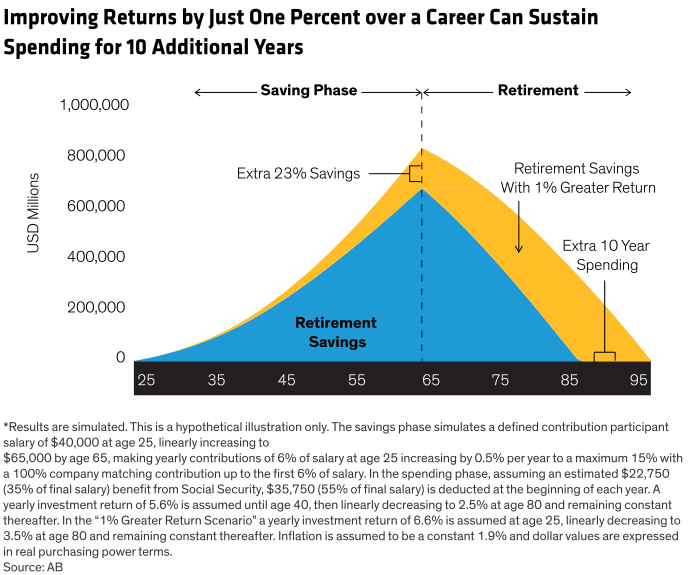
Importantly, these gains don’t require higher employer contributions or increased investment risk. They are driven by disciplined cost management, access to professionally managed solutions like Pooled Employer Plans (PEPs), and the use of lower-cost investment vehicles available exclusively under ERISA.
But where should plan sponsors start? In our experience, the most practical place to begin is with the backbone of the plan itself: the recordkeeper.
Strategy #1: Test the Recordkeeping Market
Most sponsors recognize their recordkeeper’s brand. But what’s less visible is how dramatically the recordkeeping market has evolved.
By the end of 2024, just five firms administered roughly 70% of defined contribution assets in the US.2 That concentration followed years of consolidation and margin compression that rewarded scale. To remain among the largest providers, recordkeepers have invested heavily in technology and pricing efficiency to win and retain business.
Employers who are willing to go to market can turn this dynamic in their favor. Yet many small and mid-sized plan sponsors don’t. More than 60% of plans remain with the same recordkeeper for eight years or longer, well beyond the industry’s best practice of conducting a comprehensive review every three to five years.3
Benchmarking often reveals the opportunity cost of that inertia. Industry studies consistently show that administrative fees can frequently be reduced through competitive repricing, often accompanied by improved participant tools and education capabilities rather than service degradation.4 Advisory relationships reflect similar dynamics.
Put simply, sponsors willing to revisit legacy relationships often find that market evolution has shifted pricing power in their favor.
For some organizations, efficiency gains alone don’t solve the broader challenge. As expectations around governance, documentation, and fiduciary oversight intensify, many small and mid-sized employers face a growing mismatch between what’s required of plan fiduciaries and the internal time and expertise available to meet the challenge.
Keeping pace with regulatory complexity and litigation risk demands a level of specialization that does not always scale with the business. This reality has prompted some employers to think beyond how their plan operates, and revisit how it’s structured.
Strategy #2: Consider a Pooled Employer Plan
Pooled Employer Plans, or PEPs, address that imbalance directly. PEPs build on the framework of longstanding Multiple Employer Plans but remove historical restrictions that required participating employers to share a formal affiliation. Under a PEP, unrelated employers can adopt a single, professionally managed plan while retaining control over core design features like eligibility, matching formulas, vesting schedules, and benefit levels.
The primary advantage is professionalization through scale. By joining a PEP, much of the fiduciary, compliance, and administrative burden shifts to a dedicated plan sponsor. Participating employers report reductions of 50% to 75% in internal time spent managing retirement plan responsibilities.5
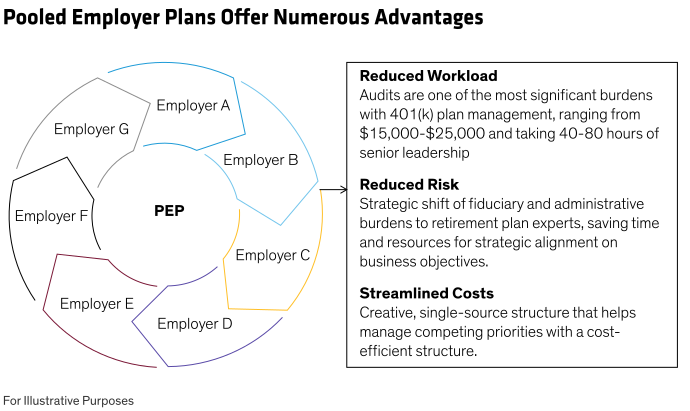
Scale also improves economics. PEPs have reduced per-participant fees by approximately 4% on average, driven by consolidated administration and access to institutional pricing.6 Just as importantly, the structure allows more focus on participant education and engagement without requiring additional effort from the employer.
Assets in PEPs now exceed $17 billion and cover more than one million employees, with adoption accelerating across the small and mid-market, according to the Georgetown Center for Retirement Initiatives. While not appropriate for every organization, PEPs have become a practical alternative when governance demands outstrip internal capacity.
Strategy #3: Modernize Investments Without Paying More
Investment structure is another area where scale and advice materially affect outcomes.
Many institutional investment strategies are available exclusively within ERISA retirement plans. Yet, historically, smaller plans struggled to access them. That’s changing, driven in large part by the growth of Collective Investment Trusts.
CITs resemble mutual funds in portfolio construction but differ significantly in cost. As bank-maintained vehicles designed exclusively for retirement plans, they avoid many of the marketing, registration, and distribution expenses associated with mutual funds. The result is often meaningfully lower expense ratios, which could help explain why CITs surpassed mutual funds as the dominant vehicle for target date strategies by the end of 2025.
Over time, those savings accrue directly to participants through improved net compounding. Many sponsors miss this opportunity not because it is unavailable, but because they are not receiving advice that keeps pace with industry evolution.
Are You Receiving the Right Guidance?
Retirement plans are no longer viewed solely as administrative necessities. Increasingly, they’re strategic assets. The sponsors who benefit most are those willing to challenge assumptions, reassess structure, and align their plans with how the market and their workforce have changed.
A practical place to start? A benchmarking analysis examines how your plan’s fees, governance model, vendor relationships, and investment structure compare with similar plans in today’s market, and where modest adjustments could materially improve outcomes for employees without increasing complexity. There is no obligation to change what is already working. The objective is simply to determine whether the plan has remained aligned—or has quietly drifted as the market evolved.
Your Bernstein Advisor can walk through the analysis, discuss what it indicates, and, just as important, what it does not. Either way, most business owners find the insight invaluable.
[1] AB, “Inside the Mind of Plan Participants,” 2025.
[2] P&I US DC Recordkeeping Report, 2024
[3] PlanSponsor, Recordkeeping Survey, 2024
[4] PlanSponsor, The Why, What, and How of Plan Benchmarking, 2025
[6] Ibid.