

“You get a car! You get a car! Everybody gets a car!” Oprah’s iconic giveaway worked because it was joyful and over the top. Today, the term “family office” feels like it’s having its own Oprah moment, except it’s quieter and sounds more like, “You need a family office.”
Sometimes that’s true, but often, it’s not. The real question isn’t whether your family is “big enough” or “complex enough” to deserve the label. It’s whether you’re at a point where the way you make decisions—and the way those decisions intersect across investments, entities, and generations—needs an upgrade. Here’s a practical way to decide when creating a family office adds value—and when it just adds cost and complexity.
A Family Office Helps Coordinate Decisions
Try not to think of a family office as a corner suite with a nameplate. At its best, creating a family office is a way to make high-stakes choices without forcing the family to relearn the same lessons every time a new opportunity—or a new life event—presents itself. One fourth-generation family member described the moment this way: “We went from being extremely tied down…and no liquidity, to, all of a sudden, a ton of liquidity and no roots.” That feeling of disorientation is often a catalyst—not to build something big, but to build something intentional.
In our work across family office wealth management, we envision a family office as a family entity driven by a common purpose across generations—an organizational tool that helps coordinate investment decisions, financial structures, and the unique foibles that shape a family’s future over time. Trusts, LLCs, advisors, and reporting systems are inputs. But the output you’re seeking is better, faster, more durable decision-making. Put simply, creating a family office is less about headcount—and more about how a family makes informed decisions that will still look astute with the benefit of hindsight.
Why the Family Office Label Can Be Misleading
As we partner with family offices, we frequently encounter two misconceptions that tend to drive expensive decisions. The first is the myth of the physical office: that you need desks, staff, and a standalone organization to “have” a family office. In reality, families can coordinate decisions quite successfully with a lean team of internal leaders and the right external partners—or less effectively with a full team and no clear mandate at all.
The second false impression is the clout narrative: that a “family office” grants an all-access pass to better deal flow, better seats at the table, and a sense of arrival. Access can be useful, but it’s not a mission. If you start with optics, you tend to build infrastructure that looks impressive—until the family needs it to do the real heavy lifting. As one eighth-generation single-family office CEO put it: “Too often people think, well, we need a family office…but they haven’t really asked and answered the most fundamental question, which is why would this exist, and what would we try to accomplish together?”
When Does a Family Office Make Sense?
A family office starts to pay off when “occasional” complexity becomes structurally embedded. That usually shows up as some combination of:
- a very large, diversified balance sheet
- multiple operating businesses or direct investments
- meaningful private-market exposure that requires hands-on monitoring
- cross-border legal and tax issues;
- a multibranch, multigenerational family where more than one person legitimately shares decision authority.
Even then, “in-house” rarely means “all internal.” Well-run family offices choose a few capabilities to own, then plug in specialists where it’s smarter to rent than to hire. For instance, in our Wealth Beyond Measure 2026 report, the top reasons for establishing—or consider establishing—a family office included professionalized financial and administrative oversight (69%) and centralized management of family wealth and investments (62%). In other words, it’s less about prestige, and more about running the family’s financial life the way it deserves to be to run.
How Family Offices Can Professionalize in Stages
Most families don’t wake up one morning and “need a family office.” They hit an inflection point—often a sale, recapitalization, major inheritance, or rapid growth in liquid assets—and suddenly the old way of handling things starts to feel outdated. A useful way to think about the journey came from a senior leader of a multigenerational family office who described three phases. “The first one being, we really don’t have anything…the second phase, we’re backfilling a lot of things and refining a lot of things. And then the last one is the mature office that’s just been humming along.”
One of the most reliable signals that it’s time to evolve isn’t the number on the balance sheet—it’s the weight of the decisions. When one choice (a concentrated sale, a large gift, a new private investment, a move to a different state or country) ripples through taxes, governance, cash flow, and family dynamics, families usually benefit more from upgrading their advisory bench than from adding more infrastructure. Experienced family-office leaders tend to echo this view. When we asked what advice they would give others, respondents most often emphasized clearly defining the family office’s role (63%) and building a strong team of internal staff and external advisors (50%). Many also urged families to implement governance early (38%).
A Quick Family Office “Self-Check”
To determine whether you’d benefit from creating a family office, ask yourself (and your family) a few direct questions:
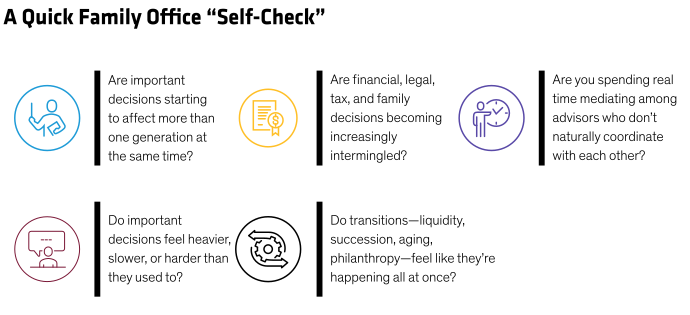
If only one—or none—of these resonates, adding infrastructure may introduce more burden than benefit.
Build the Minimum Family Office That Makes You Better
The point of creating a family office is to reduce avoidable mistakes, friction, and family strain as decisions compound over decades. For some families, that will mean a fully staffed office, but for many others, it will mean a lighter model. Between doing nothing and building a fully staffed office, there is a wide—and often underappreciated—middle ground. Many families thrive there for years.