

Recent tax legislation reflects a federal focus on encouraging risk-taking and innovation through generous, often permanent tax incentives. The expansion of Qualified Small Business Stock (QSBS) is a prime example—allowing founders and early-stage investors to potentially eliminate federal taxes on millions in gains.[1] But while federal priorities are clear, states haven’t always followed suit.
New York’s recent (though ultimately withdrawn) proposal to tax gain excluded federally under QSBS underscores a growing challenge: states are no longer automatically adopting federal tax rules.[2] And the risk is no longer hypothetical. Maine and Oregon have enacted legislation decoupling from the federal QSBS exclusion, while similar efforts have surfaced in Washington state and the District of Columbia.[3] Meanwhile, several states, including California, have long taxed QSBS gains.[4]
QSBS isn’t the only point of departure. States are increasingly adopting a provision‑by‑provision approach to other major federal incentives, including Qualified Opportunity Funds, bonus depreciation, and research and experimental (R&E) expensing. That means founders, investors, family offices, and their advisors must factor in state conformity risk when evaluating the true after‑tax value of federal tax incentives.
QSBS as the Flashpoint
QSBS remains among the most powerful planning tools available to founders and early‑stage investors—permanently excluding the greater of $10 million or $15 million, or 10x basis, from federal capital gains tax on the sale of qualifying domestic C corporation stock (the figure varies depending on when the stock was issued).
Now, new tax legislation known as the One Big Beautiful Bill Act (OBBBA) meaningfully expands this benefit, maintaining the five-year holding period for stock acquired on or before July 4, 2025 but introducing a graduated holding period for stock acquired after.[5] The law also reopens QSBS eligibility for many scaling companies and adds flexibility around capital raises, equity compensation, and exit planning.
The upshot? For those who qualify, QSBS has become even more compelling—making it that much more costly when states fail to conform.
The Economic Impact of State Conformity
QSBS has become the most visible, and economically consequential, example of post-OBBBA federal-state divergence.[6] Some states conform fully, others partially, and some eliminate the state-level QSBS benefit entirely by adding back gains excluded federally under § 1202.
The after-tax impact—across low‑, medium‑, and high‑tax jurisdictions—illustrates just how costly this schism can be. Federal QSBS delivers meaningful tax savings regardless of state, but state conformity materially enhances QSBS’ value, particularly in higher tax jurisdictions. Conversely, when states decouple, the benefit can be reduced by millions on a single transaction.
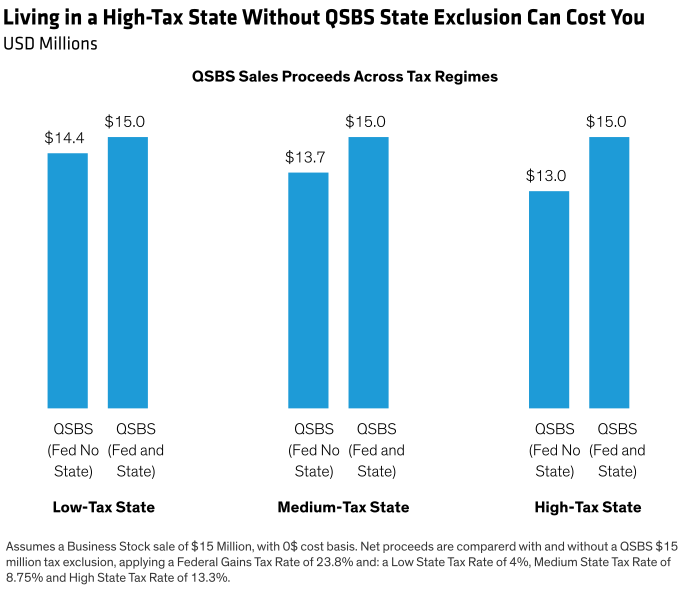
In short, QSBS eligibility is only half the analysis. A taxpayer’s state of residence—and whether that state conforms to federal treatment—can be just as consequential as satisfying the federal requirements.
What’s more, while QSBS is the most visible example today, it is far from unique. As budget-constrained states increasingly revisit federal tax breaks as a way to raise revenue, “conformity risk” has emerged as a core planning variable alongside traditional eligibility requirements.
Qualified Opportunity Funds: A Parallel Disconnect
Qualified Opportunity Funds (QOFs) offer a useful comparison. Federally, Opportunity Zone investments may allow investors to defer capital gains and enjoy a potential step-up in basis (subject to timing) while excluding post-investment appreciation from federal capital gains tax when the asset is eventually sold.[7]
Yet, state conformity has long been uneven. Some states never adopted the Opportunity Zone tax incentive, while others conform partly or impose limitations. As a result, taxpayers may end up deferring gains federally while recognizing them immediately at the state level.
Now, prevailing fiscal pressures have made this disconnect more meaningful, as states are increasingly scrutinizing capital-gain relief incentives like those for QOFs when their revenue is at risk.
Bonus Depreciation: Permanent Federally, Limited by States
Similarly, the OBBBA made 100% bonus depreciation permanent and broadened the types of property that qualify, allowing capital-intensive businesses to speed up their federal tax deductions and boost cash flow.[8]
But states haven’t been as generous. Several reject bonus depreciation, forcing businesses to add back deductions or use different depreciation schedules—even in states that generally adopt federal rules.
For operating businesses, particularly those that may later generate QSBS‑eligible stock, this divergence affects near‑term cash flow, long‑term valuation, and the financial outcome when selling. Put simply, just because the federal government lets you quickly expense cost of eligible property and equipment, it doesn’t mean your state will.
R&E Expensing: Federal Relief Meets State Resistance
The OBBBA brought back the ability to immediately expense domestic research and experimental (R&E) costs, undoing the TCJA’s requirement to capitalize these expenses. This change is aimed at giving a permanent boost to innovation.
However, states have responded differently. Some that generally follow federal tax rules adopted this change right away, while others chose not to conform or only did so partially or with delays to protect their tax revenues. For growth-stage companies—many of which may eventually qualify for QSBS—this creates timing gaps, higher taxable income at the state level, and added challenges when planning and forecasting.
Across QSBS, Qualified Opportunity Funds, bonus depreciation, and R&E expensing, the pattern is consistent: large and often permanent federal benefits are coming under intensifying scrutiny from state legislatures as the near-term hit to state revenue becomes more apparent. As a result, states are moving away from passive conformity and toward provision-by-provision decoupling, particularly for incentives tied to capital gains and accelerated deductions.
What This Means for Founders, Investors, and Family Offices
Federal eligibility for incentives like QSBS no longer guarantees your expected outcome—state tax treatment can significantly impact after‑tax proceeds. What’s more, where a taxpayer lives matters: the same exit can produce very different results depending on state rules. As a result, QSBS and exit planning must be tailored to each state, with conformity risks assessed early on rather than as an afterthought.
The post-OBBBA landscape makes clear that treating QSBS and other federal incentives as purely federal planning exercises is no longer viable. States are increasingly reevaluating high-value federal tax benefits through a revenue lens and are willing to diverge from conformity when the stakes are high. This trend extends beyond QSBS to other provisions like bonus depreciation, R&E expensing, and Qualified Opportunity Funds, where state adoption varies widely.
The key takeaway? State conformity risk is now a fundamental planning factor that can materially affect exit economics and long-term capital strategy. For taxpayers assuming federal tax benefits automatically apply across state lines, the OBBBA era serves as a clear reminder—sometimes, the benefit stops at the border.
[1] IRC § 1202(a), (b), (c).
[2] New York Senate Bill S8921A (2026) (proposed amendment to N.Y. Tax Law § 612; FY 2027 New York State Executive Budget Revenue Article VII Legislation
[3] Me. Rev. Stat. tit. 36, § 5122(1)(UU); Or. Rev. Stat. § 316.047; D.C. Code § 47‑1803.03(a)(4)(A) (Congressional disapproval pursuant to U.S. Const. art. I, § 8, cl. 17).
[4] Cal. Rev. & Tax. Code §§ 17024.5(a)(1)(E), 18038.5(a)(1)(E).
[5] IRC § 1202(a)(1); former IRC § 1202(a)(2).
[6] One Big Beautiful Bill Act, Pub. L. No. 119-21 (effective 2025).
[7] IRC § 1400Z‑2(a), (c).
[8] IRC § 168(k), as amended.
Talk to Us About Your Tax Situation
Connect with our specialists for customized solutions.