

Thanks to recent changes in the tax code, founders, employees, or investors who receive stock in small businesses may be eligible for significant tax savings under the Qualified Small Business Stock (“QSBS”) exclusion—if certain requirements are met. However, QSBS eligibility partly hinges on when the stock was issued, otherwise known as the “Original Issuance” requirement, and how it intersects with the choice of a business entity.
Understanding the Original Issuance Test
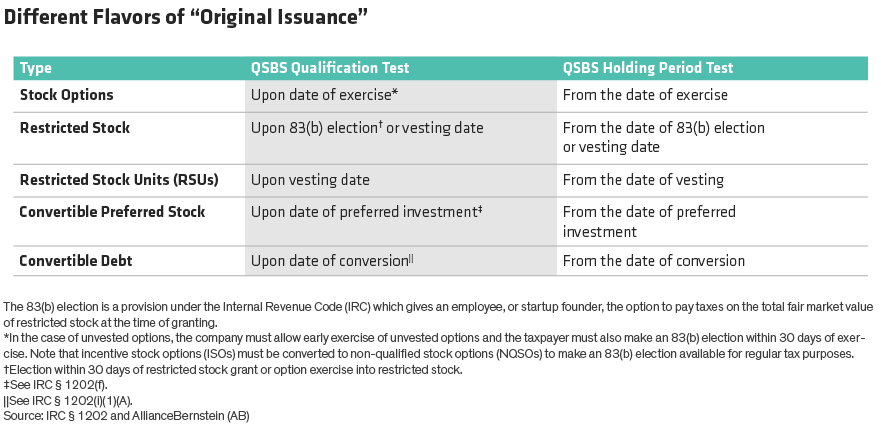
To qualify for the QSBS exclusion at the time of a stock sale, a taxpayer must hold “original issue” C corporation stock for more than five years if the stock was issued on or before July 4, 2025, or at least three years1 for a partial exclusion if the stock was issued after July 4, 2025. In addition, the issuing company must be an “active business” for substantially all of the taxpayer’s holding period. When does issuance occur for the purposes of QSBS for C corporations? The answer is straightforward—when a C corporation issues shares directly to a founder or an investor. However, determining issuance gets more complicated if:
- the corporation grants stock options, restricted stock, or restricted stock units
- the investment capital is structured as a convertible note or as a simplified agreement for future equity (“SAFE”)
In these less straightforward cases, determining when the holding period begins varies (Display).
For those meeting the requirements for QSBS eligibility, the amount of gain available for tax exclusion—whether it’s 0%, 50%, 75%, or 100%—depends on both the date of issuance and meeting the holding period requirement.2 But timing matters in other ways when it comes to QSBS for C corporations, especially when it comes to the choice of business entity.
What Is the Impact of Business Entity Choice?
Clearly, the potential back-end income tax benefits afforded under Section 1202 should not be the sole driver of whether a business is structured as a C corporation, S corporation, or LLC. But given the power of the incentive, it’s worth factoring into the analysis. As a business owner, there are various benefits to launching as an S corporation or LLC. For instance, many founders like the single layer of taxation provided through an S corporation, while others prefer the flexibility of the LLC structure. However, only the original issuance of C corporation stock counts for QSBS eligibility.
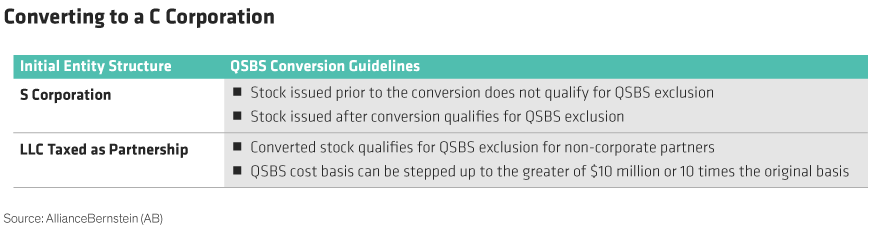
What if a business starts out as an S corporation or LLC and then converts to a C corporation?
In the case of an S corporation, stock issued prior to the conversion would not qualify for the QSBS exclusion. However, stock issued after the conversion would—assuming other QSBS requirements are met.
In contrast, LLCs taxed as partnerships are treated differently. Conversion to a C corporation could allow non-corporate partners to qualify for the QSBS gain exclusion (on post-conversion appreciation). A less obvious potential benefit for LLC conversions? They use the fair market value of the LLC interests at the time of conversion when calculating the potential QSBS gain exclusion. In this instance, the basis is determined by the greater of $10 million or $15 million, or 10 times the aggregate adjusted bases of the qualified small business stock issued by such corporation and disposed of by the taxpayer during the year.
For example, if a partner’s LLC interest is valued at $3 million at the time of conversion, the partner’s maximum QSBS gain exclusion would increase to $30 million. Importantly, the QSBS holding period starts upon conversion. That means the business owner must satisfy the full post‑conversion holding period—five years for stock issued on or before July 4, 2025, and three, four, or five years under the 50%, 75%, and 100% tiered-exclusion regime for stock issued after July 5, 2025—before exiting, to unlock the QSBS benefit.
Why QSBS for C Corporations Are Gaining Momentum
Determining QSBS eligibility demands careful consideration of the “Original Issuance” requirement, the type of entity structure initially chosen, and whether the entity is subsequently converted into a C corporation. The tax law changes that went into effect at the end of 2017 significantly reduced the top tax rate of C corporations to 21%, thus lowering the tax penalty of C corporations relative to pass-through entities. Now, the new provisions introduced as part of the OBBBA make QSBS even more attractive. For those looking to take advantage of a potential QSBS exclusion, the formation of and conversion to a C corporation is likely to become more popular.
[1] As part of the One Big Beautiful Bill Act, an investor can qualify for QSBS for C corporations tax treatment after three years where they will receive a 50% benefit and be able to avoid $7.5 million of gains, four years with a 75% benefit where they can avoid $11.25 million in gains, and five years with a 100% benefit where they can avoid all $15 million in gains.
[2] For stock issued on or before July 4, 2025, an investor can exclude a certain percentage of the gain up to $10 million as follows: 50% of gain may be excluded if stock was acquired between August 11, 1993 and February 16, 2009, 75% of gain may be excluded if stock was acquired between February 17, 2009 and September 27, 2010, and 100% of gain may be excluded if stock was acquired after September 27, 2010.
Advice for Business Owners
Learn more about our focus on entrepreneurs and the professionals advising them.