

2026 is set to be a breakout year for the burgeoning space economy. NASA’s Artemis mission has already shattered records by sending the first crew beyond low Earth orbit since 1972, notching the longest distance in human spaceflight ever. Meanwhile, your smartphone now offers satellite coverage, and SpaceX is on the brink of revolutionizing launch costs with its Starship rocket. As satellite mega-constellations reach full scale, the commercial potential of space is just beginning to unfold.
But what does this mean for investors? As the cost of space launches plummets and extraterrestrial activities ramp up, the space sector is transforming from a distant dream to a tangible investment frontier. The real question is: where will the profits lie? Will they come from the innovative goods and services offered from space, or from somewhere else along the value chain?
As we explore investing in the space economy, it’s clear that both medium-term and long-term ventures, as well as public and private markets, will all play a role. To truly grasp the potential, investors should follow the money, starting with consumer and business services provided from space, then diving deeper into the intricate layers of this nascent industry.
Opportunities in Space-Based Observation and Data Services
The first subsector delivering revenue and value to the broader economy is space-based observation and data services. To use the internet as an analogy, think of this as the “app layer,” or the one you interface with every day.
While you’re probably familiar with GPS navigation, the next generation will be increasingly dynamic. Instead of just tracking your car’s location, satellite navigation will likely underpin autonomous driving networks. What’s more, satellite communications are already proliferating, from Starlink in developing countries, satellite internet on flights, and now satellite voice and data services on your phone.
But it doesn’t stop there. Other examples include satellite imagery and analytics providers like Planet Labs and Maxar, whose data can be used for agriculture, mapping, insurance, disaster response, defense, and supply-chain monitoring. Beyond “taking pictures from space,” the bigger opportunity comes from turning persistent, high-frequency observations into useful data: crop health, port activity, wildfire risk, methane emissions, and other indicators that can be monetized across industries.
Investing in Satellite Constellations/Network Operators
Just as mobile internet wouldn’t function without cell phone towers, you can’t have a space sector without satellite infrastructure. That’s why satellite constellations and networks serve as the backbone for the entire sector.
Though capital intensive, these networks could become relatively strong franchises, given their combination of protective regulatory barriers and recurring revenue from the services built on top of them. One area to watch? How the assets and operations are structured. Will the sector evolve like terrestrial telecom, with tower companies and cellular networks split apart, or will it prove more efficient to keep those functions bundled together?
Here, the competitive landscape includes broadband and communications constellations like SpaceX’s Starlink, Amazon’s Project Kuiper, Iridium Communications, Globalstar, EchoStar, Eutelsat OneWeb, SES’s O3b mPOWER, Viasat/Inmarsat, and other multi-orbit networks. Alternatively, in some areas governments may run networks, like the EU’s IRIS.2 Ultimately, the key investment question is not just who builds the networks, but who captures the lasting economics around them.
What About Space-Based Data Centers?
In the past few months, as the AI data center boom has run into real-world constraints, some have speculated about launching data centers in space. At first glance, the idea seems smart. There’s plenty of room (eliminating NIMBY issues) and space is cold (which one would think would make it easy to cool them). But a closer look at the laws of thermodynamics suggests cooling could be a major challenge in space, where there is no air or water to absorb heat. So, is the idea of space-based data centers realistic or not?
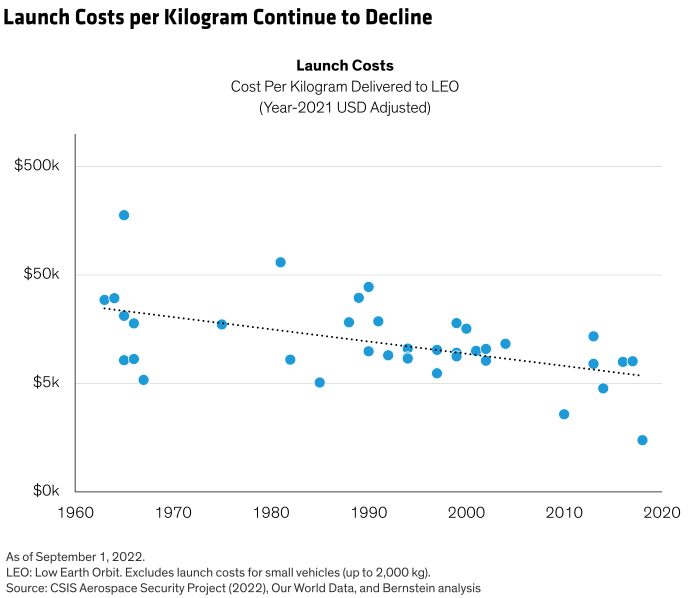
While we don’t personally hold PhDs in engineering, we work with people who do. Skipping over the Stefan-Boltzmann Law, the takeaway for investors is that with declining launch costs per kilogram and ongoing improvements in data center efficiency, space-based data centers may prove viable in the next few years (Display). Potential players in this subsector include SpaceX, Axiom Space, and Starcloud.
Will Space Tourism Take Off?
For those who grew up watching Star Wars, Star Trek, or even Zenon: Girl of the 21st Century, space travel was likely a dream. Now, it’s increasingly becoming a reality. Even Katy Perry has taken a suborbital flight. Is this the new Everest or safari?
We’re slightly skeptical of the market’s prospects over the next decade, though more optimistic for the decades to follow. Despite falling launch costs, a trip to space could still cost around $100,000 per person. This could eventually make space tourism a high-single-digit or low-double-digit billion-dollar revenue opportunity.
Key players include suborbital flight providers like Blue Origin and Virgin Galactic, and orbital missions enabled by SpaceX’s Crew Dragon, with bookings from Axiom Space, the Polaris Program, and Space Adventures. Over time, the market will likely diversify into brief suborbital flights, multi-day orbital missions, private-station visits, and eventually more ambitious expeditions.
Profiting from Expanding Launch Operations
Doing anything from space requires getting there first. That’s why addressing the bottleneck in launch services is critical to the expansion and maturation of the industry.
Prohibitively expensive launch costs have always limited the potential for space-based operations. Hence, space was reserved for governments or extremely well-capitalized business ventures (which also had a history of defaulting on their debts). As launch costs have fallen, new opportunities have emerged—and continued declines should make even more ideas economically viable (Display).
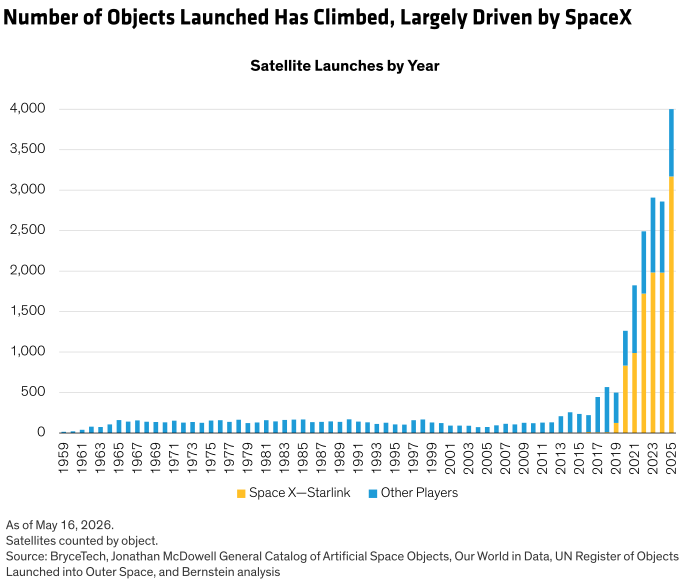
Think of launch as the toll road to orbit—every satellite, space station module, lunar lander, or orbital compute platform must traverse it somehow. But it’s also the part of the value chain most exposed to the economics of scale, reusability, and competition. If launch capacity remains scarce, launch providers may capture meaningful value; if cadence rises and prices fall sharply, launch may increasingly become an enabler of value elsewhere in the ecosystem.
Competitors in this segment include SpaceX, Rocket Lab, United Launch Alliance (ULA), Arianespace, Blue Origin, Firefly Aerospace, Relativity Space, and national or quasi-national launch providers like emerging Chinese commercial players and ISRO.
Will In-Space Infrastructure and Services Deliver Value?
With all the hardware and electronics being launched into space, maintaining and decommissioning these assets could become a small but important market.
Think refueling, inspection, in-orbit servicing, repositioning, debris removal, docking systems, space tugs, lunar landers, commercial space stations, and eventually in-space assembly or manufacturing. Who will provide these programs? Northrop Grumman’s Mission Extension Vehicle heritage, Voyager’s orbital platforms and components, Axiom Space’s modules, Astroscale’s debris-removal focus, D-Orbit’s orbital-transfer services, Momentus-style space-tug concepts, and Firefly’s lunar-lander activity, among others.
The Economics of Satellite Manufacturing
With an imminent SpaceX IPO and a host of legacy satellite manufacturers already publicly traded, this corner of the industry is one of the most accessible to investors today. For legacy manufacturers, upcoming launches represent a revenue opportunity. For SpaceX, by contrast, launches are a cost, while the revenue is earned over the operating lives of the satellites once they enter service.
It’s important to distinguish between the satellite bus and the payload. The bus is the standardized platform that supplies structure, power, telemetry, and control, while the payload performs the mission—communications, sensing, processing, missile warning, or other specialized functions. As small-satellite production scales, the bus may become more commoditized, while the payload and software layer may retain more value.
Key satellite players include legacy aerospace and defense manufacturers such as Lockheed Martin, Northrop Grumman, Boeing, Airbus, BAE Systems (Ball Aerospace), Thales Alenia Space, and L3Harris, as well as more specialized or newer entrants such as Astranis, York Space Systems, Terran Orbital, Sierra Space, and Rocket Lab.
Could Ground Systems Be a Good Angle?
Ground systems comprise the final pure-play piece of the space puzzle. From mission control centers for launch to the dishes that communicate with satellite networks, these assets and services are vital to the space ecosystem.
The less glamorous but essential terrestrial layer includes ground-station operators and communications-equipment providers like Kongsberg Satellite Services, Swedish Space Corporation, Viasat/Inmarsat, Hughes Network Systems, Gilat Satellite Networks, Comtech, and Kratos.
What About Component Manufacturers?
Following the money back to the far end of the value chain, giant assets like rockets, satellites, and ground systems comprise many smaller pieces of hardware. Each of these components is likely to be mission critical, and specific to the job at hand. Some will require significant production scale; others will be more customized. This is perhaps the most obvious way for legacy industrial companies to benefit from the growing space economy. At the same time, the companies serving this market tend to be broadly diversified across customers, products, and end markets. That means the potential for supplying the space sector will be just one driver of earnings growth in years to come.
Components include propulsion systems, avionics, sensors, solar arrays, batteries, radiation-hardened semiconductors, optical systems, antennas, thermal systems, reaction wheels, valves, connectors, composite materials, and precision manufacturing. Currently, these are supplied by diversified aerospace and industrial companies like RTX, Honeywell, Teledyne, Moog, L3Harris/Aerojet Rocketdyne, HEICO, TransDigm, Garmin, and other specialized component makers.
Ready to Blast Off?
The space industry is shifting from dreams to dollars. While rockets still inspire awe, investors should follow the cashflows. Who owns the infrastructure? Who controls customer relationships? Who enjoys recurring revenue? Who gains as launch costs fall—and who loses out? Ultimately, where does value accrue?
With industry revenues potentially increasing by an order of magnitude in the next two decades, the space economy could offer enticing opportunities, in our view. But the rewards won’t be evenly distributed. Some will be public, others private. Some are established businesses; others are bets on future technologies or markets. Some are nestled within diversified companies, while others attract investments due to exciting narratives rather than solid economics.
That distinction matters. The future of space is less about science fiction and more about smart capital allocation. Investors don’t need to own every company or even every part of the value chain. Instead, they need to pinpoint where falling launch costs, increased activity, commercial adoption, and societal benefits create durable revenues and defensible returns. That’s how our portfolio managers will be approaching this promising sector.