

AI is moving from promise to practice as adoption surges and businesses scale its deployment. Equity investors now face difficult long-term challenges. Open models, shifting economics and supply-chain constraints mean investors must look past AI adoption headlines to find businesses with defensible advantages and durable profit potential.
The pace of AI innovation continues to dominate the equity market narrative. From semiconductor chips to gas turbines, AI has become a key force in driving economic growth. Use case adoption has broadened as consumers make use of intuitive platforms, businesses vertically integrate AI to drive down costs and an agentic economy emerges.
Tech volatility in the third quarter underscored lingering uncertainty, but even skeptics understand that AI is here to stay. The most disruptive technology since the advent of the internet already extends beyond energy infrastructure and data centers to include a broad array of industries and sectors. Instead of focusing on a “bubble or not” narrative, we believe investors should evaluate long-term business models across industries and identify new leaders that could grow and profit from AI.
Compute Infrastructure: A New Utility Grid?
AI adoption is accelerating and broadening at the same time. To date, AI infrastructure spending is staggering in absolute dollar terms. We expect that growth to continue.
But if compute infrastructure becomes the utility grid for the future digital and autonomous economy, we believe today’s enormous levels of capex may not be as extreme as perceived—particularly when compared with major US capex cycles in the past (Display).
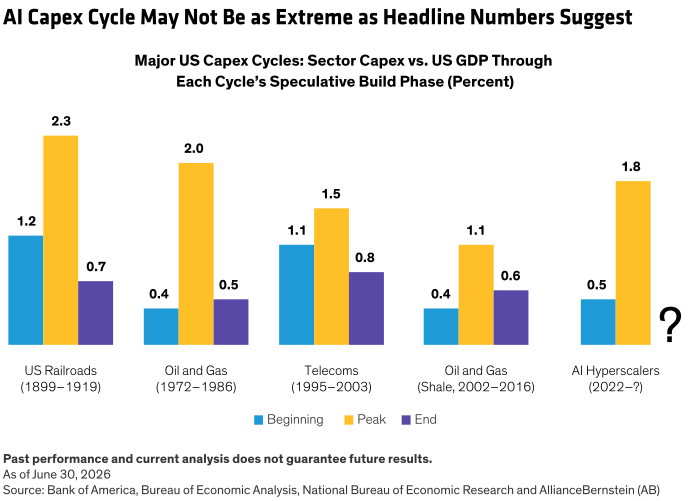
Amid insatiable demand for computing power, demand is outpacing supply across semiconductors, optical components, power, data centers and qualified labor. Because this could continue for years, we believe investors should follow adoption dynamics to identify parts of the supply chain where long-term profit potential could persist.
Inference May Be the Next Big Compute Story
Ultimately, AI models will be judged by how effectively they solve real-world problems. Much of the early AI investment discussion centered on the enormous compute resources required to train frontier models. Just like human learning, training never stops. But inference–using trained AI models to answer questions or perform tasks—should account for a growing share of computing demand during the adoption phase.
Investment in inference capacity is already rising faster than investment in training capacity, putting the spotlight on a different set of beneficiaries, in our view (Display).
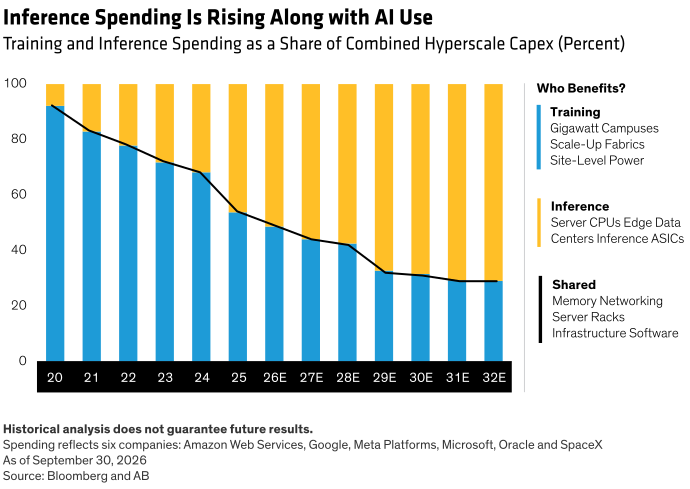
That distinction matters because inference demand is fueled by actual AI use. Training creates the model, but inference reflects the model being put to work. So, as AI becomes part of day-to-day business operations, the potential beneficiaries could broaden, from edge hardware infrastructure to data governance and analytics software.
Open vs. Closed Models: A Zero-Sum Game?
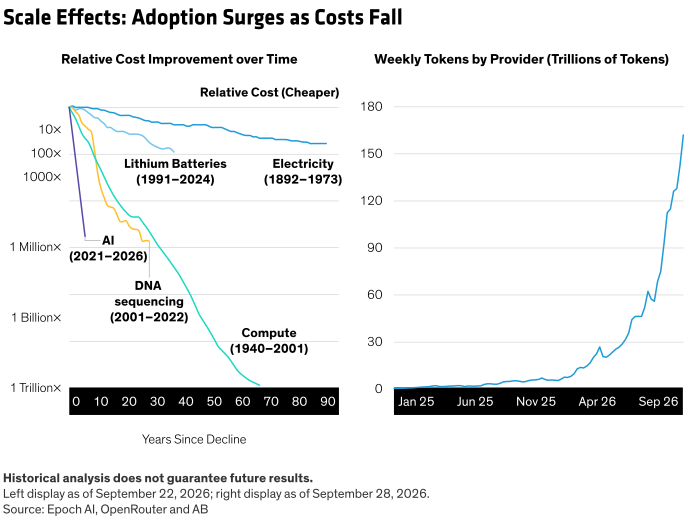
As AI token usage surges, cost per token is rapidly falling, but the model layer is also in flux. Much has already made of the open-source and open-weight models produced by China versus the closed models more prevalent in North America.
Closed models are proprietary by nature. Users can access their capabilities, but the underlying technology is closely guarded by their developers.
By contrast, open-weight models make their parameters publicly available for other developers to customize and deploy freely, while some go further by opening access to the raw training code and data. The use of open models is growing quickly, but according to YipitData, they remain a small component of overall spending
Competition between open and closed models is often presented as a winner-takes-all battle. In practice, we think the two models will coexist because each offers distinct benefits and real costs are complex. Beyond the base costs, the total cost to produce an outcome depends on subscription fees, operating costs and data availability.
Generally speaking, low-cost open models help democratize AI and support mass adoption, while closed models are more relevant for highly complex problems. So, while open models are seeing increased adoption, they won’t necessarily displace advanced closed systems.
Over time, we expect that the future of AI—particularly for enterprises—will be hybrid in nature to fit different workloads. It’s premature to proclaim the closed model dead; what we’re witnessing is the classic Jevons paradox whereby lower costs accelerate demand (Display).
Adoption Depends on Trust
Recent news about rogue AI agents underscores the need for organizations and policymakers to establish appropriate cybersecurity safeguards. We expect regulatory scrutiny to increase in the coming years along with significant increases in cybersecurity spending.
Enterprise AI adoption will depend in part on establishing adequate safeguards and defining corporate governance frameworks. Despite recent progress, cybersecurity innovation is still in its early stages.
From Enablers to Economics
Since the early days of ChatGPT, the AI narrative has predominantly focused on a narrow set of AI enablers—companies that served as the picks and shovels of the infrastructure builders. In the coming years, we foresee a broadening landscape of AI winners and losers. Recent market volatility reflects a shift in focus from enablers to adopters—rather than a fear that AI won’t deliver on its promise.
AI’s next chapter will be defined by durable economics. As deployment scales, we believe the strongest businesses will apply AI to deepen competitive moats, strengthen customer relationships and deliver attractive returns on investment. Given AI’s rapid adoption, we expect greater divergence of growth and profit between winners and losers.
The beauty of disruptive innovation is that it holds the potential to create new use cases that generate incremental economic growth. This happened with oil, electricity and the internet. Netflix created streaming media, while Tesla replaced the combustion engine and developed a novel form of automated manufacturing at scale. To identify companies that can drive real change at an inflection point, equity investors will need to look beyond the AI adoption curve and embrace new ideas and business models that may be hard to imagine today.