

From Paris to Marseilles, public unrest over the cost of living across France in mid-October underscored the political challenge facing a government under pressure to repair public finances without intensifying social strains. France’s widening sovereign spreads reflect those mounting fiscal and political risks. Even so, we think today’s backdrop differs materially from the 2011–12 eurozone sovereign-debt crisis.
While concerns are warranted, the European Central Bank (ECB) has more tools today to prevent a full-blown debt crisis. As a result, we think recent market dislocations may create selective investment opportunities in French government debt.
Fiscal Strains Are Harder to Ignore
Global bond yields have surged recently as stronger growth, AI-related investment and mounting scrutiny of public finances have unsettled sovereign-debt markets. In Europe, France is in the spotlight: Since September, the spread between French government bonds and German Bunds has widened to its highest level since the eurozone sovereign-debt crisis. While the move doesn’t reflect new domestic developments, it signals growing investor unease with a steadily deteriorating fiscal position.
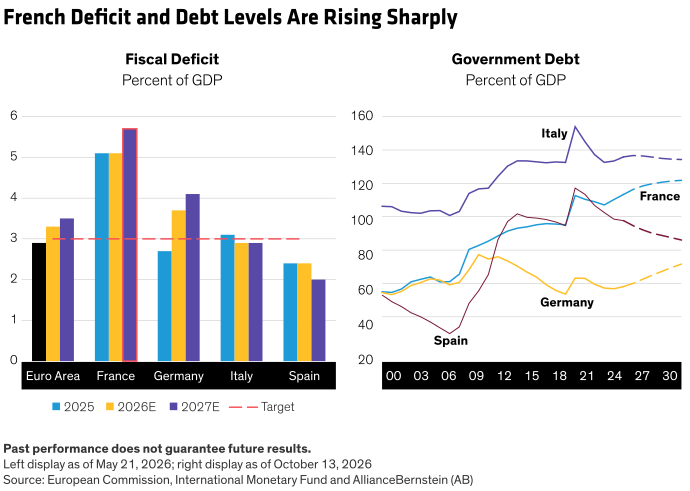
France’s budget deficit continues to rise. It hit 5.1% of gross domestic product (GDP) in 2025 and is expected to climb further to 5.4% in 2026, well above the government’s target of 4.9%–5.0% (Display). Public debt is projected to exceed 120% of GDP over the medium term, approaching Italy’s much higher starting point. Even in a region where debt ratios are elevated, France is a clear outlier.
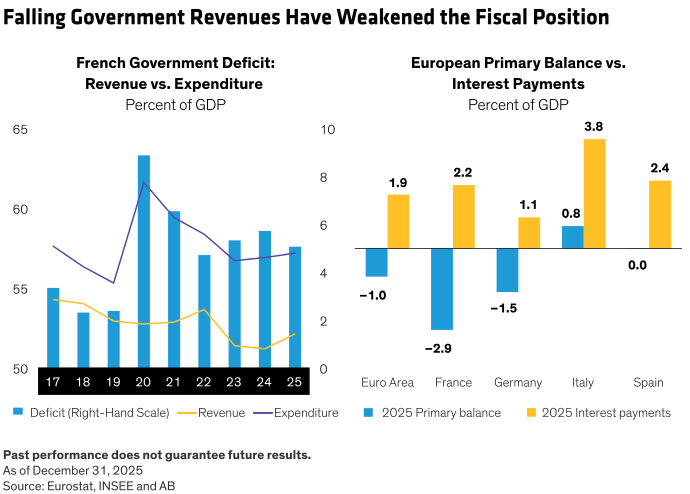
High spending is only part of the problem. Government expenditure represents 57.3% of GDP, the highest in the region, while revenues have structurally declined over the past decade (Display). A failure to finance tax cuts for households and companies has left revenues 2.2 percentage points below their 2017 level. According to the OFCE, the French Economic Observatory think tank, a deterioration in the primary balance accounts for about 80% of the deficit’s widening. That makes France’s fiscal gap more structural—and potentially harder to reverse—than those of many European peers.
Politics Complicate the Job
Political instability has magnified these concerns. Since 2024, a divided parliament has struggled to agree on a credible consolidation path. The presidential election in spring 2027, followed by parliamentary elections in June, adds uncertainty about the path for public finances. Markets are likely to remain sensitive to proposals that could widen the deficit or weaken the commitment to fiscal repair. Ongoing protests will pile pressure on to an already difficult political backdrop.
These challenges warrant a risk premium in French debt. But, as we see it, they don’t necessarily point to a replay of the 2011–12 sovereign-debt crisis.
Can Europe Absorb a Shock?
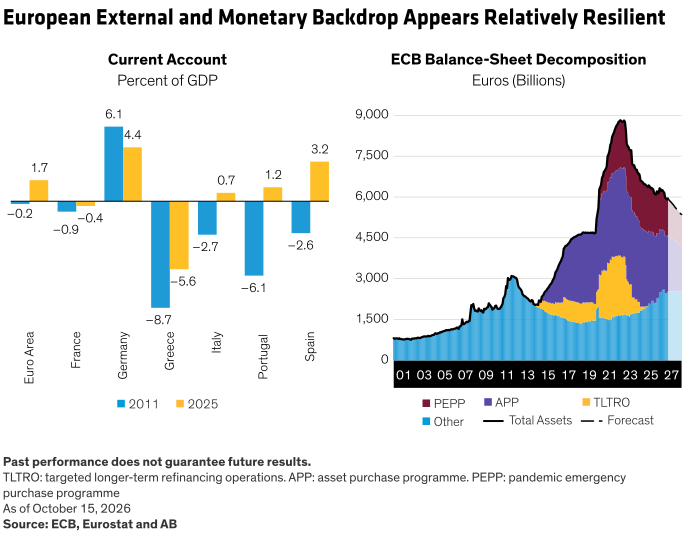
Back then, large fiscal and current-account deficits left several euro-area economies dependent on external financing. Today, France’s current-account deficit is much smaller than the imbalances seen across the periphery 15 years ago (Display). The regional backdrop is healthier too. Spain, once at the center of the crisis, has become an important driver of euro-area growth, while fiscal positions elsewhere reduce the risk of contagion from French stress.
The financial system is also less vulnerable to the negative feedback loop that intensified the earlier crisis. Banks have lower and less spread-sensitive sovereign exposure, and a larger share of their government-bond holdings is carried at amortized cost. This helps insulate bank capital from mark-to-market volatility. France, meanwhile, continues to enjoy reliable market access, as strong demand at recent government-bond auctions demonstrates.
ECB’s Toolkit Has Expanded
The ECB is also better prepared. If disorderly moves in French bonds tightened financial conditions more sharply than expected, the ECB could first adjust quantitative tightening (QT) under its pandemic emergency purchase programme (PEPP). Because PEPP reinvestments can be deployed flexibly across countries, the ECB could favor French securities while maintaining the portfolio’s overall pace of balance-sheet reduction. It could also pause QT more broadly if sovereign yields threatened monetary-policy transmission.
The Transmission Protection Instrument, created in 2022 to counter “unwarranted, disorderly market dynamics” that posed a serious threat to the regional transmission of monetary policy, is probably a more distant option. Its activation bar is high, and eligibility includes compliance with the European Union’s fiscal framework—a potential obstacle for France. Current spreads also remain below levels that previously elicited a forceful ECB response.
We think adjustments to PEPP reinvestments or a pause or adjustment to QT are the more likely first steps. That said, the ECB has pledged in the past to do “whatever it takes” to stem significant and widespread sovereign distress—a scenario that we think is still unlikely.
Evaluating the Sell-Off
Investors shouldn’t dismiss France’s fiscal problems. Its debt trajectory is unfavorable, and political constraints are real. Even so, we believe the speed and scale of the sell-off may have pushed valuations beyond what the fundamentals alone justify.
Belgium offers a useful comparison. Its fiscal deficit exceeds 5% of GDP, debt is similar and its political system is also fragmented. Yet the Belgium–France spread has widened to more than 50 basis points, suggesting that technical factors and positioning—not just fiscal fundamentals—have shaped relative valuations.
Volatility May Be Creating Value
French government-bond spreads over Bunds are now comparable with those of some BBB-rated corporate bonds, despite France retaining a higher, average single-A rating profile. Momentum-driven investors appear to have amplified the move, leaving short positioning elevated. As a result, even a modest improvement in sentiment might produce some spread tightening, in our view.
To be sure, we don’t expect French sovereign spreads to return to their previous levels. France faces a difficult fiscal adjustment and an uncertain political path. But much has changed since 2011–12, and we think a systemic European crisis is unlikely. For active bond investors, that argues for selectivity—not complacency or wholesale avoidance. At today’s spreads and all-in yields, volatility may be creating opportunities to add French sovereign exposure while remaining alert to policy developments and downside risks.