

Precious metals have gone wild recently. Even after its recent slide, gold currently sits at around $5,000/oz, up 170% in just over three years. Meanwhile, silver went on a 190% tear from the end of August through late January, before giving back a quarter of its price over the past week or so.
Given the magnitude of gold’s three-year move, the recent sharp turn in the gold-silver ratio has been all the more astounding to watch (Display).
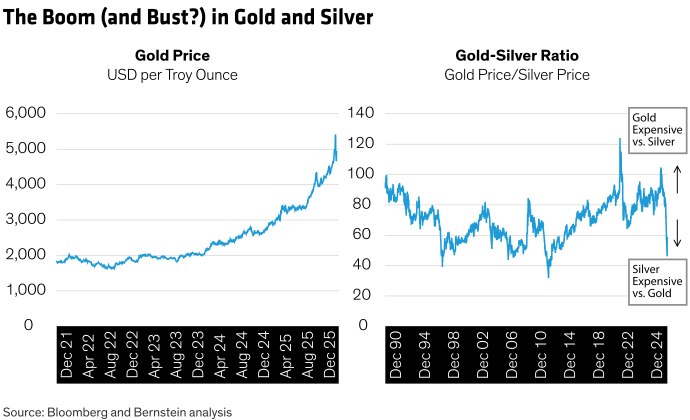
Some of this rally has been fundamentally driven. But much of it—particularly the short-term boom-bust in silver—has been speculative, in our view. That’s not to say gold and/or other precious metals should be dismissed. Instead, the question becomes: Do they belong in a long-term portfolio? And if so, what role should they play after their recent run?
What’s Driven the Rally in Gold?
In recent years, four main forces have fueled gold’s strong showing:
- Chinese central bank buying, which picked up in mid-2022, pushed prices modestly higher.
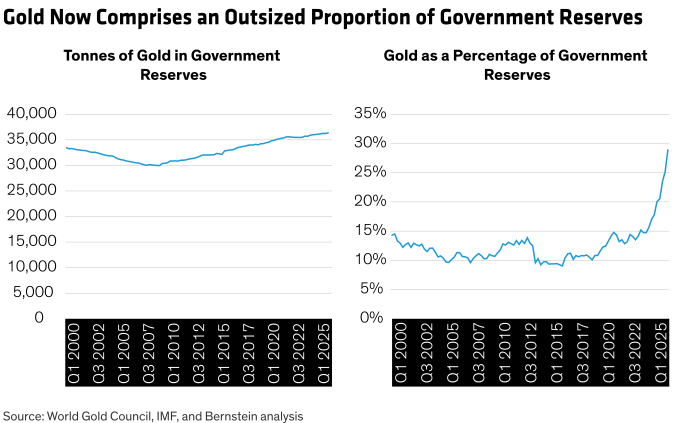
- Other emerging-markets central banks followed (and possibly the Chinese continued, in secret). At the same time, the overall tonnage in government reserves has grown steadily in recent years. The percentage of reserves being held in gold has risen alongside the price of gold and may be considered outsized for some holders today (Display). In aggregate, gold’s portion now outweighs that of US Treasuries.
- Commodities have historically been prone to significant momentum effects. So once the shift triggered trend signals, momentum investors continued pushing up the price. Individual investors around the world also climbed aboard. For instance, as Chinese authorities have sought to cool their local markets, they have caught people smuggling large quantities of precious metals for trade.
- The Trump administration’s 2025 policies have stoked the risk of global conflict and uncertainty. Since gold serves as the world’s foremost “chaos/disaster hedge,” its fundamental value climbed as more buyers pursued safety.
Gold Prices, the Dollar, and the True Meaning of Debasement
Throughout 2025 and into 2026, the press has often referenced “the debasement trade” to capture surging gold prices, the falling dollar, and, at times, other price moves. But we’d argue that that phrase debases the word “debasement.” The term has a specific meaning: lowering the intrinsic value of coinage, or, in the modern era, of currency.
The moves in gold and the dollar are related, but distinct. As noted, central bank buying, heightened geopolitical instability, and momentum trading have all propelled metals higher. Meanwhile, the dollar’s move has primarily been driven by global investors hedging their exposure to the US as it becomes increasingly unpredictable on the world stage. While these narratives are related, they’re different stories playing out over different timelines.
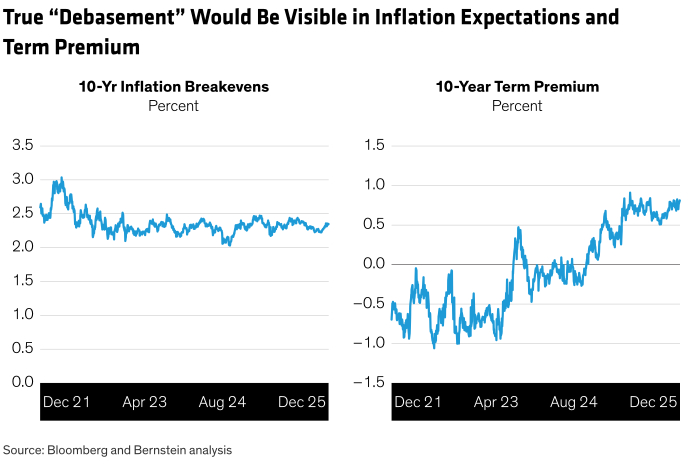
What’s more, if debasement were the true theme, inflation concerns would dominate. Yet the two most important inflation measures have remained stable in recent months, even as precious metal prices have soared (Display). Inflation breakevens reflect the market’s expected inflation rate while the bond term premium compensates investors for inflation uncertainty (among other macroeconomic concerns). If investors feel anxious about inflation spiking, that’s where you would see those worries priced in. While the term premium did rise from the election through the tariff tantrum, it’s since stabilized. In fact, both measures have held quite steady over the past two quarters, while metals have accelerated their run-up.
How Should Investors Value Gold?
Unlike most assets we invest in, gold has no fundamental value based on future cash flows. In fact, its cash flows are negative, due to the cost of storing and securing it. In effect, gold’s value is entirely based on its future selling price and the prevailing sentiment at that time. Yet, investors are still attracted to gold based on those expectations, its low correlation to other assets, and most notably, the way its price tends to rise in times of chaos or geopolitical stress. As the ultimate disaster hedge, gold earns its keep—and that’s enough to theoretically offset the piddly returns it delivers for long stretches of time.
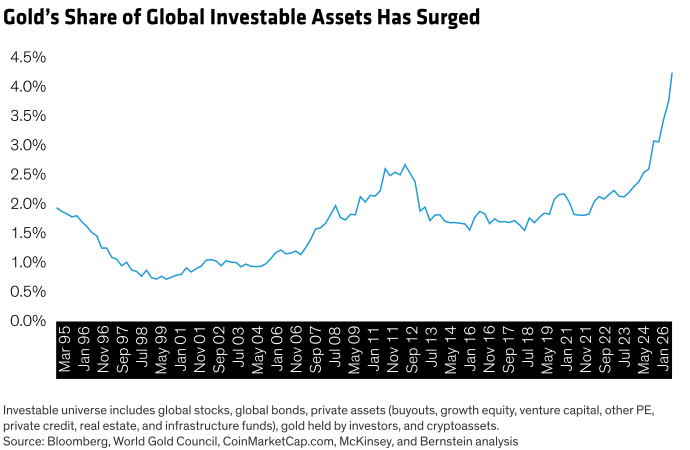
Over the years, gold’s value as a hedge can be viewed through its aggregate weight in global portfolios. Consider that in recent decades, it has averaged around 1.7% of global total investable assets. Yet with the latest run, it’s now surpassed 4% of global investable portfolios (Display). Admittedly, gold’s fair value as a disaster hedge should be higher today than it was two years ago—but has it more than doubled?
Not all gold above ground is held by investors, though. Only around a quarter is held for investment while roughly one fifth is held by central banks. And a little under half is in the form of jewelry, where demand is partially for investment, but mostly for display.
Beyond investors, government demand is the other key driver to watch. It’s challenging to fully understand the mindset of reserve managers, but they generally provide consistent demand as they deploy surplus capital and rebalance currency reserves. Major holders like the US and several Western European nations don’t seem to be sellers, even with the recent price run. But this surge might prompt some to rebalance their holdings opportunistically. Other governments have been reliable buyers, and while we expect this to continue, we’re curious if higher prices will change their activity. Overall, we still view governments as a net source of demand, but we’re cautious about the possibility of large holders selling to take advantage of price gains.
Assessing Silver’s Value Amid Market Volatility
Silver is a hybrid between a precious metal and an industrial metal, but lately, it’s emerged from gold’s slipstream and traded as a meme stock. We consider it a derivative of gold, though silver may merit a smaller place in portfolios, too. From a tactical perspective, the only way to distinguish between the two is the gold-to-silver ratio, a long-standing metric used by both governments and investors.
What does that ratio tell us today? That silver’s recent move looks downright absurd. You can often tell when a market is frothy, but not how close it is to bursting. Even with its recent collapse, silver’s near-term moves are anyone’s guess—and that is not our remit.
What Should Long-Term Investors Do About Precious Metals?
With clients asking in recent months how to view precious metals, we always start with what they currently hold. On a look-through basis, many of our clients already have exposure to gold and silver futures as well as precious metals miners, as part of a broader inflation hedge.
For those looking for a potential entry point, the question becomes: How can you build a long-term allocation in assets that have run away? Put simply, with great care.
In the near term, gold and other metals could continue their run, before ultimately crashing back down as they’ve done in past cycles. Where they’ll level off remains to be seen. Gold’s proportion of the global investable asset pool is historically outsized, as is its share of central bank assets. Between the two, we think the former is likely to revert more quickly than the latter, as government holdings are stickier and their investment policies less pliant. But even investors could dawdle when it comes to rebalancing. At today’s levels, we generally see other asset classes offering better prospects in the medium term. So, while we would still favor an appropriate strategic weight over time, we also wouldn’t chase this move.
Crypto Isn’t Digital Gold—Yet
Despite the current rise in precious metal prices, cryptoassets haven’t followed suit. As we previously noted, we’re still looking for signs that investors are treating bitcoin like they’ve historically treated gold, especially in times of uncertainty, like the tariff shock last April. So far, evidence supporting bitcoin as “digital gold” is limited. While gold and silver’s moves have been partly due to froth, bitcoin hasn’t enjoyed the same investor enthusiasm or the same investment narrative as gold in this recent surge. For now, that weakens the case for bitcoin as digital gold, in our view.
Discipline Is Key When It Comes to Precious Metals
Soaring prices in precious metals reflect a mix of legitimate macro forces and unmistakable speculative fervor. Gold’s role as the world’s disaster hedge is very real—and arguably more relevant today than in years past—but its meteoric rise has also pushed it to historically elevated levels within global investable portfolios. For its part, silver has behaved even more erratically, trading more like a meme stock than a fundamental building block.
The combination of fundamental drivers and froth leaves some long‑term investors feeling flummoxed. We’d suggest approaching precious metals with discipline, not excitement. Strategic allocations to gold still make sense as a hedge against geopolitical instability, but these positions should be sized with long-term objectives—not recent price action—in mind. Chasing momentum after a parabolic run, especially in sentiment-driven assets, rarely ends well. That’s why we favor gradual scaling, if need be. Opportunities will emerge to adjust exposures, but forcing a decision in a moment of exuberance is unnecessary and potentially harmful.
Ultimately, precious metals can still play a role, but they should do so within a disciplined framework. At moments like this, the most valuable action may be intentional, incremental positioning and relative inaction in the face of market frenzy.