

With the estate tax exclusion set to $15 million per person in 2026, many wealthy families are taking a fresh look at their trusts, especially those established during earlier times of tax uncertainty. Before passage of the new tax law, commonly known as the “OBBBA,” many rushed to create irrevocable trusts to shield assets from a potential drop in the estate tax exclusion. These grantor trusts, or Intentionally Defective Grantor Trusts (IDGTs), became popular for their unique tax advantages, allowing the trust creator (its “grantor”) to pay income taxes on trust earnings with assets from their taxable estates.
But with estate taxes now feeling like a distant concern, many families are increasingly focused on income tax efficiency. That shift raises an important question: should you convert your grantor trust to a non-grantor trust? The answer isn’t clear cut. Grantor trusts remain powerful, but it’s essential to evaluate factors like liquidity, income tax deductions, and basis planning holistically.
Here’s a concise health checkup for grantor trusts to help you navigate this critical decision in light of the changed tax landscape.
The Grantor Trust Health Checkup
1. Liquidity: Can You Sustain the Tax Burden
Grantor trusts intentionally place the income tax obligation on the grantor, rather than the trust. When liquidity is ample, this makes it a highly efficient wealth transfer mechanism: trust assets compound without the tax drag, while the grantor’s taxable estate is reduced by the taxes paid. However, those advantages may be outweighed by countervailing forces if you’re liquidity-constrained. In other words, if your balance sheet has tightened, IDGTs may no longer be the best fit.
Key Questions:
- Do you have sufficient cash flow to support the trust’s ongoing income taxes, or could this obligation force you to sell personal assets or otherwise hamper your lifestyle?
- Has the trust accumulated income-producing assets, like private credit, which can be used to fund its own tax burden?
2. OBBBA Deductions: Can a Conversion Let You Capture More Deductions?
Individual Deductions
Certain individual deductions—Roth IRA catch-up contributions and the OBBBA senior deduction among them—phase out at higher income levels. Converting an IDGT to a non-grantor trust can reduce your adjusted gross income (“AGI”), restoring your eligibility for deductions that your previous income level disqualified you from.
State and Local Tax (SALT) Deduction
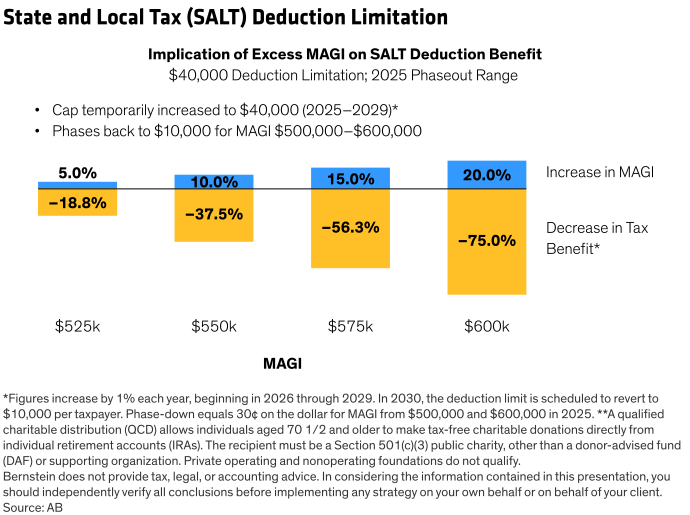
Non-grantor trusts may qualify for their own SALT deduction, potentially up to $40,000 per trust under current law. But, in practice, the benefit is narrower than it appears.
- Individuals and non-grantor trusts can each receive their own SALT deduction of up to $40,000, translating to a maximum tax savings of $14,000 per person or trust.
- Some clients are tempted to convert grantor trusts to non-grantor trusts to qualify for an additional “stack.” But stacking trusts for SALT deductions only helps if the trusts you create pay state income taxes; many families set up non-grantor trusts in no-income-tax states, which eliminates the deduction entirely.
- This deduction phases down when modified adjusted gross income (be it for an individual or a trust) exceeds $500,000 (Display).
- Non-grantor trusts pay income tax at highly compressed, graduated rates—with the top rate of 37% applying to all income in excess of $16,000 for 2026.
- Even in the ideal case—where an individual and/or a trust has the right income level and pays state taxes—the enhanced SALT regime is scheduled to sunset in 2030. Consider whether the increased deduction is worth the planning effort given this shortened timeline.
Key Questions:
- Would shifting income from your balance sheet to a non-grantor trust reduce your AGI to a level where you qualify for new deductions?
- Would changing your IDGT to a non-grantor trust mean an extra SALT stack, and is that benefit worth the hassle given it will disappear in 2030?
- Would application of the non-grantor trust’s compressed tax rates negate the trust’s other tax savings?
3. Flexibility, Control, and Basis Planning: Are You Giving Up Optionality
Grantor trusts offer planning tools that are difficult to replicate once grantor status is terminated. Many IDGTs permit the grantor to substitute assets of equivalent value (a “swap power”) and to take unsecured loans—powers that materially preserve optionality.
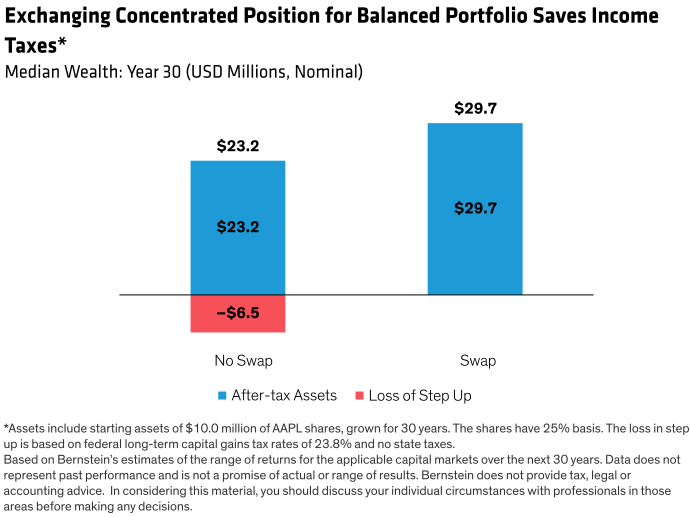
If a grantor trust includes a swap power, the ability to manage basis becomes one of the most valuable, but potentially underutilized tools available. When an asset is sold for a profit, capital gains are incurred based on the difference between the asset’s original purchase price (its “basis”) and its selling price. If a low-basis asset is included in your taxable estate at your death, it receives a step-up in basis to the asset’s then fair market value, which can substantially reduce capital gains taxes paid by later-selling heirs.
A swap power allows a grantor to exchange an IDGT’s low-basis, high-growth assets for higher-basis, lower-growth assets to preserve step-up potential for the reclaimed assets. For instance, a grantor could eliminate roughly $6.5 million dollars in capital gains tax by swapping $6 million of global equities and $4 million of bonds for $10 million of Apple stock with a $2.5 million basis held inside an IDGT, assuming the Apple stock continues to appreciate after the swap over a 30-year horizon (Display).
While converting a grantor trust to a non-grantor trust can address liquidity concerns or give the grantor access to certain income-sensitive deductions, such conversion requires the release of any swap power and other means of access that trigger grantor trust status. For many families, that loss of control outweighs any near-term income tax advantage.
Key Questions:
- Does your grantor trust hold assets with substantial unrealized appreciation?
- Would your heirs benefit from a step-up in basis more than further estate tax avoidance?
- Are near-term income tax savings worth foregoing long-term capital gains efficiency?
- How important is maintaining flexibility and control as your financial situation and the markets evolve?
Should You Switch from a Grantor to Non-Grantor Trust?
For some, the answer might be yes. A significant change in liquidity needs or a clear income-shifting opportunity may justify the conversion. But the OBBBA didn’t undermine the value of grantor trusts. It just changed the framework for evaluating them. Reach out to your Bernstein Advisor for a disciplined grantor trust health check—one that incorporates liquidity, deductions, basis planning, and flexibility in an after-tax model.
For families navigating the twin goals of income tax efficiency and multigenerational wealth transfer, an integrated analysis is the real planning opportunity.
Talk to Us About Your Tax Situation
Connect with our specialists for customized solutions.