

Collectibles are having another moment, and this time the proof spans both digital and physical markets. Consider nonfungible tokens (NFTs), digital tokens certifying ownership and authenticity of a specific asset. Select NFT projects have shown signs of renewed activity after a brutal reset while Labubus’ viral rise—fueled by social media unboxings, celebrity exposure, and resale premiums—has shown how quickly a niche collectible can become a global frenzy.
For UHNW families, that momentum can make passion assets feel like planning opportunities, especially as federal estate tax rules continue to evolve. But the timing cuts both ways: gifting into a hype cycle can consume more lifetime exclusion than the asset ultimately justifies, while also passing along the donor’s original basis and forfeiting a potential step-up at death. If today’s hot collectible cools tomorrow, will the family have transferred wealth efficiently, or simply used scarce tax capacity on an inflated asset?
Before You Transfer Collectibles, Model the After-Tax Outcome
With sophisticated analytics, families can see the estate and income tax consequences of buying, holding, and selling their collections, allowing them to make analytically sound decisions. The drive to build a collection is often rooted in passion, rather than profit, but at the end of the day, collections are still financial assets. Many appreciate over time, but some will lose value—and planning strategies need to account for both outcomes. That involves two key questions:
- For collections held at a gain, what taxes would an heir face, and how long would it take a lifetime sale to overcome the income tax cost?
- For collections held at a loss, what charitable options are available to the owner?
Should You Gift Collectibles Now or Wait for a Step-Up in Basis?
How can a savvy collector capitalize on success? The answer depends on your goals.
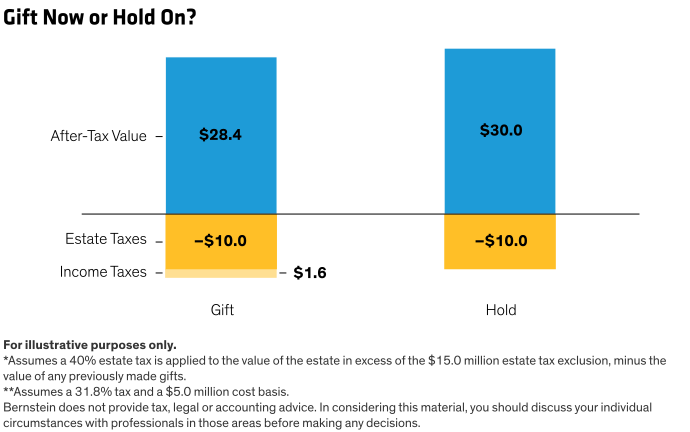
If you want your prized collection to remain intact across generations, you must first ask whether it’s better to give the collection away during life or hold it until death. Consider Lochlann, a 65-year-old retiree with a $40 million estate, including $10 million in trading cards originally purchased for $5 million. Lochlann wants his son, Ian, to inherit the cards and preserve them as a family heirloom, selling only in a financial emergency. Should Lochlann give the cards now, or wait and pass them through his taxable estate?
The choice has meaningful tax consequences. Whether Lochlann gifts the cards today or not, the estate taxes remain identical. But that doesn’t tell the full story. If Lochlann holds the cards until death, they receive a step-up in basis to their date-of-death value, meaning Ian would owe capital gains taxes only on appreciation occurring after Lochlann’s passing, assuming Ian ever needed to sell. Alternatively, Ian would inherit Lochlann’s original cost basis if Lochlann gifted the cards today. In this scenario, any future sale would trigger approximately $1.6 million in capital gains taxes—roughly 16% of the collection’s current value (Display).
How to Capitalize on an Appreciating Collection
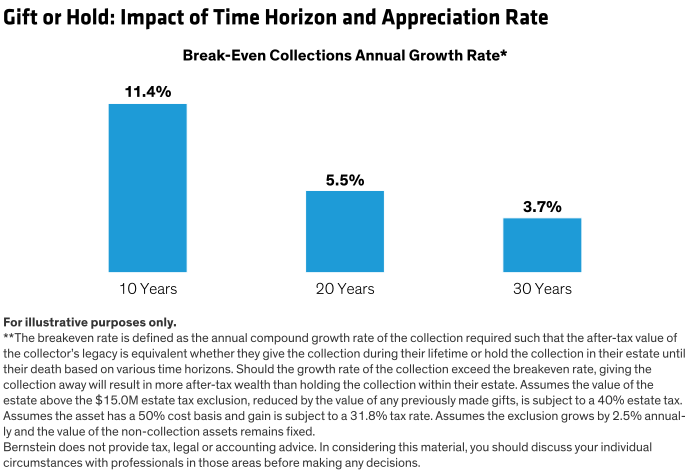
The next question is how much the collection is likely to appreciate over Lochlann’s remaining lifetime. If the cards are expected to grow significantly in value, a gift today may be advisable because it would consume less of Lochlann’s $15 million lifetime gift tax exclusion. On the other hand, if the value is expected to remain relatively stable, Lochlann is better off keeping the collection in his taxable estate and securing the step-up in basis at death.
We can evaluate these trade-offs by modeling how long the collection must compound at various annual growth rates in order for Ian to achieve greater after-tax wealth from a lifetime gift than from inheriting the collection with a stepped-up basis (Display). For instance, if Lochlan lives another 10 years, the collection needs to appreciate at approximately 11.4% annually for a lifetime gift to beat out an inheritance. But if Lochlann lives closer to three decades, a lifetime gift outperforms at a much lower annual growth rate, roughly 3.7%. Analyzing both scenarios from a post-tax perspective allows Lochlann to make a deliberate, informed decision.
Before Selling Collectibles, Calculate the After-Tax Break-Even Point
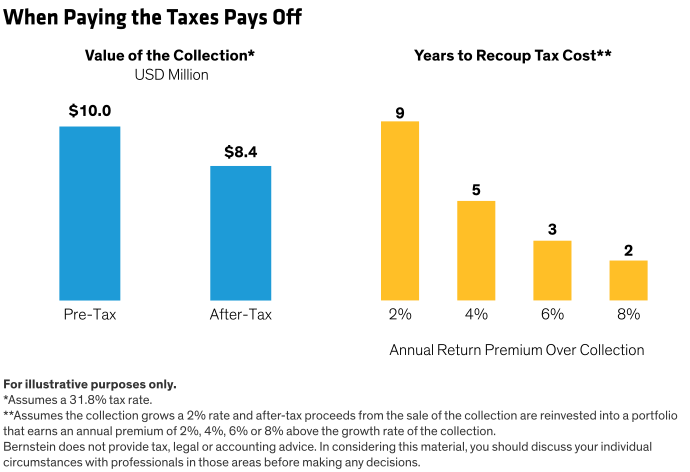
Not every collector is sentimental; sometimes a collection simply needs to be sold. That’s when a “break-even” analysis comes into play: when the sales proceeds are reinvested, how long should a collector expect to wait before recouping the tax costs?
Imagine Lochlann decides to sell part of his card collection because he expects the market to cool. With a $5 million cost basis, a $10 million sale would net nearly $8.4 million after tax. The question is how quickly he could make up that tax cost by reinvesting the proceeds. If the collection would have grown at 2% annually, and the reinvested portfolio earns a 2% return premium above that assumed growth rate, Lochlann would need to wait nine years before breaking even—that is, before the after-tax reinvested dollars equal what the collection would have been worth had he not sold. If the portfolio earns an 8% annual premium instead, the break-even period falls to just two years (Display). Framing the sale this way helps Lochlann weigh the certainty of locking in today’s gains against the opportunity cost of parting with an appreciating asset.
Donating Collectibles at a Loss: Tax and Estate Planning Considerations
Sometimes, collectors find themselves holding assets that have lost value. A collector could sell the asset without taking a tax hit, removing the asset from their taxable estate, but generally cannot deduct losses on the sale of collectibles held for personal enjoyment.[1] Another option? Donating it to a qualified charity or donor-advised fund (DAF) may generate an immediate charitable income tax deduction while removing the collection from your taxable estate, without the size of the deduction hinging on how the charity uses the gift.
Assume Lochlann has a separate collection of watches purchased for $5 million, now worth only $3 million. If he donates the watches to a charity that uses them to further its tax-exempt mission, his deduction equals the $3 million fair market value. If the charity or DAF instead sells the watches, the deduction is limited to the lesser of his cost basis or fair market value, here, also $3 million. The related-use distinction makes no income tax difference for an underwater collection: either way, the deduction is capped at current fair market value. That distinction becomes critical, however, when the collection is held at a gain.
Collectibles Planning Requires More Than Market Momentum
Collectibles can enhance high-net-worth portfolios when approached with discipline and clear intent. Recent cycles, from NFTs to trading cards to art, highlight how rapid appreciation can obscure volatility, liquidity risk, and tax complexity. A structured planning framework, grounded in realistic return assumptions and tax trade-offs, helps distinguish when collectibles build long-term wealth from when they introduce uncompensated risk. By applying the same rigor employed with traditional investments, collectors can align passion with financial strategy, preserving both value and enjoyment across generations.
[1] An “investor,” someone who buys and sells collectibles for profit outside a regular trade or business, can recognize a capital loss on sale, but that classification is narrow.
Talk to Us About Your Tax Situation
Connect with our specialists for customized solutions.