

Prediction markets have gone from a curiosity for political junkies to a fixture of the financial landscape. Take Kalshi and Polymarket, where combined monthly notional volume has jumped from $810 million in July 2024 to $53.0 billion in July 2026, while sports volume on these venues now rivals that of the entire legal US sportsbook industry. Currently, Kalshi claims more than 90% of US prediction market activity and a majority of global volume. Yet Wall Street has taken notice, with recent forays from ICE (the NYSE’s parent company), Interactive Brokers, and Robinhood to market makers like Susquehanna and Jump.
Growth like that tends to attract fund pitches sooner or later. And while no manager has pitched us yet, we want to be ready, so we ran the concept through the same manager research lens we use for any new asset class: value proposition, return drivers, capacity, and risks.
Ultimately, size and liquidity don’t make an asset class. The real question comes down to what exactly these markets pay you for. Stocks pay you for bearing cash-flow risk, insurance for event risk, and bonds for lending. For now, prediction markets pay you only for being right—making them a zero-sum transfer among participants. In other words, they’re a trading strategy, not a risk premium, in our view. In other words, they’re a trading strategy, not a risk premium, in our view. That sounds a lot like a hedge fund, doesn’t it?
Are Prediction Markets a Good Investment?
The main appeal of prediction markets is that their exposure hinges solely on whether the event happens. Elsewhere, you can accurately forecast the economy’s growth rate and still lose money, because you have to express your view via assets with confounding variables. Meanwhile, as we write this, “US GDP growth in Q3 2026” coming in between 2.0%–2.5% is priced at 22 cents in prediction markets. If you’re right, you make a dollar, if you’re wrong, you lose your 22 cents.[i] The view is the contract.
That focus also means prediction markets aren’t correlated with stocks, interest rates, or credit. But that’s also the problem. Without exposure to broader market forces, there’s no built-in reward for taking risks, and the return comes entirely from being smarter than everyone else who is betting.
To be fair, the prices themselves can be informative. For instance, Fed staff found Kalshi’s Fed Funds contracts beat Fed Funds futures on the eve of FOMC meetings, and Kalshi’s own data suggest its non-sports markets are well calibrated a week to a month out.[ii] But anyone can read those prices for free, so their informational utility says nothing about whether to invest in them.
Where Do Prediction Market Returns Come From?
While this is currently a zero-sum market (or worse, after the exchange takes its cut), real hedgers entering the market could change the equation. If companies and individuals begin offloading actual exposures here, they’ll pay a premium for it. Then the market will start to resemble insurance, with capital earning a return for absorbing risk. That would turn prediction markets into an asset class rather than a venue for trading.
How might that look? Picture a retiree with a $4 million waterfront home in Naples. Her policy has a 5% hurricane deductible, so a major storm could cost her $200,000 out of pocket. She pays $30,000 for contracts that return $200,000 if a Category 3 or stronger hurricane makes landfall in southwest Florida this season. If no storm comes, she loses $30,000 but doesn’t mind, the same way no one minds an unused fire policy.
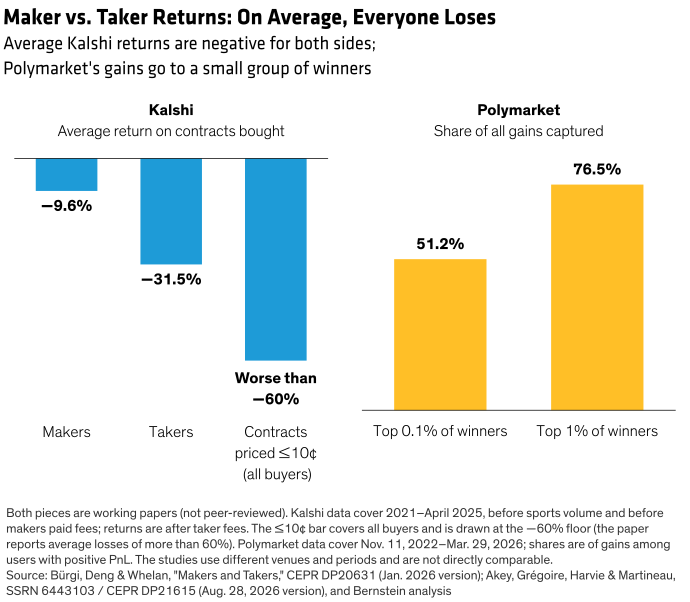
Until hedgers show up, the closest thing to a steady, repeatable pattern in prediction market returns is the “favorite/longshot” bias common to most betting markets: people tend to overpay for long odds. Across more than 300,000 Kalshi contracts, those priced under 10 cents lost more than 60% on average, while those priced above 50 cents earned small positive returns after fees. Who typically captured that edge? On average, traders who posted orders lost about 10% while traders who took the orders lost about 32% (Display). In other words, the opportunity lies in patiently posting orders on favorites, a strategy that earned single-digit gross returns during a period when those order posters paid no exchange fee. That’s a market-making business, and it doesn’t obviously scale.
How Much Capacity Do Prediction Markets Really Have?
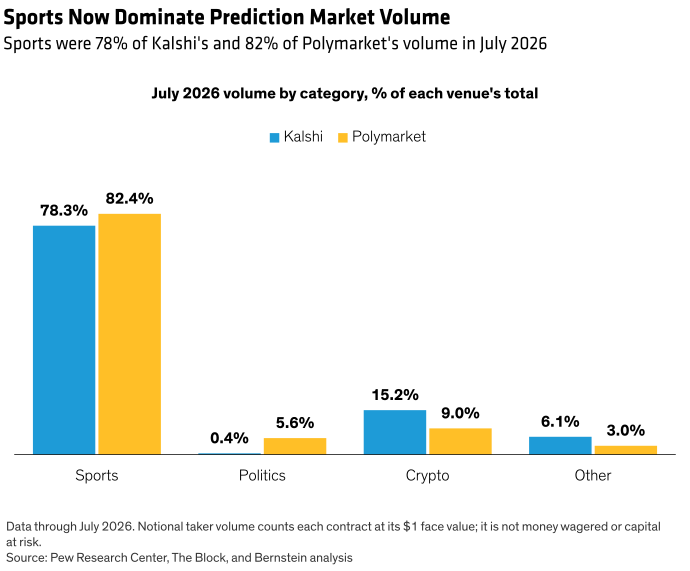
The capacity arithmetic is tougher. The growth, while real, is concentrated in sports, which accounted for 78% of Kalshi’s July 2026 volume and 82% of Polymarket’s. Politics—the use case that put these venues on the map—made up 0.4% of Kalshi’s business. Volume also overstates the capital deployed, particularly for low-priced and short-dated contracts: a $10 purchase of 10-cent longshots registers as $100 of volume.
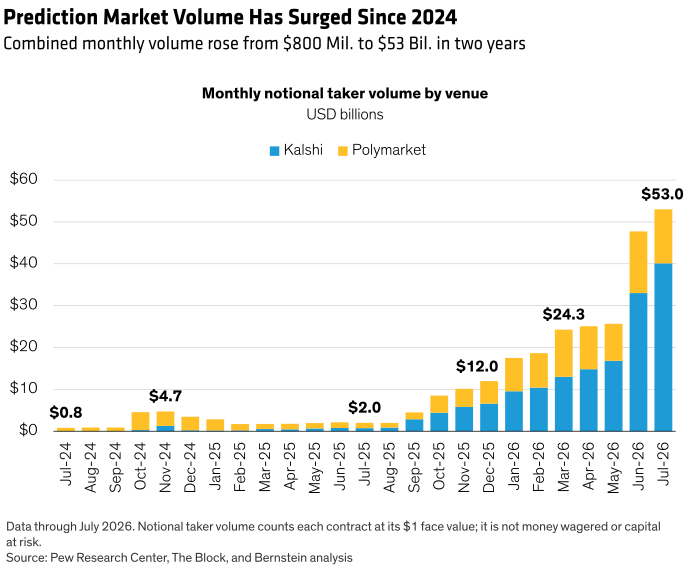
But what matters for capacity is open interest, or the capital actually at risk. Sector-wide open interest was about $1.11 billion on May 1, 2026—a figure a single midsize hedge fund could absorb. The gap between $45 billion of monthly volume and $1 billion of open interest tells you these are very short-dated instruments that turn over constantly.
According to industry reports, even the top Polymarket markets hold only about $30 million of liquidity. The plumbing is arriving (Cantor Fitzgerald now brokers Kalshi block trades), but actual capacity that could be underwritten today sits plausibly in the low hundreds of millions sector-wide.
What Are the Biggest Risks of Prediction Markets?
Three concerns get bundled here, but it helps to separate them.
Let’s call the first “distaste.” Some contracts are simply unpleasant to own—whether a named person dies, whether a town falls in a war. Nothing illegal, no manipulation, but a fiduciary has no good answer for why the portfolio was positioned for a certain type of disaster. Hedging or insuring a real risk, like a hurricane, is a different matter.
The second concern is incentive hazard, or contracts whose outcome a participant can influence. Kalshi has disciplined political candidates for trading on their own races and banned disgraced former Congressman George Santos for life for betting on whether he’d attend the February 2026 State of the Union. CME’s chief executive has told the CFTC that individual-based sports contracts are being manipulated.
The third is information integrity, where insider trading is the main threat. The CFTC settled with Trump’s teleprompter operator over trading on words from speeches he’d already read, and prosecutors charged a Special Forces sergeant who helped plan the Maduro operation. A month later, the CFTC alleged that a Google employee earned roughly $1.2 million trading “Year in Search” contracts on nonpublic information. Surveillance caught the first two; online users spotted the third only after payout. While the cases that get caught are encouraging, the ones that may not are an outstanding risk.
Outcome resolution is the other weak point. Polymarket’s Paris temperature contracts settled off one airport sensor that appeared to have been warmed manually, in two separate cases.
What Would Make Prediction Markets Investable?
Liquidity and capacity—Depth beyond sports and the top markets, with enough open interest to build and exit positions without moving the price, and a strategy with a realistic capacity figure.
Integrity—A regulated venue, working surveillance, resolution sources that defy tampering, and real answers on custody and platform failure.
A repeatable process—For the time being, the return is entirely skill-based, so the manager and strategy is the entire investment. We’d want enough resolved positions to demonstrate clear skill, and ideally, performance that persists across sub-markets.
Benchmarkability—With no broad market benchmark, the yardstick is a peer group of managers with audited records, large enough to separate skill from luck. That peer group doesn’t exist yet.
Net-of-everything economics—Add exchange and manager fees to single-digit gross returns and see what’s left over. Taxes may matter even more. The tax treatment for these gains remains unclear; with the contracts generally having shorter-term horizons, applicable federal tax rates for those in the top bracket could range from 27%–37%.
One final risk sits outside any manager’s control: whether these fall under federal commodity trading laws or state gambling laws. The issue is headed for the Supreme Court, and an adverse ruling could drain the liquidity everything else depends on. Now, if only there were a contract to trade on that ruling as a hedge.[iii]
Are Prediction Markets an Asset Class Yet?
In their current form, prediction markets pay you for being right. That is a real skill and a legitimate way to make money, but it’s a trading strategy, and deserves to be underwritten as one. That means evaluating them against a manager’s record and a credible capacity estimate, not against a risk premium that doesn’t yet exist. Today, prediction markets offer a trading venue without a structural return, a benchmark, or settled regulatory status, so they remain uninvestable as a mainstream asset class. The infrastructure has arrived well ahead of any institutionally relevant return streams.
For now, we’re watching rather than allocating. This doesn’t mean prediction markets are unimportant—their prices are already useful and their growth is tangible. But it does express a view about what they pay you for. When that changes, it will show up in open interest and in who sits on the other side of the trade, rather than volume headlines. Until then, it’s a market we’d rather read about and learn from than own.
[i] This market resolved between writing and publishing, with GDP growth coming in north of 3%. So, taking the view that it would come in in at 2.0%–2.5% would have lost a trader their 22 cents.
[ii] Nicole Kagan and Rubens Baiocchi, “Calibration in Prediction Markets: Theory and Evidence,” Kalshi Research Working Paper, August 2026, https://kalshi.com/research/kalshi-research-calibration.pdf.
[iii] Yes, we’ve checked Polymarket and Kalshi for this event.
Pew Research Center analysis of The Block data (September 23, 2026); Robinhood Form 10-Q, Q2 2026; Kalshi press release (May 7, 2026); Bloomberg (May and August 2026); Bürgi, Deng & Whelan, “Makers and Takers,” CEPR DP20631; Akey, Grégoire, Harvie & Martineau, SSRN 6443103 (June 2026); Tsang & Yang, arXiv 2603.03136; Diercks, Katz & Wright, FEDS 2026-010, Federal Reserve Board; CFTC staff advisory (March 2026) and enforcement releases (April–May 2026); CFTC proposed rule (June 10, 2026); KalshiEX v. Flaherty (3d Cir., April 6, 2026); Ninth Circuit decision (August 28, 2026); Kalshi fee schedule. Tax rates derived from statutory rates; not tax advice.