

After years of strong stock market gains, many investors find themselves holding appreciated positions that create significant volatility and raise tough questions about how—and when—to reduce exposure. While selling shares or donating appreciated stock can be effective strategies, they aren’t always ideal due to tax implications or personal preferences around charitable giving. But what if you could reduce your exposure to a concentrated stock position without selling or making an outright charitable gift? Could exchange funds or charitable remainder unitrusts (CRUTs) be the sophisticated solutions you’ve been looking for?
How Do Exchange Funds Work?
Exchange funds offer an astute way to diversify a large position in a low-basis, single stock without triggering an immediate tax bill. Here’s how they work: you contribute your individual shares to a privately placed investment vehicle, and in return, you receive units in a diversified portfolio that aims to track a broad market index like the S&P 500. Because you’re exchanging stock rather than selling it, the contribution is tax-free—the original cost basis of your single stock simply transfers to your new fund units, letting you defer taxes while gaining exposure to a wider range of securities.
Funds often provide some level of liquidity, allowing you to redeem your units daily or monthly. Depending on when you redeem, you may receive your original shares back along with additional securities to cover any excess return (if redeemed within the first seven years), or a basket of diversified assets after that period. These redemptions may also be tax-free, with your fund units’ low-cost basis applied to the new shares you receive.
Typically formed as limited partnerships, exchange funds tend to allocate roughly 80% of their assets to equities and 20% to illiquid, income-generating real estate. But exchange funds come with some notable constraints: you must be an accredited investor and qualified purchaser, and the fund must be willing to accept your specific stock. There are also the liquidity requirements to consider.
Yet for investors looking to manage the risk of single stock positions while deferring taxes, exchange funds may prove ideal.
How CRUTs Solve for Concentration
Donor advised funds (DAFs) are another popular way to diversify out of a single stock while enjoying a tax deduction. But if you’re looking for something that offers those benefits while providing an income stream back to you or some other non-charitable beneficiary, a charitable remainder unitrust (CRUT) might be the answer.
How does it work? When funding a CRUT, you contribute your concentrated position to an irrevocable trust, which then pays out a set percentage of its value each year to you or a beneficiary of your choosing. At the end of the trust’s term, the remaining assets go to charity. When you fund the trust, you receive an immediate charitable income tax deduction based on the present value of the assets that will eventually go to charity (i.e., the trust’s remainder interest). Because the trust is considered a tax-exempt entity, the appreciated assets can be sold without triggering capital gains taxes. Instead, those capital gains are passed through to the noncharitable beneficiaries as part of the trust’s annual payments.
The annual payout, or distributions, are based on a fixed percentage of the trust’s asset value each year—anywhere between 5% and 50%—and must be structured so that the charity receives at least 10% of the trust’s initial funding amount. Over time, the wealth accumulated from investing the annual distributions can potentially exceed what you’d have if you simply sold the stock, paid the associated capital gains taxes, and invested the net proceeds. How quickly you reach this “crossover point” depends on factors like your state income tax, the payout rate, the trust’s term, and how the CRUT’s assets are allocated.
In short, a CRUT can be a powerful way to diversify, generate income, and ultimately support a cause you care about—all while managing taxes thoughtfully.
Which Option Makes the Most Sense?
As with most questions of this nature, the answer depends on your individual goals and objectives. Consider an investor with $1 million in a single stock with a cost basis of $300,000. Using sophisticated modeling, we can explore the results over 20 years assuming they:
- hold: Keep the stock for 20 years;
- sell: Sell the stock immediately, pay the taxes, and reinvest the proceeds in a diversified US stock portfolio;
- contribute the stock to an exchange fund, then hold the investment for 20 years; or
- transfer $1.0 million to a CRUT that is structured to make a 10% payout.
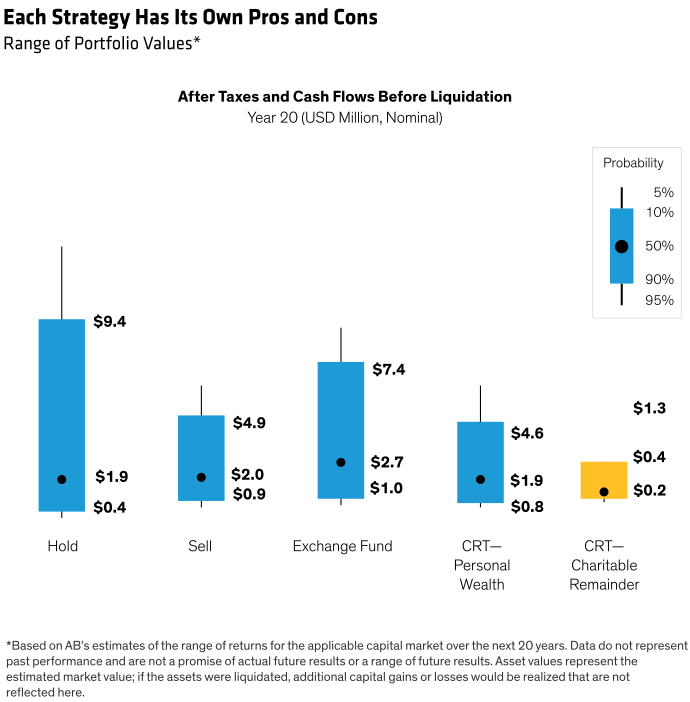
In our analysis, each scenario has its pros and cons (Display). Holding onto the stock delivers the most upside, but also the greatest downside if the stock underperforms. Selling the stock provides considerable downside protection and liquidity—but comes with the highest upfront tax cost and least upside potential. Contributing the stock to an exchange fund allows for instant diversification while preserving a step-up in basis at death. However, it only provides access to a diversified US stock portfolio and generally offers the lowest amount of lifetime liquidity. What about the CRUT? It offers a unique combination of benefits, including (i) a tax deduction, (ii) a tax deferral on the gain, (iii) an annual income stream, and (iv) a charitable legacy upon death. The main drawback is that the investor only has access to 10% of the capital per year.
Since each strategy has its advantages, using a combination seems optimal. Hold some stock to capture the upside potential, sell some stock to satisfy current liquidity needs, use the exchange fund for immediate diversification, and employ the CRUT for income, tax deferral, and charitable goals.
The Takeaway on Diversifying Concentrated Stock
Handling a large, concentrated stock position can feel complicated, especially when you factor in your personal risk comfort, tax situation, investment goals, and even your own instincts. Each strategy we’ve discussed has its upsides and downsides, so it’s important to think about which approach—or mix of approaches—fits you best. With thoughtful planning and regular check-ins, you can keep your portfolio balanced and aligned with your financial goals.
Talk to Us About Your Tax Situation
Connect with our specialists for customized solutions.