

In estate planning’s long pursuit of efficient wealth transfer, the intentionally defective grantor trust (IDGT) has earned a second acronym: the transfer-tax GOAT. Treated as a separate gift and estate taxpayer but ignored for income tax purposes, the IDGT lets its creator, or grantor, remove future growth from their taxable estate while remaining personally liable for taxes on the trust’s income and capital gains.
That income tax bill is a feature, not a bug. It further reduces the grantor’s taxable estate and allows the trust to grow more rapidly, all while subjecting the trust’s taxable income to the grantor’s typically lower tax brackets. The IDGT’s disregarded status also enables income-tax-free sales and loans between the trust and the grantor, while common IDGT provisions—like naming the grantor’s spouse as a beneficiary or giving the grantor a nonfiduciary power to swap assets with the trust—preserve flexibility and allow potential access to transferred assets.
But sometimes an IDGT can be too much of a good thing, particularly after enactment of the One Big Beautiful Bill Act (OBBBA). Now that tax law has changed the playing field, even the GOAT deserves a fresh scouting report.
How a Higher Estate Tax Exclusion Changes IDGT Math
By raising the federal gift and estate tax exclusion to $15 million per person, OBBBA has eliminated federal transfer tax exposure for many taxpayers. Yet as that risk recedes, a new form of “overplanning” emerges. If an IDGT’s ongoing income tax liability shifts more wealth out of the taxable estate than necessary, it may forfeit a basis step-up at death without producing any offsetting estate tax benefit. That’s because assets included in a decedent’s taxable estate receive a basis adjustment to their then fair market value, eliminating built-in capital gains. Meanwhile, assets held in an IDGT outside of the decedent’s taxable estate do not. OBBBA also makes nongrantor trusts more relevant, since income-based phaseouts may limit access to new or expanded deductions, including the expanded state and local income tax deduction.
Why the Best Trust Strategy After OBBBA May Not Be an IDGT
So, when does the IDGT shine—and when should planners rethink this heavyweight strategy? Consider Alexander and Zara, a 75-year-old retired couple living in California with a $30 million taxable estate and annual living expenses of $500,000, adjusted for inflation. One-third of their wealth sits in low-basis stock that they prefer to keep to avoid capital gains tax, while their remaining $20 million is invested in a 60/40 stock/bond portfolio. Under typical markets, our forecast shows their taxable estate will grow to roughly $46.8 million over the next 15 years—exposing the couple to a potential $10.6 million estate tax liability.
To mitigate that risk, the couple decides to make a $15 million gift to an irrevocable trust created for their daughter, Aria, a Nevada resident. While they initially considered an IDGT, their advisors flag the risk of transferring too much wealth out of their taxable estate. To help the couple find an optimal trust structure, we modeled two scenarios—funding either an IDGT or a nongrantor trust with $15 million of high-basis assets (Display).
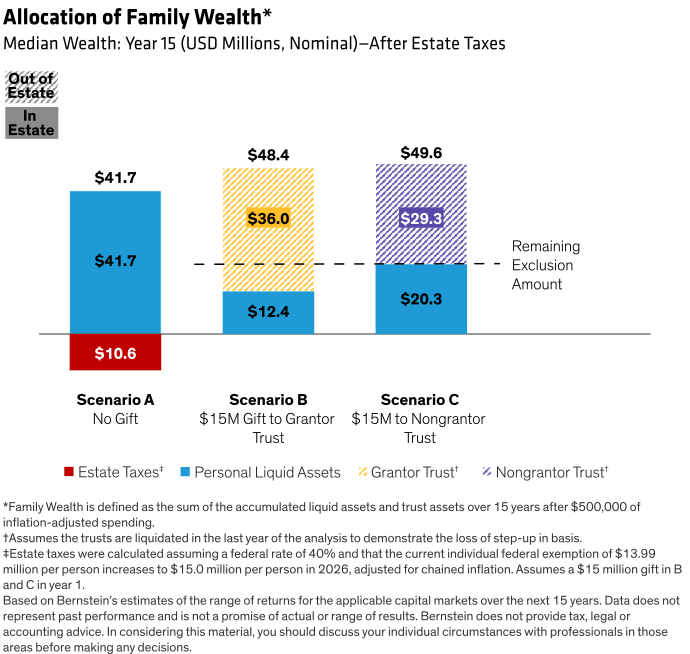
Both approaches eliminate the couple’s potential estate tax liability while enhancing the family’s overall after-tax wealth. But, as suspected, the IDGT proves too efficient: it reduces the couple’s taxable estate to $12.4 million after 15 years. With an inflation-adjusted exclusion of $20.3 million at that point, this overcorrection costs the family a step-up in basis on $7.9 million of assets without an offsetting estate tax savings. On the other hand, the nongrantor trust allows for a more tailored approach. By avoiding the IDGT’s ongoing income-tax burn, the couple retains exactly $20.3 million in their taxable estate—the maximum amount eligible for a basis step-up without triggering estate tax. That difference translates to $1.2 million more in family wealth after accounting for both estate and income taxes.
The Hybrid Trust Strategy That Can Beat IDGT Overplanning
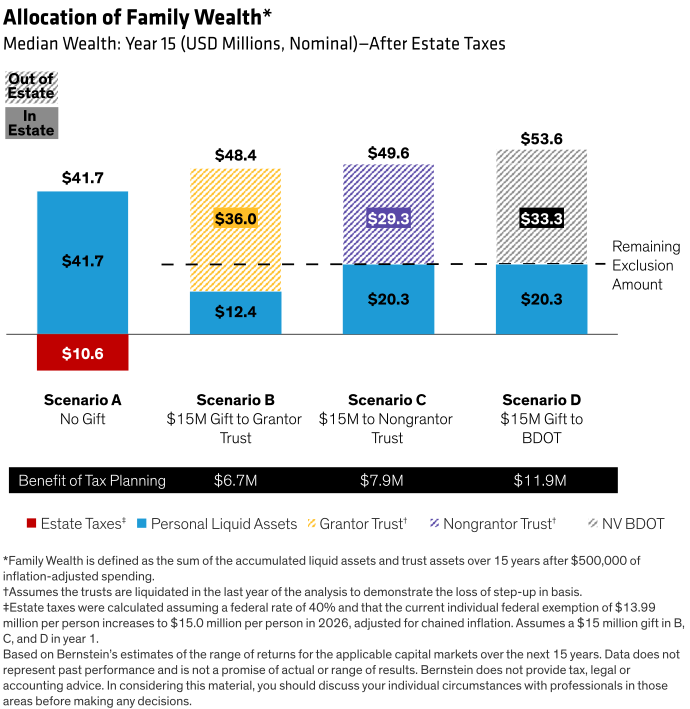
Yet the analysis isn’t quite complete. Nongrantor trusts face compressed income tax brackets and, for California resident trusts, potentially steep state income taxes.[1] To address both concerns, the couple’s advisors propose a hybrid solution: an irrevocable trust that is a nongrantor trust for Alexander and Zara, but a grantor trust when it comes to Aria—a beneficiary deemed owner trust (BDOT).[2] Under this trust structure, a beneficiary who holds (or held) a qualifying withdrawal right over the trust’s assets is deemed the owner for income tax purposes.[3] Put simply, by making the gift to a BDOT, Alexander and Zara can retain an ideal amount of assets within their taxable estate, while the trust reaps the benefits of grantor trust status.[4]
When we model the BDOT, the combined benefits—maximizing basis step-up without estate tax, accessing individual income tax brackets, and eliminating state income tax—generate an additional $4 million in after-tax family wealth, even after accounting for the taxes Aria pays personally (Display).
IDGTs Still Matter—but May No Longer Be the Default
The IDGT remains a powerful wealth transfer tool, but in today’s post-OBBBA world, it may no longer be the default solution. Revisiting the IDGT means weighing estate tax savings alongside a client’s broader financial, tax, and personal goals. Your Bernstein Advisor can help you explore how to craft a truly tailor-made transfer tax strategy.
[1] California’s top tax rate is 13.3%. https://taxfoundation.org/location/california/
[2] For an in-depth discussion of the BDOT structure, see Edwin P. Morrow, IRC Section 678 and the Beneficiary Deemed Owner Trust (BDOT), available at SSRN: https://ssrn.com/abstract=3165592.
[3] I.R.C. § 678(a) provides that “[a] person other than the grantor will be treated as the owner of any portion of a trust with respect to which: (1) such person has a power exercisable solely by himself to vest the corpus or the income therefrom in himself, (2) such person has previously partially released or otherwise modified such a power and after the release or modification retains such control as would, within the principles of sections 671 to 677, inclusive, subject a grantor of a trust to treatment as the owner thereof.”
[4] To implement this structure, Aria could be given a withdrawal right over the trust’s taxable income, with such right lapsing each year in an amount not to exceed the greater of $5,000 or 5% of the trust’s corpus. Applying the withdrawal right to taxable income, rather than fiduciary accounting income, ensures that capital gains are also attributed to the beneficiary who holds the right. See, e.g., PLR 2016-33021. The trust should also include other grantor trust powers—such as giving Aria the nonfiduciary authority to swap assets of equal value with the trust—to ensure that the trust’s taxable income is taxed to Aria at her personal income tax rates and without state income tax.
Talk to Us About Your Tax Situation
Connect with our specialists for customized solutions.