

As the AI revolution accelerates, one question looms: What does this mean for jobs—whether for current workers, or younger generations especially? The rapid evolution of artificial intelligence is reshaping the labor market in ways we’re only beginning to understand.
While we’ve already seen dramatic breakthroughs, the technology is far from reaching its full potential. As AI continues to evolve—eventually encompassing everything from robotics to autonomous vehicles—it promises to absorb even more labor hours, raising critical questions about the future of work. The implications of these changes are profound, and as we navigate this uncharted territory, it’s essential to consider how these developments will impact generations to come.
Will AI Lead to Displacement or Redeployment?
If AI can save workers meaningful amounts of time, we’ll need fewer hours (or headcount) to generate the same output. But what does that actually mean? A reshuffling of workloads, reassigned roles within the same firm, or higher rates of unemployment? And how quickly can those who are displaced find employment in legacy firms or in new ventures that will inevitably emerge?
As the labor market effects take hold, the rate of redeployment could become nearly as consequential as the scale of the initial displacement. We can credibly imagine displacing 10%–20% of the workforce over the next decade. Without redeployment, that would cause the unemployment rate to rise by 1–2 percentage points per year—a far too pessimistic scenario, in our view. Yet even a 1% total rise over the medium term does not seem unreasonable, and we can’t rule out higher figures.
If that does occur, policymakers may face questions about AI’s circular effects on the economy. After all, the aggregate paycheck fuels most consumer spending and economic growth. Indeed, a recent thought piece from Citrini Research spooked the markets by laying out a potential worst-case scenario. We appreciate their thought experiment—imagining AI displacing white collar labor faster than the economy can reabsorb it—as we’ve toyed with similar ones ourselves. However, we see two main ways that this scary vision falls apart:
- Say’s Law, a basic economic principle that holds that one person’s spending is another person’s income, kicks in. Put simply, companies can’t keep growing revenue if they have no customers because so many people are out of work.
- The economy isn’t set in stone. It’s a system and set of rules derived by political means. Faced with such a massive impact, people would likely fight back politically, either by slowing the pace at which AI could develop or ensuring its benefits are more widely spread.
While the future of AI remains fuzzy, our analysis considers both of those aspects.
For instance, as AI starts to affect the labor market, automatic stabilizers like unemployment insurance would kick in, blunting at least some of the impact, but further fiscal policy responses may be required. There’s a reason why conversations about artificial general intelligence (AGI) tend to touch on universal basic income (UBI). If the benefits of technology overwhelmingly accrue to the providers of capital at the expense of labor, then the system will be forced to adjust, either incrementally or more drastically. And while monetary policy can’t put people to work, we suspect that global central banks would feel compelled to keep interest rates low to stimulate labor markets—even at the risk of inflating asset prices.
Of course, if the job market deteriorates dramatically, or fears grow substantially, we could see a populist backlash. Those concerns may be labor related, or could have to do with the water and power needs of large datacenter projects and how communities respond. However, based on society’s reaction to past technological advancements, we’re choosing to be slightly more optimistic. We think people will find ways to incorporate AI and redeploy labor to a meaningful degree. In fact, if they can redeploy labor efficiently enough, the medium-term impacts on unemployment could prove minimal.
From ATMs to AI: Lessons in Labor Evolution
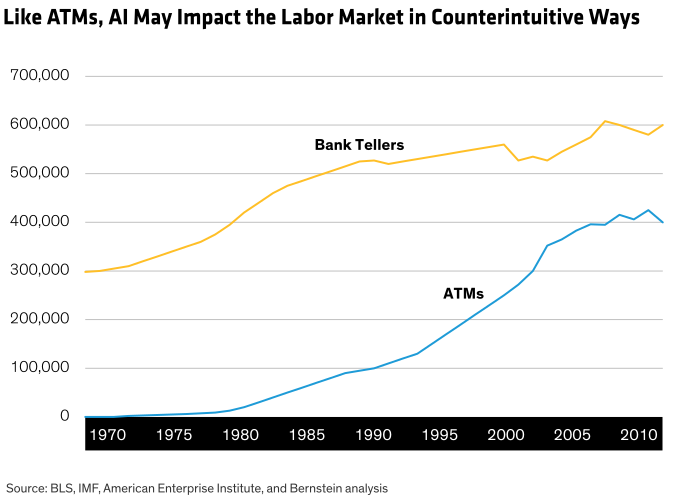
Consider the introduction of the ATM (Display), which many assumed would supplant bank teller jobs. Between 1985 and 2002, the number of ATMs grew from 60,000 to 352,000. But the ranks of bank tellers also swelled from around 500,000 to 527,000. Why? ATMs reduced branch operating costs, so banks opened more of them, though with fewer tellers. Plus, the teller role evolved—instead of just cashing checks, they focused on customer service and selling financial products.
We’re hearing similar anecdotes in the field of radiology. Following ChatGPT’s rollout three years ago, we flagged the efficiency of radiology as highly likely to improve with AI. The “godfather” of AI, Geoffrey Hinton, even went so far as to suggest we should stop training radiologists. And studies have shown significant improvements by specialized AI, saving 15%–40% of time, depending on the task.[1] Yet, the number of job postings for radiologists continues to climb. The American College of Radiology’s Career Center job board—the “gold standard” for the field’s job market—consistently saw roughly 500–600 postings in 2016. By March 2024, that figure had risen to over 1,400 and stands at 1,964 today.
That raises one of the more underappreciated angles: if AI does spur a giant leap in productivity, we’ll likely make and buy more stuff, rather than keeping output the same. But what types of goods and services will see a spike and who will make them? What new business models and what new industry dynamics will emerge? These are all questions worth pondering, and frankly, are among those that intrigue us most as investors.
Capital’s Role in AI Labor Redeployment
We must also consider that labor isn’t productive without capital. New enterprises may absorb displaced workers, but they also need to be funded. Everyone talks about hundreds of billions per year in anticipated AI capex. Yet we almost never hear about the trillions of dollars in incremental capital that will be required to redeploy workers and produce all that new stuff.
Those latent capital market demands will likely generate even more investment opportunities. And with capital raising shifting to private markets, we suspect much of that capital deployment and value creation will take place outside of public exchanges. That will be an important consideration for venture and growth equity investors. Relatedly, if AI technology changes the cost structure for startups, it may stoke demand for venture debt, since companies may be able to achieve positive cash flows at an earlier stage.
The Wild Card: Artificial General Intelligence
Much of our perspective has been predicated on continued advancements in AI, increasing its utility without making the leap to AGI. The rules of the game could face a sharp jolt if that occurs—something we should be aware of, though we’re less sure how to prepare for it.
Attaining AGI could allow computers to become even more effective than humans at a wide variety of tasks. At that point, the lines between labor and capital start to blur and the existing social contracts between labor and capital—and between citizens, companies, and governments—may need to be rewritten.
Nobody knows if or when that could happen. Some technology leaders—OpenAI’s Sam Altman, Anthropic’s Dario Amodei, Google DeepMind’s Demis Hassabis, and xAI’s Elon Musk—all anticipate AGI, or at least functionally similar advancements, within five years. Others, including Meta’s former AI chief Yann LeCun and the aforementioned Geoffrey Hinton, are more cautious.
The potential for AI to enhance productivity and reshape industries is undeniable, but it also brings with it a wave of uncertainty about the future of work. Will younger generations find themselves navigating a landscape filled with new opportunities, or will they face the daunting challenge of displacement? Society may grapple with that issue, but from an investor’s standpoint, you probably still want to be in control of the development, implementation, and distribution of that technology so you can best harness its value. The future of work is not just a challenge; it’s a chance to invest in a more dynamic economy.
[1] In a large‑scale clinical deployment across the Northwestern Medicine health system, a workflow‑integrated generative AI tool improved radiograph report completion efficiency by an average of 15.5%, with some radiologists achieving productivity gains of up to 40%, depending on modality and individual workflow, without compromising diagnostic accuracy. Source: https://www.mccormick.northwestern.edu/news/articles/2025/06/new-ai-transforms-radiology-with-speed-accuracy-never-seen-before/