
In the world of investing, market cycles often steal the spotlight with their dramatic ups and downs. But for taxable investors, the story involves more than riding the waves of volatility—it’s also about navigating the quiet, persistent undercurrent of taxes.
While market fluctuations come and go, taxes have a lasting impact, silently eroding your wealth by siphoning your principal, along with the compound growth it could have achieved.
Here’s how to refocus on what truly matters for long-term wealth preservation: after-tax compounding.
When a “Small” Tax Drag Leads to Wide Outcomes
Unlike the drama of market volatility, tax drag—the gradual reduction in your investment returns due to taxes on income, dividends, and capital gains—tends to sneak under the radar. But don’t be fooled. While subtle, taxes can have a significant impact on your portfolio’s long-term performance.
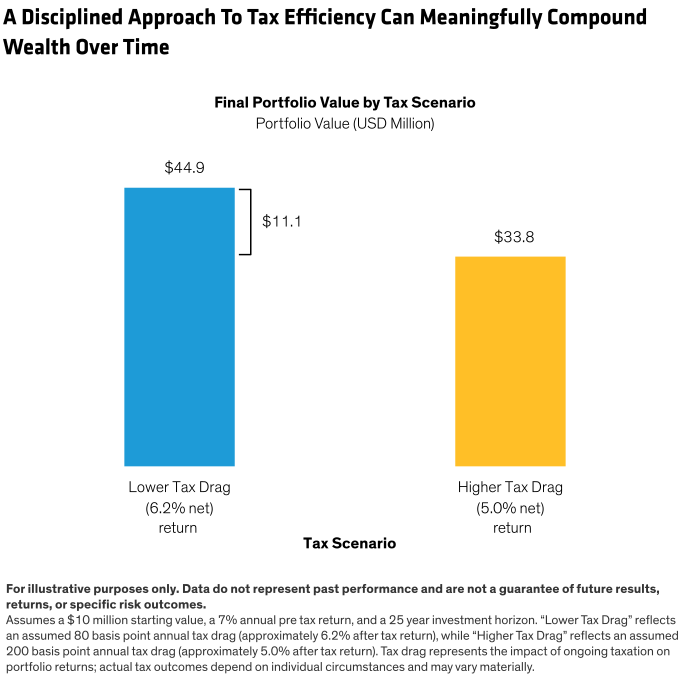
Imagine two portfolios with the same pretax returns and market risk. The only difference is the tax drag: one experiences a 0.8% drag, while the other faces a 2.0% drag each year.[1] At first glance, a 1.2% difference might not seem like much. Yet over two and a half decades, this seemingly narrow gap can lead to a whopping $11.1 million difference in wealth on a $10 million portfolio (Display). That’s about one-third more wealth, achieved not by taking on more market risk, but by simply minimizing the persistent friction of taxes.
How Uncoordinated Planning Can Undermine Wealth
Wealth’s real attrition rarely comes from one big mistake. Instead, it’s often the result of a series of small decisions that go unnoticed:
- Unnecessary trading that heightens turnover, accelerating taxable gains
- Asset location by default rather than design, such as failing to strategically place investments in taxable versus tax-advantaged accounts
- Poor timing of liquidity events
- Transfers that squander tax advantages and future flexibility (like forfeiting basis)
Each decision might seem sensible in a vacuum, but cumulatively, they can impair your long-term wealth.
This is where traditional planning tends to fall short. When investment, tax, and estate decisions happen in silos, any coordination happens too late, if at all. The outcome? Short-term tax savings that ultimately increase long-term tax drag, silently undermining your wealth’s growth potential.
How Can You Prevent the Erosion of Taxes?
Many investors approach strategies like loss harvesting, asset location, setting up trusts, making gifts, and transferring assets to charities as items to cross off their checklist. But few investors have a cohesive approach that ties them all together. That can be problematic. Because when these techniques lack a unifying framework, they can sometimes work against each other, resulting in unexpected tax burdens, limited liquidity, or added complexity.
This is where Total Tax Optimization (TTO) comes in. Rather than a single strategy or outcome, TTO is a framework for making more informed, tax-aware decisions across your entire portfolio. It encourages investors to evaluate each decision through three complementary lenses—asset location, tax-aware investing, and estate planning—while recognizing the trade-offs inherent in any approach. Put simply, by adopting TTO, investors can better preserve their wealth and enhance their financial outcomes.
Three Levers That Drive Long‑Run After‑Tax Outcomes
When focusing on long-term after-tax outcomes, three strategies stand out: embracing tax-aware portfolio management, making smart decisions about where to hold your assets, and efficiently transferring wealth. Let’s explore each in turn.
1) Embracing Tax-Aware Portfolio Management
Not all returns are taxed equally. Some are taxed immediately as earned, while others are only taxed when you sell. That asymmetry is powerful because paying taxes early permanently reduces the capital available to compound.
Tax‑aware portfolio management turns this lopsided dynamic in your favor using three main levers:
- Convert short‑term taxable gains into long‑term opportunities for compounding
- Reduce selling to extend the compounding runway
- Harvest investment losses as strategic assets to offset gains and reduce taxes
By treating taxes as a variable you can manage, rather than a fixed cost, tax-aware portfolio management helps minimize tax drag so you can reinvest more of your returns.
2) Making Smart Asset Location Decisions
Just as realization governs when taxes are triggered, your tax environment governs where returns compound. Taxable accounts, retirement vehicles, trusts, and charities determine not just timing, but rates, deferral, and constraints.
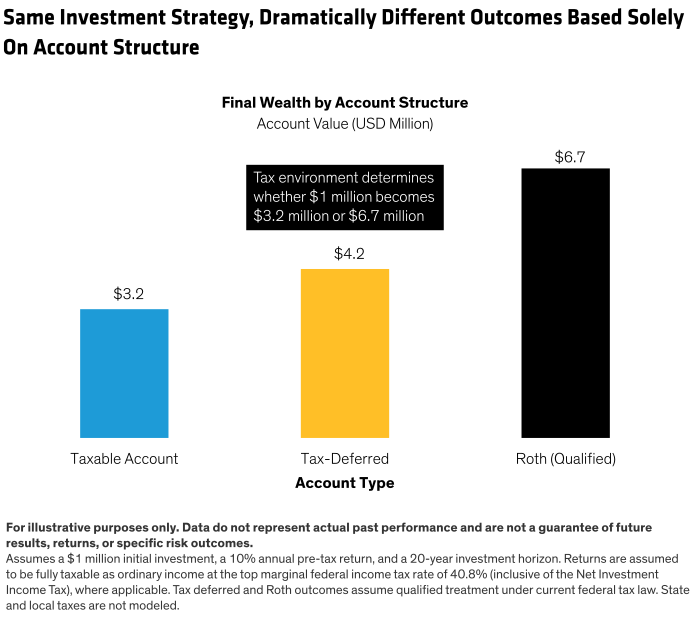
Since tax‑advantaged capacity is limited, astute asset location is a way to ensure scarce tax‑efficient space is reserved for the return streams most vulnerable to ongoing taxation. For instance, allocating $1 million to a tax-efficient strategy earning 10% for 20 years enhances compounding by roughly 1.6% annually for the same risk and expected return (Display). Notably, annual taxation reduces the effective return of the taxable account from 10% to 5.9%, limiting compound growth over two decades. In contrast, the tax-deferred account allows full pretax compounding to $6.7 million, though distribution tax reduces the final value to $4.2 million—about 34% more than taxable.[2] Meanwhile, the Roth account with qualified distributions retains the complete compounded value of $6.7 million, demonstrating its tax-free growth advantage.[3]
Purchasing Extra Tax‑Efficient Capacity
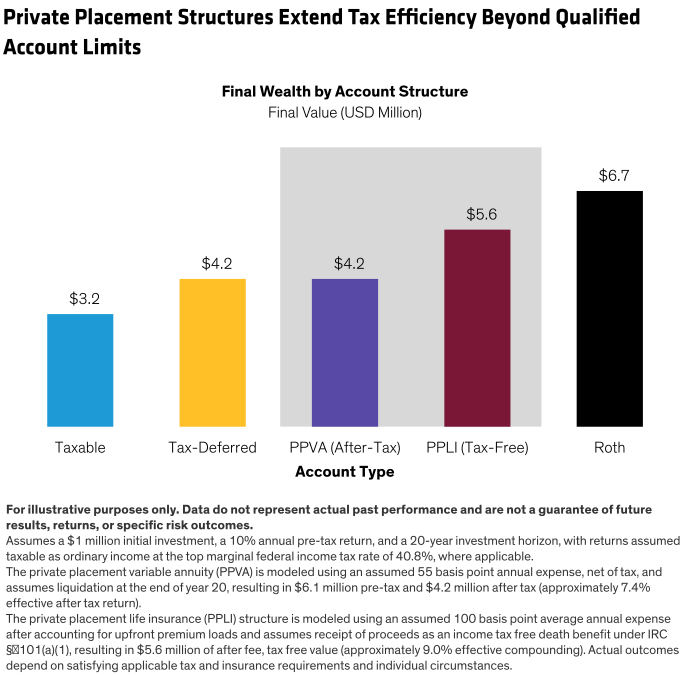
For many families, statutory limits mean traditional retirement accounts aren’t enough. Fortunately, capacity can be expanded in some cases through insurance‑based structures like PPVA and PPLI, whose tax treatment derives from life insurance exclusions.
The economic test comes down to: does the tax drag of holding the strategy in a taxable account exceed the costs and constraints of an insurance wrapper?[4] Applying the same assumptions as the previous example, PPVA improves returns by 1.5% after fees versus taxable ownership. When held until death, PPLI can be even more compelling (Display).
3) Efficiently Transferring Wealth
Cost‑basis planning is central to wealth transfer, as it focuses on preserving the financial benefits of adjusting asset values at death (i.e., basis adjustment). Currently, when someone passes away, the assets included in their estate are reset to their fair market value. This means any unrealized gains are erased, but so are any unrealized losses that could have been deducted.
In short, if you hold onto valuable assets until you pass away, you might avoid paying capital gains tax on them altogether. But if you have assets that have lost value and don't sell them before you die, you lose the chance to claim those losses on your taxes. How you transfer assets matters: gifts made while you’re alive keep their original value, but assets held until death get revalued.
The bottom line? Planning goes awry when you treat cost basis as an afterthought and focus solely on estate or gift taxes without considering the income tax implications.
In a Total Tax Optimization framework, cost-basis is seen as a valuable but fleeting opportunity. Its value depends on which assets you gift, which you keep, and when you decide to sell them. Once the adjustment occurs, your optionality is gone.
Why an Integrated Approach Matters to Long-Term After-Tax Wealth
In the end, after-tax wealth is shaped by a handful of decisions that may not seem urgent in the moment but can make a meaningful difference over time. How long you hold investments, where you place them, and how you plan for a basis adjustment all influence how much of your capital stays invested and keeps compounding. When those choices are made thoughtfully and in concert, more of your wealth can keep working for you instead of being lost to avoidable tax drag.
[1] Bergstresser, D., & Pontiff, J. (2013). “Investment Taxation and Portfolio Performance.” Journal of Public Economics, 97, 245–257.
[2] IRC §§ 401(a), 408(d).
[3] IRC § 408A(d).
[4] IRC §§ 72(e), 7702.
Talk to Us About Your Tax Situation
Connect with our specialists for customized solutions.