

Rebalancing looks simple on paper: set a target allocation, monitor the drift, and trade when the portfolio moves too far off course. In practice, taxable investors face a more nuanced trade-off. Rebalancing helps control risk, but every trade can also create costs. The art is knowing where risk control ends and unnecessary trading begins.
How Tax-Aware Investors Should Think About Rebalancing Triggers
Our analysis shows that a trigger-based approach—rebalancing when portfolio weights move outside preset bands—provides a better indication of when to rebalance than a calendar-based approach (rebalancing monthly, quarterly, or annually). But an effective rebalancing policy must also address a second question: how far should the portfolio be rebalanced once a trigger is reached? A common assumption is that once a portfolio breaches a rebalancing threshold, it should be restored fully back to its target allocation. Our research suggests there’s often a more efficient approach.
The reason? Rebalancing generates costs every time assets are bought and sold. While bringing a portfolio closer to its target allocation helps reduce the unintended risk from tracking error, the incremental benefit of each additional trade becomes smaller as the portfolio gets closer to its target. In other words, at some point, the cost of making another trade outweighs the benefit of reducing a very small remaining allocation difference.
Why “Halfway Back” May Be the Smarter Rebalancing Strategy
Consider an investor with a target allocation of 70% stocks and 30% bonds and a rebalancing trigger of ±5%. If the bond allocation drifts from 30% to 35%, a traditional rebalancing approach would sell bonds until the allocation returns all the way back to 30%. However, much of the risk-control benefit is achieved well before the final trade is executed. In other words, eliminating the first half of a portfolio's drift removes much of the unintended risk, while eliminating the last fraction of the drift often requires additional trading but provides relatively little additional benefit.
A more efficient approach? Rebalance the out-of-balance asset class approximately halfway back toward its target allocation. In the example above, rather than reducing bonds from 35% all the way back to 30%, the allocation would be adjusted to 32.5%. This approach captures much of the benefit of rebalancing while reducing the amount of trading required. The result is lower implementation costs, and in taxable accounts, potentially lower taxes without materially compromising the portfolio’s alignment with its strategic allocation.
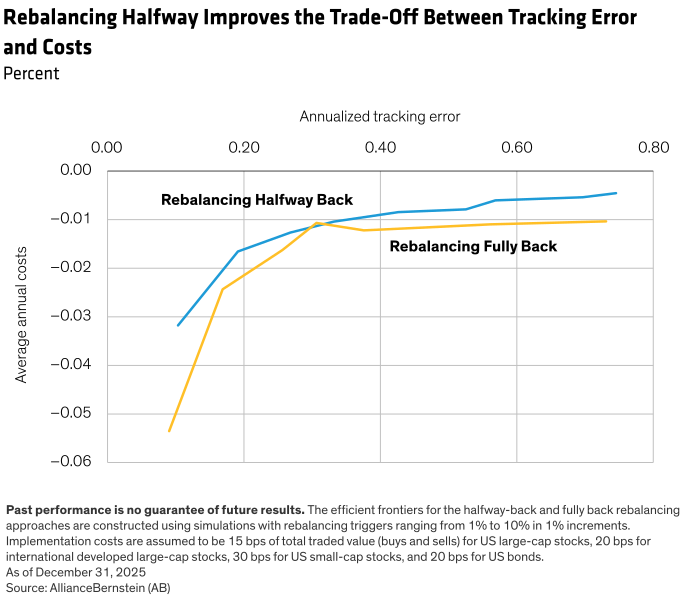
To evaluate this approach, we simulated the tracking error and transaction costs associated with rebalancing halfway back to target versus rebalancing fully back to target (Display). The efficient frontier (the set of portfolios that offers the best trade-off between risk and cost) for the halfway-back approach lies above that of the fully back approach.
While the difference is modest, it consistently demonstrates a more attractive trade-off between maintaining allocation discipline and controlling costs using the halfway-back approach. In other words, for a given level of tracking error, the halfway-back approach generally incurs lower costs. Alternatively, for a given level of cost, it can often maintain tighter alignment with the target allocation. This is one way a tax-aware rebalancing framework aims to add value: by recognizing that effective rebalancing is not simply about trading more, but about trading efficiently.
Soft Rebalancing Can Reduce Trading Costs
Another way to add value in rebalancing is by using portfolio cash flows as a form of “free” rebalancing. For example, new contributions can be directed toward underweight asset classes, while withdrawals can be funded from overweight asset classes. This allows the portfolio to move back toward its target allocation without requiring additional trade. We call this “soft rebalancing.”
Even in portfolios without external cash flows, opportunities for soft rebalancing still exist. Stocks pay dividends, bonds generate coupon payments, and bonds periodically mature and return principal. Rather than automatically reinvesting these cash flows into the same asset class, they can be directed toward areas of the portfolio that have become underweight.
For instance, if stocks have appreciated and become overweight relative to bonds, dividends generated by the stock allocation can be invested in bonds instead. Over time, this helps move the portfolio back toward its target allocation while reducing the need for more true rebalancing with costly buy-and-sell transactions. By taking advantage of these natural cash flows, soft rebalancing can reduce both transaction costs and, in taxable accounts, potential tax consequences. It allows portfolios to maintain allocation discipline in a more cost-efficient manner.
While this may seem straightforward, it’s far from a widespread practice. That’s because implementing this approach requires portfolio management systems capable of monitoring allocations and directing cash flows appropriately. Yet select managers incorporate these tax-sensitive capabilities, offering another way to improve rebalancing efficiency and enhance long-term client outcomes.
Smarter Rebalancing Starts with Knowing When to Stop
Rebalancing is essential for keeping portfolios aligned with long-term goals—but in taxable accounts, more trading is not always better. The most effective approach is not about forcing portfolios back to perfect target weights at any cost. It’s about making thoughtful, cost-aware decisions that balance risk control with after-tax efficiency.
That means using triggers to identify when action is needed, rebalancing only as far as the benefits justify, and taking advantage of portfolio cash flows whenever possible. For high-net-worth investors, the discipline of rebalancing still matters. But the real value may come from knowing when enough is enough.