

Ask 100 ultrahigh-net-worth families whether they hold “regular family meetings,” and only about a quarter will say yes. But ask whether they gather in other ways—a Sunday dinner, a holiday tradition, a family text thread—and nearly all do. That gap reveals something important about modern family stewardship: preparedness is rarely the result of a single, formal process. Instead, it’s built through stacking several recurring habits together.
That’s one of the most compelling insights from Bernstein’s Wealth Beyond Measure 2026 report, which draws on responses from more than 100 families Bernstein serves with an average net worth of $200 million. The most confident families are not those with an updated estate plan, a detailed cybersecurity protocol, or an annual family retreat. They’re the ones layering these practices together.
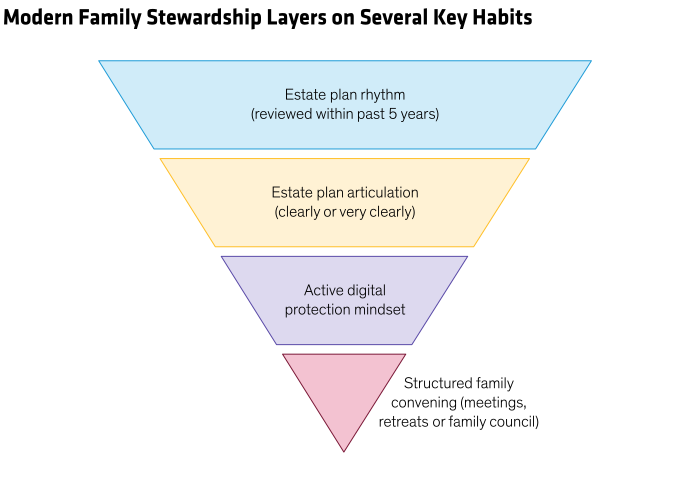
We found that when stewardship behaviors are pooled into one composite score that combines estate-plan readiness, an active digital-protection stance, and a structured form of family convening, the most confident respondents register meaningfully higher overall activity than the least confident—rising nearly four points on our composite scale. In other words, the “modern steward” isn’t the family chasing the perfect will, the guaranteed cybersecurity protocol, or the flawless family retreat. Rather, they’re building an effective system that can be repeated, reinforced, and handed down.
Habit One: Find the Right Review Rhythm
Start with the clearest habit in the data: confident families revisit their plan before life forces their hand. 53% of participants had reviewed their estate plan within the past year, and nearly nine in 10 had done so within the past five years. But the most telling finding may be what prompted those reviews. The largest single trigger wasn’t a death, divorce, liquidity event, or tax-law change—it was the routine planning cycle (41%).
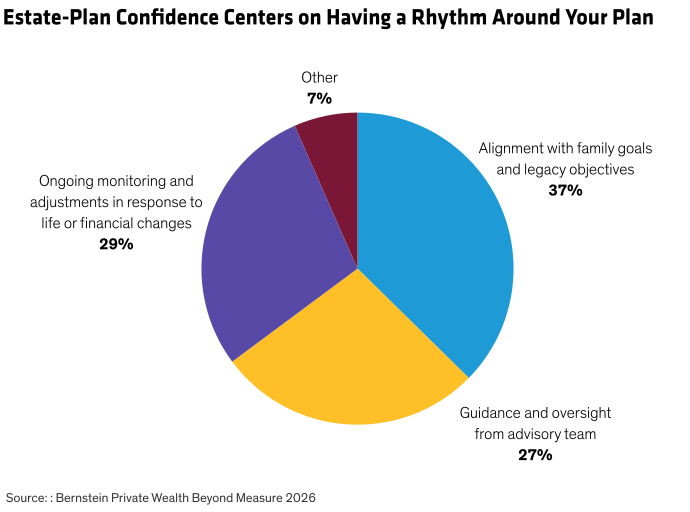
That distinction matters. When respondents were asked what makes them feel confident in their estate plan, the top three drivers were alignment with family goals (37%), advisor oversight (27%), and ongoing monitoring (29%) (Display). All three point to process, not paperwork. In short, confidence is less about having a plan on file than having a rhythm around it, whether that rhythm takes the form of a calendar trigger, an advisor check-in, or a recurring family conversation.
Families describe that rhythm in practical terms. As one third-generation family member with a family-owned business put it, “We’ll have maybe once a year, a meeting with our estate lawyers, and they’ll go through the different structures and vehicles that we have set up.” Another global entrepreneur, explaining why he rated his estate plan confidence a four out of five, said, “You have to stop and say…this is good enough just to print, but of course, you can think about more scenarios and more things. You can always…improve everything, but it is as up-to-date as it can be.”
Habit Two: Make Family Conversations a Practice
The second habit is convening—but the real insight hinges on how we define it. If you look broadly at text threads, family dinners, and traditions, 96% of respondents convene in some form. Yet while nearly every family communicates, the difference is whether those conversations are intentional enough to become a stewardship practice.
When narrowed to formal meetings, retreats, or councils, only 35% of respondents report structured convening, with just over 10% following a monthly or quarterly cadence. That share is roughly identical to those who report having regular family discussions about their estate plan itself—suggesting that structured convening is rarely the first step. It’s a practical, layered habit that appears once the basics, like having a plan, are already in place. Yet despite the ready accessibility, the gap between informal communication and structured convening is exactly where stewardship most often stalls.
Still, for some families, structure can be formal but relaxed. A fourth-generation leader of a family office observed, “We do a family retreat once a year where we bring the leadership team and the family business, and then key employees that help us run the foundation, as well as the whole family. We bring it together…somewhere super fun and do a little work and a whole lot of fun, and that’s important to get people together.”
For others, the value compounds over time. A senior member of a family office described a family summit followed by a family assembly: “With each one of those high-touch opportunities, I think…they’re becoming more and more involved and thinking more and more about this aggregated wealth.” In other words, convening is less about one perfect meeting than building the muscle memory to discuss shared wealth before a decision, transition, or crisis forces the conversation. By creating a forum for regular structured conversations, there’s already a format in place for when tricky topics or conflicts arise.
Habit Three: Adopt Digital Safeguards
The third layer is the newest and, for many families, the most overlooked. Just over half of respondents use multi-factor authentication, while 41% report no digital safeguards at all, and only 9% retain professional cybersecurity support. As a stand-alone metric, digital stewardship looks early-stage. But when viewed alongside confidence in trust-and-estate readiness, a clearer pattern emerges: 61% of high-confidence respondents—those who scored 4 or 5 on the survey’s trust-and-estate-readiness question—take an active stance on digital protection, versus 38% in the low-confidence tier and 30% in the middle. Digital safeguards are not yet universal, but they may be an early marker of families extending the same discipline they apply to estate planning and family communication to their digital lives.
The risk isn’t theoretical. As the CEO of an eighth-generation family office noted, “We’re constantly probing and phishing testing the hell out of our employees and educating the family regularly on cyber,” adding that “the real weak link is not the company, it’s really the lowest common denominator of knowledge and education [individuals] have about what they should and shouldn’t be doing with their own data.”
Another family office leader echoed the point: “I think having that security as a forefront of your family office is very important,” especially when protecting information “not just physically, but also virtually.” As risk becomes more distributed across devices, accounts, households, and generations, digital protection becomes a family governance issue.
Why AI Remains a Curiosity—For Now
Beyond the three core habits, one emerging theme deserves attention—even if it isn’t yet a practice most families have adopted. 39% of respondents are watching emerging technologies as an investment trend, but 87% say AI plays “none” or “not much” of a role in how they actually make investment decisions. The study’s in-depth interviews back this up. Families are intrigued by AI’s potential as a “co-pilot” or an “interesting” tool, but they’re not ready to hand over discretion.
One entrepreneur with a second-generation family business captured that tension: “AI’s going to be…a tremendous tool. It’s more of, what’s a practical application, and how can we leverage that, as far as thinking about our investments? We’re not there but we know there’s a need, we know there’s an opportunity.”
For now, it appears that AI is a curiosity worth exploring rather than a habit worth measuring when it comes to consequential decisions. Another interviewee with self-made wealth emphasized the human filter: “I really think everything should just be looked over from a human…standpoint, someone who can integrate all this different information. AI could maybe develop an amazing investment plan, but I just want it approved by an intelligent human being who knows what’s important to me and my goals.” For families still translating wealth into values, governance, security, and decision-making, that caution makes sense. Technology may accelerate inputs, but stewardship still depends on human judgment, especially when the decision revolves around what kind of legacy the family is trying to build.
What This Means for Building Confidence
For families, the takeaway is encouraging. Modern stewardship is not a single threshold to clear; it’s a sequence of habits to build. Start with a reliable estate plan review rhythm, then add more intentional family conversations. Extend that same discipline to digital safeguards and allow technology curiosity to layer in as the rest of the system matures. The most confident families aren’t the ones who have solved every problem. They are the ones who have learned to stack the right habits and made stewardship something they can pass down—providing an example for others still building their own rhythm.