
Most defined contribution plan sponsors already have an advisor. But is that advisory relationship built for the fiduciary pressure sponsors face now? Litigation is expanding, regulatory enforcement is intensifying, and governance gaps that once seemed manageable are becoming harder to defend.
ERISA fiduciary lawsuits reached near-record levels in 2025, with defined contribution plans named in roughly two-thirds of class actions.[i] Plaintiff firms have refined repeatable claims around fees, investments, documentation, and process, while the Supreme Court’s 2025 Cunningham v. Cornell University decision lowered the bar for certain prohibited-transaction claims to survive early dismissal. For sponsors without a formal, well-documented governance process, the margin for error is shrinking.
Small and midsize organizations may feel that shift most acutely. Many are managing retirement plans without dedicated internal teams, yet they are increasingly exposed to the same scrutiny that has long targeted larger plans. With the Department of Labor recovering more than $1.4 billion through enforcement actions in fiscal year 2025, the fiduciary standard of care is clearly rising.[ii] Sponsors who have not revisited how their advisory relationship is structured may be carrying more risk than they realize.
Why the Right Advisory Partner Is the Most Important Governance Decision You’ll Make
That is why the advisory relationship matters so much. Sponsors are managing retirement plan decisions amid constant legal, regulatory, and market change, often while the plan competes with dozens of other business priorities.
The right advisor helps close that gap by bringing discipline, continuity, and accountability to the process. When committee members turn over, the advisor preserves the institutional memory behind plan design, investment decisions, and governance practices. When rules shift, the advisor translates what changed and helps the plan respond. When markets evolve, the advisor benchmarks investments and fees against current alternatives. That ongoing oversight creates the record sponsors need if decisions are challenged, and it is difficult for most organizations to sustain on their own.
In that sense, choosing an advisory partner is not just a service decision. It is a governance decision: one that determines whether complexity is managed consistently, decisions are documented clearly, and the plan remains aligned with both fiduciary expectations and employee needs.
Two Fiduciary Structures That Formalize Accountability
The question that naturally follows is how to structure that advisory relationship in a way that formalizes accountability and matches how the plan operates. There are two primary frameworks, which differ in practice (Display).
%20Plan%20Sponsors%20Need%20More%20Than%20an%20Advisor%20Display1_d1.svg)
Under a 3(21) arrangement, the investment advisor acts as a co-fiduciary, providing recommendations on investment selection, ongoing monitoring, and governance support while the sponsor retains final decision-making authority. This structure works well for committees that are actively engaged and have the expertise to evaluate investment decisions, formalizing accountability around the process the committee is already following.
Under a 3(38) arrangement, investment discretion is formally delegated to a fiduciary investment manager who assumes responsibility for selecting, monitoring, and replacing investments. The sponsor’s role shifts to oversight, ensuring the manager is fulfilling their mandate through a prudent, documented process. 3(38) transfers both the decision-making responsibility—and the liability that comes with it—to the fiduciary manager, which is particularly valuable for sponsors that are stretched thin or for organizations that want a clearer separation between governance oversight and investment execution. This structure also often unlocks access to institutional pricing and investment vehicles that may not be available to the plan otherwise.
PEPs Offer Another Path to 401(k) Fiduciary Support
For sponsors looking to go further, a Pooled Employer Plan offers an additional path. By joining a professionally managed plan structure, sponsors can offload a significant portion of their fiduciary and administrative burden to the PEP’s pooled plan provider while still maintaining a retirement benefit tailored to their workforce. This is an increasingly relevant option for small and midsize organizations.
Each of these structures addresses a different version of the same fundamental question: how much fiduciary responsibility is the sponsor willing and able to carry, and where should discretion and liability sit? What matters most is that the structure is intentional, documented, and aligned with how the plan is governed day to day, because when decisions are tested, that alignment is exactly what courts and regulators look for.
What the Caesars Case Shows About Structural Protection
The Caesars Entertainment litigation shows why structure matters. Employees alleged that the plan’s discretionary investment manager replaced a diversified lineup with its own underperforming target-date funds, costing participants more than $100 million. The court dismissed claims against Caesars and its committees while allowing claims against the investment manager to proceed.
Why? Caesars had documented a prudent process before delegating discretion under a 3(38) arrangement, including independent consultants, multiple candidates, and negotiated terms. In Wanek v. Russell Investments, that record helped insulate the sponsor from liability when outcomes were challenged years later. Put simply, delegation only protects sponsors when it is intentional, documented, and overseen.
Governance Shapes Employee Outcomes More Than Most Sponsors Realize
Vanguard estimates that an effective advisory relationship adds approximately 4.5% in value over time.[iii] And that value comes from exactly the kind of hands-on work that strong advisory partnerships are built around: better portfolio construction, cost discipline through institutional pricing, and financial wellness support that helps employees make more informed decisions.
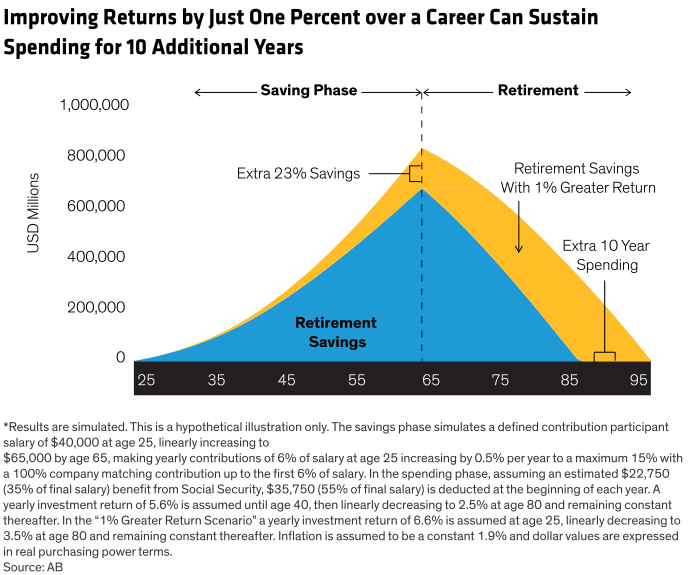
A sustained one-percentage-point improvement in annualized returns translates to nearly 25% more retirement savings over a full career, and that kind of improvement doesn’t require higher employer contributions or increased risk (Display). It comes from governance and plan design decisions applied consistently over time, supported by engagement that helps employees use the benefits they have.
A Practical Place to Start
Every plan has a next step.
It may be that overdue fee benchmarking, an outdated Investment Policy Statement, or a fresh look at whether a 3(21), 3(38), PEP, or standalone plan still fits the organization today. The sponsors best positioned for scrutiny are the ones who ask these questions early. They build cleaner documentation, stronger governance, and a fiduciary framework that reflects how the plan actually operates.
If you are wondering whether your plan governance would hold up under scrutiny, that is the right question. We would welcome the opportunity to help you answer it.
[i] ERISA fiduciary lawsuits reached near-record levels in 2025; defined contribution plans were named in 63% of ERISA class action litigation—PLANADVISER, “DC Plans Involved in 63% of 2025 ERISA Litigation,” Feb. 20, 2026, citing Encore Fiduciary analysis.
[ii] DOL recovered ~$1.4B in FY 2025; 878 civil investigations closed; 63% produced monetary results or corrective action—U.S. Department of Labor EBSA enforcement fact sheet (Jan 2026).
[iii] Vanguard Advisor’s Alpha (Nov 2021); PLANSPONSOR (Jun 2025); PSCA (Mar 2025).