

The old fixed-income playbook is starting to show its limits for affluent investors. While investment-grade bonds, traditional municipal funds, and select taxable credit strategies still have a role, expected returns across most fixed-income sectors are more constrained today. Many high-net-worth investors also continue to face meaningful tax friction from state taxes and deduction limits, despite lower federal income tax rates. And the search for more tax-efficient income increasingly comes with trade-offs: more credit risk, more leverage, or less liquidity.
That doesn’t mean the opportunity set has disappeared. In fact, one of the more compelling sources of income may be emerging from a familiar corner of the market—not because municipal bonds themselves have fundamentally changed, but because the municipal market has.
For decades, municipal bonds occupied a well-defined place in client portfolios, offering high-quality, transparent, and relatively liquid exposure compared with many other fixed-income investments. Yet for many investors, “municipals” still brings to mind large state and local governments issuing tax-free debt to fund public infrastructure improvements.
Increasingly, that picture is incomplete. The municipal credit market is evolving in ways that are changing where value is created. For long-term taxable investors, that shift is opening a compelling new opportunity set—but one that requires specialized knowledge, access, and credit underwriting expertise.
How Directly Sourced Municipal Credit Is Changing the Opportunity Set
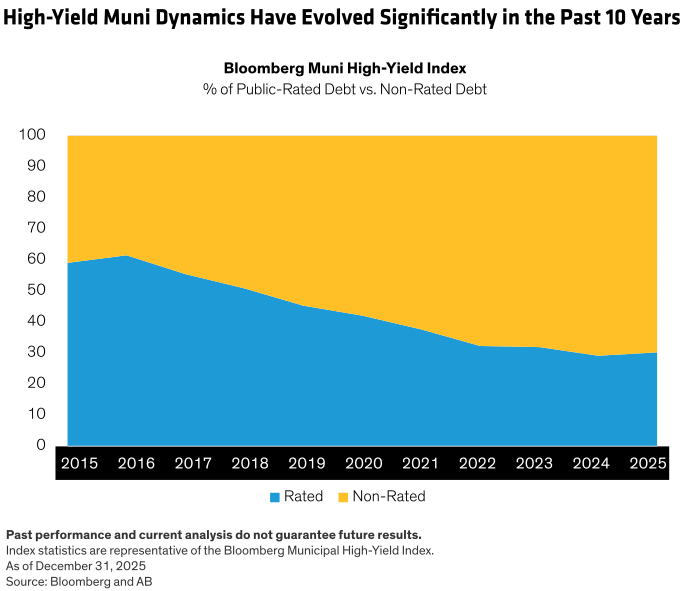
Over the past decade, the high-yield municipal market has changed dramatically.
The number of issuers has expanded significantly while average deal sizes have become smaller. At the same time, non-rated issuance has grown from roughly 40% of the market to 70%, reflecting a shift toward smaller, more specialized financings where obtaining a public rating often provides little economic benefit to issuers (Display). Meanwhile, sectors like infrastructure, affordable housing, healthcare, and public-private partnerships have generated an increasingly diverse pipeline of projects requiring customized financing solutions.
These changes have altered how many municipal transactions come to market. Rather than a single competitive pricing day, many transactions now begin months in advance through direct discussions between issuers, underwriters, and a relatively small group of institutional investors. Financing structures are often developed collaboratively, with terms, covenants, collateral packages, and repayment structures refined throughout the structuring process.
For investors with the expertise and resources to participate early, including a deep bench of credit analysts, this opens access to opportunities that may never become broadly distributed—or are too complex for smaller, unsophisticated teams to explore. In other words, many of the most attractive transactions may never make it to the traditional public marketplace.
Importantly, these securities are still municipal bonds. Many retain familiar characteristics such as CUSIPs, public disclosure, and third-party pricing. What has changed is not the instrument itself, but the path it takes to reach investors.
Why Directly Sourced Municipal Bonds Differ from Private Credit
It’s tempting to describe this segment as “private credit for municipals,” but that comparison only tells part of the story.
Unlike traditional private credit, these investments are generally issued as bonds rather than bespoke loans. They often retain standardized documentation, observable pricing, and the ability to trade in secondary markets, even if their liquidity is more limited than for traditional public municipal securities. These features place directly sourced municipal credit in a hybrid category: less liquid than traditional public municipals, but generally more transparent and standardized than many private credit investments.
For investors, the trade-off becomes more than just public versus private. It is the deliberate exchange of some liquidity for access to a broader universe of municipal credit opportunities that have the potential to generate yield premiums and capital gains for those who know where to look.
The Role of Direct Municipal Credit in a Taxable Portfolio
For investors in the highest tax brackets, municipal bonds have long served as a cornerstone of tax-efficient income generation. What’s changed is the breadth of opportunities available within the asset class itself.
Traditional municipal portfolios remain an important foundation, providing daily liquidity, broad diversification, and efficient market exposure. But for investors with longer investment horizons and limited near-term liquidity needs, there may be an opportunity to complement traditional allocations with exposure to directly sourced municipal credit.
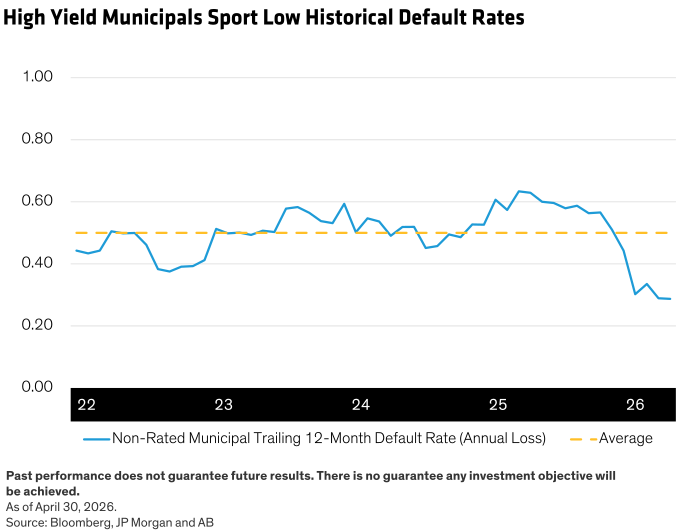
Rather than replacing core muni holdings or replicating private credit, the goal is to broaden the investable universe. This is accomplished by accessing transactions that sit outside traditional public market distribution while preserving many of the characteristics that have long made municipal bonds attractive: attractive tax-free income and low relative default rates. In fact, non-rated high-yield municipals have historically experienced default rates averaging just 0.5% over the past five years (Display).
Seen in this light, liquidity becomes an intentional decision instead of an unavoidable product constraint.
A Different Way to Think About Municipal Investing
To be clear, public municipal markets aren’t disappearing. But the opportunity set is becoming broader, more fragmented, and increasingly dependent on specialized expertise.
At one end sits highly liquid, benchmark-oriented municipal strategies that provide efficient exposure to publicly available markets. At the other are privately negotiated municipal financings offering greater structuring flexibility, deeper underwriting engagement, and more limited liquidity.
Between those endpoints sits a growing segment of directly sourced municipal credit—still bond-based, still largely tax exempt, but shaped by earlier participation in the capital formation process.
As the municipal market continues to evolve, competitive advantage may depend less on identifying the best bonds after issuance and more on participating before issuance ever begins. For long-term taxable investors willing to exchange some liquidity for broader access, that evolution may represent one of the more significant—and underappreciated—changes in municipal investing over the past decade.