

When markets move, rebalancing a stock-and-bond portfolio can be relatively straightforward: trim what has grown, add to what has lagged, and restore the target mix in a tax-efficient manner. Unfortunately, private markets don’t work that way. Commitments are called over years, distributions arrive on their own timeline, and exposure can drift even when you’re following your plan. That makes commitment pacing key when investing in illiquid asset classes.
How Traditional Rebalancing Breaks Down in Private Markets
Rebalancing becomes more challenging when portfolios include illiquid private market investments such as private equity, venture capital, private credit, and private real estate. Unlike public stocks and bonds, private market investments cannot typically be bought or sold on demand. Investors commit capital to a fund at inception, but that capital is drawn down gradually through capital calls over a multiyear investment period, often lasting five years or more. As investment opportunities are identified, the fund manager then determines when capital is deployed. Similarly, capital is returned gradually through distributions as underlying investments are realized.
Put simply, investors have less direct control over their private market allocation than they do with liquid assets. Managers may accelerate deployment when opportunities are attractive and slow it when opportunities are scarce. Once invested, capital may remain locked up for years before being returned. That makes traditional rebalancing—simply buying or selling assets to restore target weights—impractical for private alternatives. Instead, investors need a disciplined commitment pacing strategy: making new commitments over time to build and maintain target exposure while accounting for liquidity needs, capital calls, distributions, and diversification across vintages.
In many ways, you can think of commitment pacing as the private-market equivalent of rebalancing. While liquid portfolios can be adjusted directly by buying and selling securities, private market exposure must be steered more indirectly through the timing and size of new commitments. If distributions push an allocation below target, future commitments may need to increase. If exposure grows beyond its intended range, new commitments can be reduced or delayed. Over time, those decisions help guide the portfolio back toward its strategic allocation.
Private Market Commitments vs. Allocations: Why Exposure Takes Time to Build
The first step is recognizing that a commitment does not immediately become invested exposure. When investors commit capital to private equity, venture capital, private credit, or private real estate funds, that money is typically drawn down over time through capital calls—not deployed all at once.
That’s an important distinction. A portfolio may appear underallocated even after a sizable commitment because capital has not yet been called. Later, distributions from older funds may arrive while newer commitments are still being drawn, making exposure a moving target. Investors therefore need to look beyond today’s reported allocation and consider unfunded commitments, expected capital calls, anticipated distributions, and the likely pace of deployment (Display).
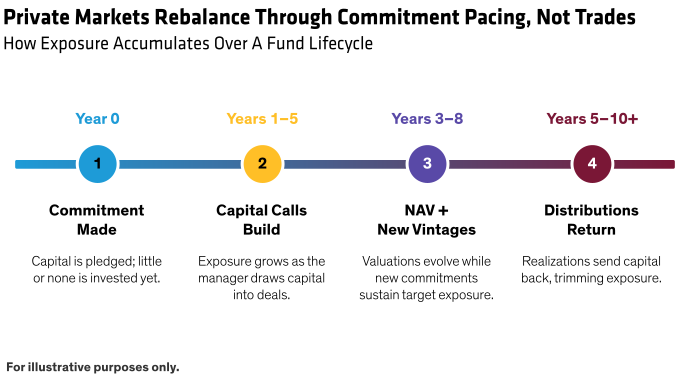
Still, pacing is less precise than rebalancing liquid assets. Capital calls, distributions, investment performance, and market conditions all affect the path of private market exposure. For that reason, investors should view pacing as a framework for keeping private market exposure reasonably aligned with long-term objectives—not a tool for maintaining a perfect allocation at every point in time.
Vintage Year Diversification: Managing Private Market Timing Risk
Commitment pacing also helps reduce vintage-year concentration. Because private market funds invest capital over several years, outcomes can be shaped by the environment in which commitments are made and capital is deployed. Committing too much in one period may leave investors overly exposed to a single valuation, credit, or exit-market backdrop. On the other hand, spreading commitments across multiple vintage years can diversify entry points and reduce reliance on one market moment.
In public markets, investors may use rebalancing or dollar-cost averaging to manage timing risk. In private markets, vintage-year diversification plays a similar role—but requires planning ahead, since exposure can’t be adjusted on demand. But keep in mind, the goal isn’t to identify the best vintage year in advance. It’s to build a systematic approach that can stay disciplined across changing market conditions.
Capital Call Liquidity Planning: Avoiding Forced Sales in Private Markets
Pacing also depends on liquidity planning. Investors must be ready to meet capital calls when they arrive, even though the timing is uncertain. Holding all unfunded commitments in cash may reduce shortfall risk, but it can create return drag if capital is called gradually over years. Investing those dollars too aggressively creates the opposite problem: needing to sell at the wrong time to meet a capital call.
A dedicated funding account can help balance those trade-offs. Depending on liquidity needs, tax profile, and expected drawdown schedule, it may hold cash, bonds, or other liquid assets designed to keep capital available without leaving it entirely idle. Investors should also be careful about what they consider “liquid.” Semi-liquid vehicles like interval funds typically provide only periodic windows for liquidity and repurchase requests may be prorated when they exceed the amount a fund offers to repurchase (for example, some interval funds offer quarterly repurchases of only 5% of outstanding shares). In extreme market stress, liquidity can become even more constrained: under limited emergency circumstances, interval funds may suspend or postpone repurchase offers altogether. In short, “semi-liquid” can become effectively illiquid precisely when investors crave liquidity most.
Planning ahead with a dedicated funding account may also reduce the need to sell appreciated securities to fund capital calls, which can create tax consequences that erode after-tax returns. In that sense, liquidity management is not separate from the private market allocation—it’s what makes the allocation sustainable. Done well, commitment pacing gives investors a practical way to pursue the long-term benefits of private markets without letting illiquidity dictate short-term portfolio decisions.
The Bottom Line: Pacing Turns Illiquidity into a Planning Discipline
Private markets can play a valuable role in a long-term portfolio, but they require a different approach to staying on target. Because commitments, capital calls, distributions, and liquidity needs unfold over years, investors need a pacing framework that looks ahead—not just a rebalancing process that reacts to today’s allocation. By pairing disciplined commitments with vintage-year diversification and thoughtful liquidity planning, investors can build private market exposure more intentionally while preserving flexibility along the way.