

2026 has the potential to be one of the most consequential IPO years on record, with high-profile names across technology, aerospace, and infrastructure transitioning to public markets. Among them, SpaceX stands apart—not just for its scale or ambition, but for being one of the most powerful wealth engines in a generation.
Long-time owners of SpaceX shares have seen their account balances compound dramatically, well ahead of public market benchmarks. Now, facing an imminent IPO, a fresh challenge arises: How to plan for a potentially volatile ride as the countdown nears zero.
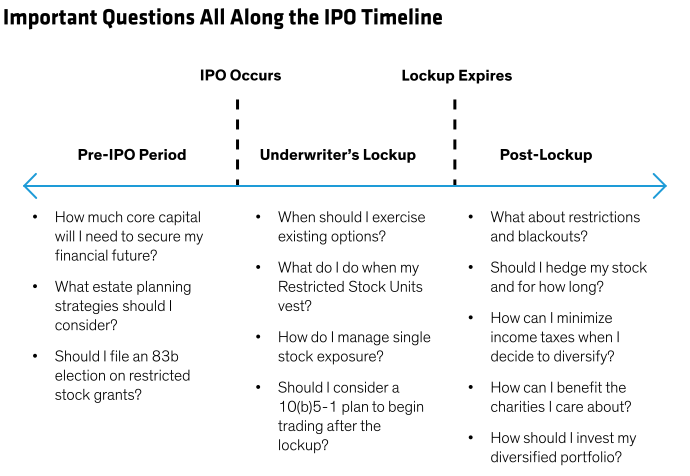
One common mistake? Waiting for the rocket boosters to cool before engaging in planning. That’s because preparing for an IPO unfolds along a continuum, not a single moment (Display).
How SpaceX Shareholders Can Calculate Core Capital Before an IPO
Before verifying you’re “go for launch”, you must understand your core capital needs. Think of core capital as the amount of diversified assets you’ll need to sustain your lifestyle over your lifetime, while withstanding high inflation and challenging market conditions with a high degree of confidence. Aside from your annual spending, your mix of diversified assets also drives your core capital needs. For instance, if you plan to spend $300,000 annually for the next 50 years, your core capital requirement declines as your asset allocation becomes more growth-oriented, but expected volatility increases (Display). In other words, choosing the ideal portfolio mix involves tradeoffs between allocating more assets to your core capital and the amount of investment risk you’re comfortable assuming.
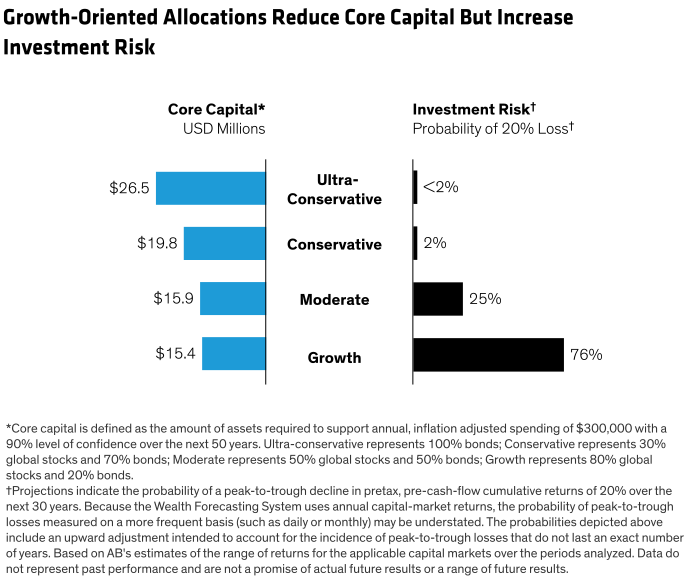
For a pre-IPO shareholder, knowing your core capital needs serves as a flight plan toward your ultimate destination: your diversified portfolio. But you needn’t reach it overnight. What’s more, core capital shapes other key wealth decisions. Any assets that exceed your core capital are considered surplus that’s available for major purchases, new ventures, or gifts for children and charity. Essentially, core capital planning sets the stage for how you could proceed once SpaceX goes public.
Estate Strategies to Consider
Faced with a potential windfall, you might start exploring estate planning strategies that help pass down wealth to future generations, such as Grantor Retained Annuity Trusts (GRATs). Creating a GRAT involves transferring assets to a grantor trust in exchange for fixed annuity payments for a set number of years. If structured properly, the present value of those payments, discounted by what’s called the Section 7520 rate, is treated as a qualified interest that reduces the value of your taxable gift.[1, 2] To minimize gift taxes, many estate planners aim to match the value of the annuity payments to the value of the assets funding the GRAT, resulting in a “zeroed-out” GRAT. At the end of the trust term, any remaining funds may be transferred to your descendants free of transfer tax.[3]
While a GRAT can be funded at any time, funding it with shares after the IPO ensures any future appreciation shifts to the next generation. On the other hand, if the shares fail to appreciate more than the hurdle rate (the Section 7520 rate), you’ll receive the shares back and be no worse off.[4]
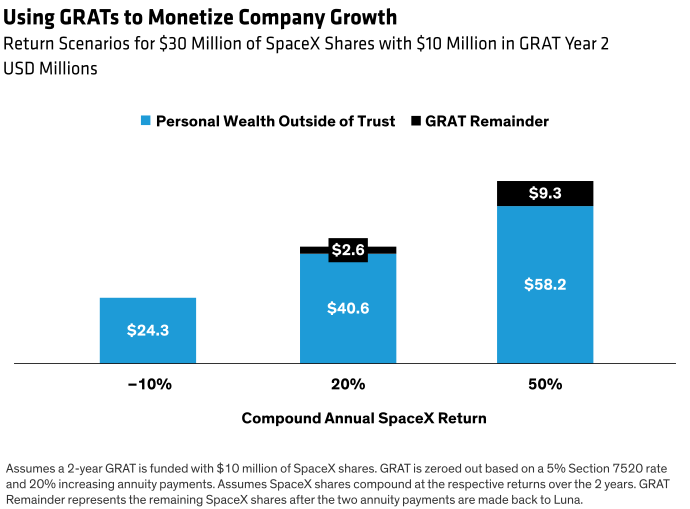
Let’s walk through an example. Take Luna, who owns directly held SpaceX shares that could be worth $30 million at the IPO. While she’d like to transfer some wealth to her children, she’s hesitant to gift the shares outright for fear of jeopardizing her core capital. Instead, she weighs putting $10 million of SpaceX shares into a 2-year GRAT with 20% increasing annuity payments and asks to see the potential results under different return assumptions for the stock (Display).[5] Our analysis shows that if the stock appreciates by 20% over the two-year term, Luna will transfer $2.6 million to her children. Conversely, if the stock fails to reach the stratosphere, Luna receives all of her shares back.
Easing into Orbit When Selling Post Lock-Up
Once the underwriting lock-up ends, shareholders must decide whether to trade immediately or hold a bit longer. While lock-ups have historically expired at a single point, often around the 180-day mark, not all companies follow this traditional structure. Some, like SpaceX, have introduced more complex, conditional release schedules that gradually expand trading eligibility in stages rather than unlocking all shares at once.
This distinction matters. Historically, a defined lock-up expiration date has often coincided with increased selling pressure, as a large cohort of shareholders simultaneously gain the ability to transact. In contrast, a more gradual release may diffuse that selling activity over a longer period, potentially softening the sharp price moves sometimes seen around traditional lock-up expirations.
For some context, we explored the historical performance of stocks around their lock-up release periods, focusing primarily on IPOs with fixed lock-up timelines. Specifically, we observed stock price movement during the first post-IPO year for operating companies that raised at least $50 million during the 10-year period ending April 30, 2025 (Display). We found that the average IPO stock blasted off, then struggled to maintain altitude before additional supply entered the market. Six months following the traditional lock-up end date, the median return was a roughly 10% decline. While most stocks began to recover, they typically failed to revisit their initial IPO heights.
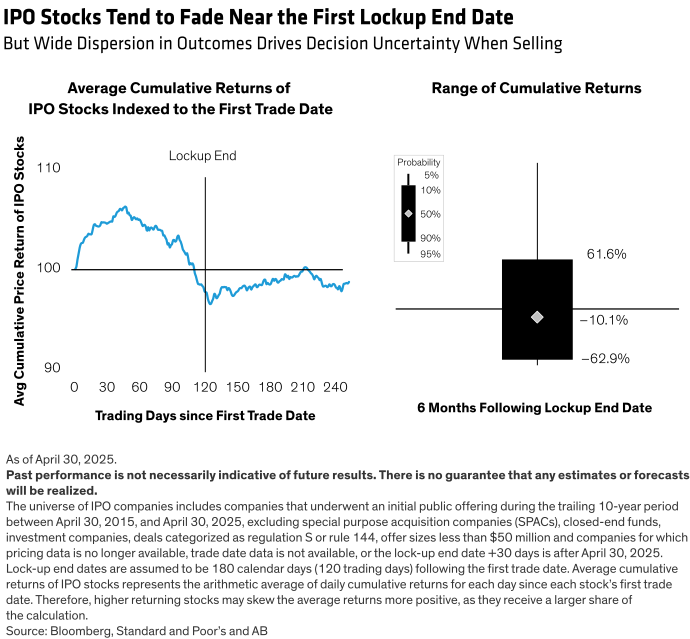
While you may be tempted to hold out for a rebound, the downside risk is substantial. In the six months following traditional lock-up expirations, one in 10 IPO stocks dropped by at least 62%. Even in situations with more flexible or staged releases, the underlying dynamic remains: periods of increasing liquidity can introduce volatility and lead to a wide dispersion of outcomes. Given this, many shareholders consider staged selling plans, whether formal 10b5-1 plans or informal guides, which aim to achieve diversification over time rather than around a single liquidity event. Successful plans typically spread sales out over days, weeks, or months, often paired with limit orders designed to capture outsized gains during the life of the trading plan.
How you sell your shares and invest the proceeds is equally important. Faced with the potential for high volatility, some shareholders may consider using options or exchange funds to hedge their SpaceX shares. Option-based hedging strategies, like zero-cost collars, offer a mix of protection and upside participation. Variable prepaid forwards provide similar benefits, but take it a step further by injecting liquidity, making them useful for limiting downside exposure without incurring immediate income taxes.
When considering options-based strategies, be sure to weigh the benefits against the implied transaction costs, including capping the upside and deciding whether to settle in cash or SpaceX stock when the contract expires. While some shareholders find hedging strategies to be powerful tools, current employees should consult the company’s insider trading policy for specifics on allowable hedging techniques.
How to Control the Afterburn of Taxes
How about managing taxes? Here, there are several popular strategies, including tax-loss harvesting or a leveraged tax-loss harvesting strategy (known as 130/30 or 150/50). These strategies aim to deliver equity index returns while taking losses on individual portfolio holdings that decline along the way. These losses can then be used to offset potential capital gains generated when selling to diversify SpaceX shares.
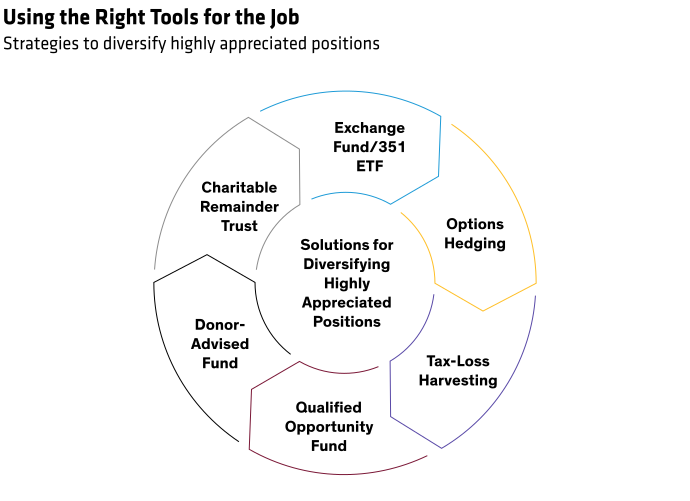
Notably, hedging and tax-loss harvesting strategies are just two ways to manage SpaceX exposure. Other tools, ranging from exchange funds and charitable remainder trusts to 351 ETF exchanges, can be used in isolation or together to help diversify concentrated stock positions while potentially shielding from income tax consequences (Display).
As SpaceX moves closer to what could be the largest IPO on record, the opportunity is hard to overstate—and so are the stakes. The right plan can help turn a volatile moment into a lasting advantage, with your goals, taxes, and timing working in sync before liftoff. Reach out to a Bernstein advisor to help you navigate the final station checks before launch.
[1] The Section 7520 rate is calculated as 120% of the mid-term Applicable Federal Rate (“AFR”). The mid-term AFR is, in turn, published monthly by the IRS.
[2] Internal Revenue Code Section 2702(b).
[3] The grantor must survive the GRAT term in order to remove the GRAT’s assets from the grantor’s taxable estate and to transfer appreciation above the 7520 rate to descendants. Some estate planners design GRATs so that the value of the remainder interest at inception is a small positive number, enabling the grantor to report the GRAT on a gift tax return; doing so should cause the three-year statute of limitations to run. Appreciation is not exempt from generation-skipping transfer tax.
[4] The grantor should consider, however, legal fees incurred to create the GRAT and administrative complexity involved in GRAT administration.
[5] Treasury Regulation Section 25.2702-3(b)(1)(ii)(A) allows GRAT annuity payments to increase by up to 20% each year.