

The IPO may be behind you, but now the hard part comes. Your ticker is live, and though the value of your holdings shifts in real time, you can’t sell a single share.
That tension often surfaces in the post-IPO lock-up period. Employees, executives, and early investors are typically restricted from selling for up to 180 days, though some companies now release shares in stages. The exact terms vary, making your lock-up agreement the essential guide to what’s permitted and when.
Fortunately, being unable to sell doesn’t mean you’re stuck. While selling and hedging are generally off the table, planning usually isn’t. A price pullback may create an opening for a grantor retained annuity trust (GRAT), while a surge may strengthen the case for a charitable gift of stock. Put simply, what if the lock-up isn’t in limbo—but one of your most valuable planning windows?
How Much IPO Stock Can You Afford to Transfer?
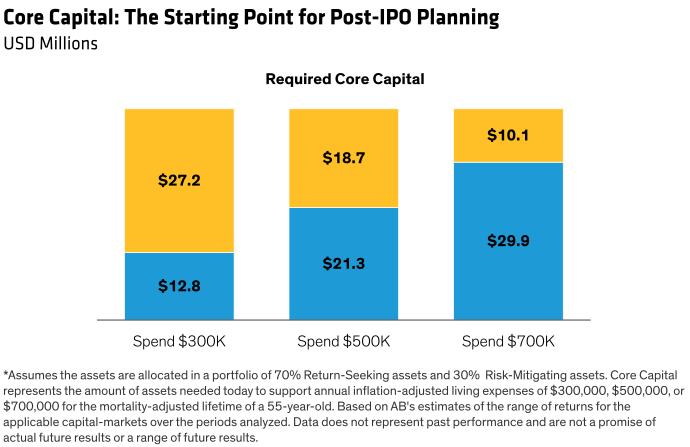
Before choosing a direction, start with core capital: the diversified wealth you need to sustain your lifestyle over your lifetime with a high degree of confidence, even through elevated inflation and difficult markets.
Knowing your core capital does two things. First, it tells you how much stock to sell over time once the lock-up lifts. Second, it shows you what’s left over. Anything above core capital is surplus capital, which you can use to transfer wealth to family, friends, or causes you care about.
Consider a 55-year-old shareholder who wants to spend $500,000 a year for life after taxes. Our sophisticated modeling projects they’d need $21.3 million in core capital. On a $40 million portfolio, that leaves $18.7 million of surplus capital available for other beneficiaries (Display).
Should You Use a Trust During an IPO Lock-Up Period?
While you can’t typically sell shares during the lock-up, many lock-up agreements allow gifts and transfers to trusts—often on the condition that the recipient agrees to the same restrictions. That raises an important question: When should you act on wealth transfer?
For shareholders thinking about gifts to family, post-IPO price swings can complicate matters. Imagine the worst case: you gift shares outright, using part of your lifetime exclusion, only for the stock to fall sharply. Your beneficiaries receive a fraction of what you intended, and you’ve spent valuable exclusion that you can’t get back.
But with a grantor retained annuity trust (GRAT), you can help limit that risk. How does a GRAT work? You transfer assets to the trust and receive annuity payments for a set number of years.
Many estate planners set the payments to roughly equal the value of the assets contributed, creating a “zeroed-out” GRAT. This means the grantor receives back all the value they contributed plus interest, calculated using the 7520 rate (which is based on US Treasury yields). If over the term of the GRAT the asset outperforms the hurdle rate, the excess appreciation can pass to your descendants free of transfer tax. If not, the assets come back to you and you’re no worse off.
A Post-IPO Stock Dip May Be the Best Time for a GRAT
Our research shows that newly public stocks often face price pressure after the first few weeks of trading. And watching your stock fall can be unsettling. But that may be exactly the right time to fund a GRAT. Here’s why.
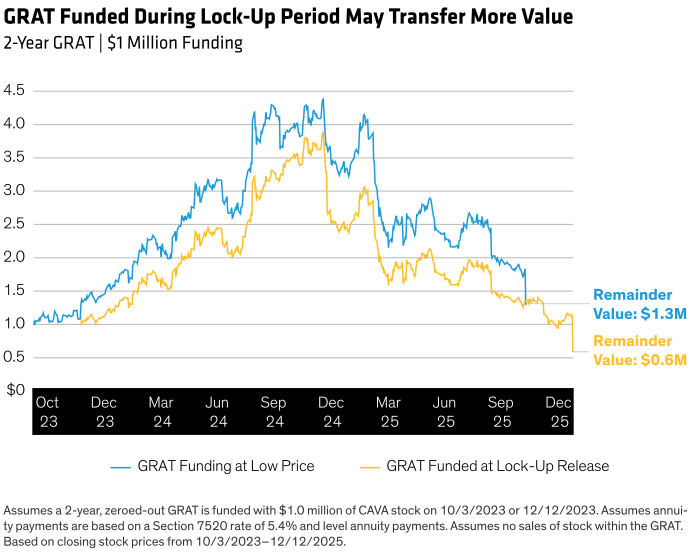
Take a representative stock that went through an IPO in 2023. It went public at $22 and closed at $43.78 after its first full trading day. The stock touched $57 before pulling back to the low $30s a few months later. From there, it soared past $150 by late 2024. Because the stock had a standard 180-day lock-up, pre-IPO shareholders couldn't sell until mid-December 2023.
Suppose a shareholder funded a two-year, $1 million GRAT with shares on the lock-up release date. The GRAT’s beneficiaries would have ultimately received about $597,000 (Display). Now suppose the same GRAT had been funded when pricing pressure hit the stock earlier that fall. It would have transferred about $1.3 million, or 118% more wealth, simply by acting during the lock-up rather than waiting for it to end.
Why an Elevated Price May Favor Charitable Gifts
If a post-IPO price dip creates an opening for a GRAT, a rising share price may point to a different strategy: charitable giving. Charitable giving can help you diversify in a tax-efficient way, once you settle on donating appreciated stock. Cash is simpler, but it is rarely the better choice.
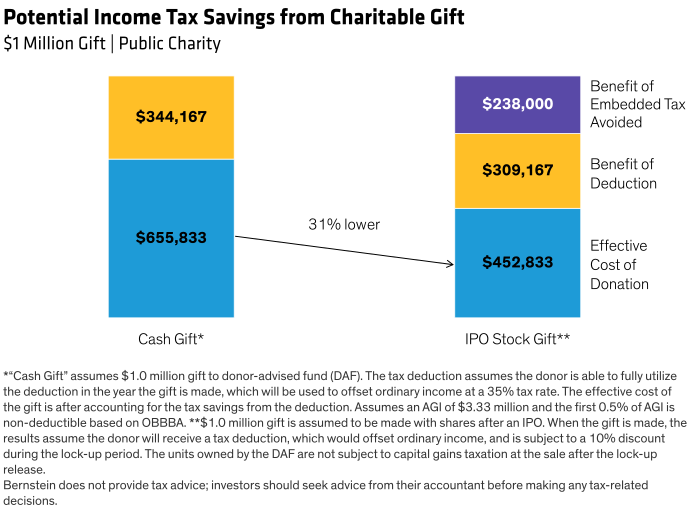
Newly public shares are often strong candidates because of their large built-in gains. If your stock climbs higher during the lock-up, you may be able to give IPO shares to charity and maximize the deduction before selling pressure builds around the lock-up release. Plus, donating appreciated stock in-kind provides two tax benefits. You receive a charitable deduction, subject to limits based on your adjusted gross income, but more importantly, you avoid paying tax on the embedded gain.
There is one trade-off, though. Because the shares can’t be sold right away, their fair market value for deduction purposes generally reflects a discount for the lock-up, which is typically determined through a qualified appraisal. Even so, gifting stock often comes out ahead.
Assuming a 10% discount, the effective cost of a gift could still be nearly 31% lower than making the same gift in cash (Display). Even with the discount, factors like a fear of a potential price decline or making a gift in the same calendar year as large tax events can make giving IPO shares during the lock-up period a valuable planning strategy.
How to Make the Most of Your IPO Lock-Up Period
Going public is an unquestionable milestone. And while you may not be able to sell yet, you can still move forward. Define your core capital so you’ll see how much you need to secure your lifestyle—and how much surplus you have to share with family or causes you care about. Then, whether your IPO stock rises or falls, view the lock-up period as a planning opportunity. While the stock is still settling, a price dip might favor a GRAT whereas a high price might favor a charitable gift. The shareholders who plan ahead during the lock-up are usually the ones ready to confidently act when it ends. To map out your best route, reach out to your Bernstein Advisor.