

Whether you ultimately sell, transition to the next generation, or remain independent, waiting for a buyer to come calling isn’t the best way to determine what your home services business may be worth. Having credible valuation can sharpen the decisions you make now—where to invest, who to hire, how to plan for succession, and how to protect what you’ve built.
It’s a question that’s becoming harder to ignore across the home services industry. Owners of HVAC companies, plumbing businesses, electrical contractors, roofing firms, and other essential-service companies have spent decades building trusted local brands and, often, far more value than they realize.
As private equity firms and strategic acquirers roll local operators into well-funded platforms, understanding what drives value is becoming increasingly vital. It can reveal where your business is strong, where future competitors may have an advantage, and which investments could expand your choices. Importantly, that fine-tuning rarely happens overnight. Improvements that buyers reward typically take 12 to 36 months to show up in the bottom line. Starting the conversation now gives you time to act deliberately while preserving the option to sell, transition to the next generation, or remain independent on stronger footing.
Why Home Services Businesses Are Attracting More Buyers
Plumbing, electrical, HVAC, flooring, roofing, landscaping, pest control, garage doors, fire and life safety systems, and numerous adjacent categories collectively represent a market estimated at more than $700 billion. What makes these businesses especially attractive is their resilience. Homeowners may postpone certain purchases, but they cannot indefinitely avoid repairing a broken air conditioner, replacing a failed electrical panel, or fixing a plumbing emergency.
Investors have taken notice. The home services market is seeing capital and buyer competition sit near cyclical highs while median post-money valuations (the value placed on the business when a deal closes) reached approximately $118 million in 2026, the highest level in the past decade (Display).

As owners weigh what these market conditions mean for them, it’s a natural time to seek professional advice. Alongside business consultants and those in M&A, professional wealth advisors can help you evaluate what the market will pay and how to best position your business to command a premium.
What Drives a Higher Home Services Business Valuation?
Investors increasingly recognize that modern home services companies often possess sophisticated technology platforms, professional management teams, scalable marketing capabilities, and recurring customer relationships—traits that allow acquirers to create value well beyond the original transaction.
But while buyers have been paying up for quality and scale, they’re not paying up across the board.
Instead, here’s what has tended to drive higher multiples:
- Recurring revenue: non-discretionary, repeatable work such as service agreements and maintenance contracts, which buyers value because it’s predictable
- Skilled workforce: a real bench of technicians and installers, which in this industry is often harder to acquire than customers
- Operational infrastructure: streamlined systems, dispatch, CRM, job costing, that let a business grow without the owner in every decision
- Scale and growth: proven momentum with room left to run
- Management depth: leadership that extends beyond the founder, so the business isn’t dependent on one person
- Brand/platform fit: local strength that plugs cleanly into a larger platform
What does all of this mean for home services founders? Clean up the financials early, document your systems and management, and position your growth and recurring revenue mix so a buyer can clearly visualize your future earnings.
How Can You Reduce the Tax Hit When Selling Your Home Services Business?
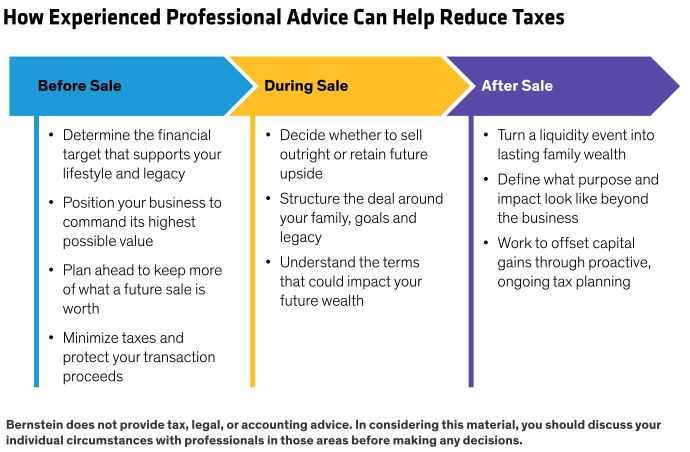
The value of your home services business is only one part of the equation. What ultimately matters is how much of the sale proceeds you keep after taxes. Because many tax-saving strategies must be implemented well before a transaction is underway, waiting until a buyer makes an offer can significantly narrow your options. Planning early allows your tax, estate, legal, and wealth advisors to evaluate the ownership structure, deal terms, charitable goals, and wealth-transfer opportunities together.
Before a sale: Establish a credible valuation range and model after-tax proceeds you may retain after federal, state and local taxes. Coordinate with your advisors early to evaluate potential planning opportunities—including ownership and estate-planning strategies, charitable giving, and the timing or structure of a transaction—before negotiations limit your flexibility.
During a sale: Evaluate more than the headline price. The allocation of the purchase price, the form and timing of payments, rollover equity, earnouts, and other deal terms can materially affect the transaction’s after-tax outcome.
After a sale: Once the transaction closes, tax planning shifts from the business to the proceeds. Build a coordinated investment, estate, and charitable plan designed to manage future taxes, diversify concentrated wealth, and preserve more for your family and the causes you value.
Keep in mind, the most expensive tax decision may be waiting too long to plan. By the time a letter of intent is signed, some of the most valuable strategies may no longer be available.
When Should Home Services Owners Start Exit Planning?
For most home services owners, selling a business is a once-in-a-lifetime event. But professional buyers evaluate and execute transactions every day. That imbalance makes preparation—and the right advice—especially important.
Don’t wait for a buyer or a deadline to determine what happens next. Start with a valuation, define what a successful outcome would mean for your family, and surround yourself with advisors who can evaluate the business, transaction, taxes, and your long-term wealth as an integrated whole. Ask yourself: If a sophisticated buyer reached out today, what would you be most excited for them to see? What would you wish you had another year to work on?
An early conversation with a wealth advisor who understands both sides of the transaction can help you identify blind spots, weigh competing deal terms, and keep the process aligned with your priorities. The sooner that planning begins, the more opportunity you have to strengthen the business, improve the transaction’s after-tax economics, and convert a lifetime of work into lasting flexibility.
Advice for Business Owners
Learn more about our focus on entrepreneurs and the professionals advising them.