

For founders with charitable inclinations, the year of an exit has long been the obvious year to give. The logic was simple: a once-in-a-lifetime liquidity event often produces a once-in-a-lifetime tax bill, and a significant charitable gift can offset some of that outsized income.
But certain provisions of the One Big Beautiful Bill Act (“OBBBA”) have since rewritten that math. Charitable contributions are now deductible only to the extent they exceed 0.5% of adjusted gross income (AGI)—and in a year when a sale sends AGI soaring, that floor can wipe out a meaningful share of a gift’s tax value. In other words, what was once conventional wisdom has now become a costly assumption. For business owners who are selling and their advisors, the question now goes beyond how much to give to when, and in what form.
Gifting Before or After a Business Sale: How the Numbers Compare
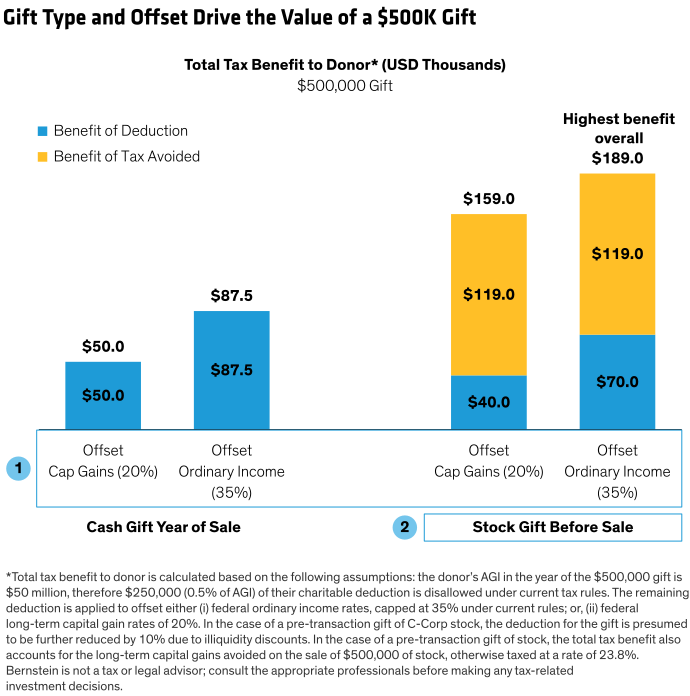
Consider a founder whose private C-Corp is headed for a sale expected to generate $50 million in pretax proceeds.1 Alongside the exit, he’s considering giving $500,000 to a donor-advised fund (“DAF”) or other public charity. The accompanying displays show how the value of that gift shifts depending on three choices: what the deduction offsets, what he gives, and then when he gives it.
Notably, at $50 million of AGI, the new 0.5% floor means the first $250,000 of his gift is nondeductible. Put simply, half of his contribution produces no tax benefit, however he structures it.
Here are the other factors at play:
1. What the deduction offsets matters, too. The remaining $250,000 deduction is worth $50,000 for a gift of cash if it offsets long-term capital gains taxed at 20%. If it offsets ordinary income, such as compensation paid at closing, it’s worth $87,500, because OBBBA now caps a deduction’s value at 35%.2
2. What he gives matters more. Suppose that instead of cash from the sale proceeds, he gives $500,000 of zero-basis C-Corp shares before the deal closes.3 He then permanently avoids capital gains tax on those shares, and the total benefit rises to $189,000.
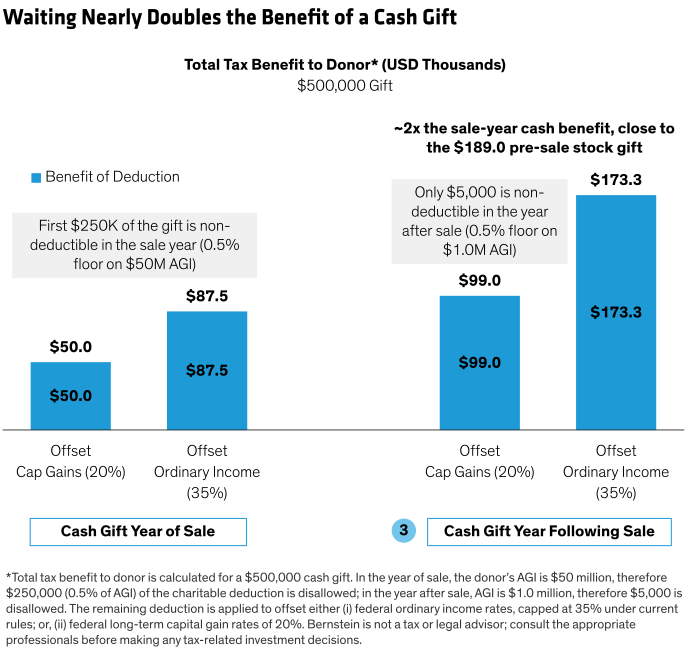
3. When he gives can close the gap. Now suppose he waits until the year after the sale, when his AGI settles at about $1 million, mostly from his newly liquid portfolio. The floor drops to just $5,000, leaving $495,000 deductible, nearly double the sale-year amount. At 35%, a simple cash gift is now worth $173,250, close to the pre-sale stock gift.4
Given this founder’s fact pattern, the conclusions are clear: if he moves forward with a cash gift, either for simplicity’s sake or timing considerations,5 he’s better off waiting until after the year of sale to maximize his available deduction. But completing a pre-transaction gift of his C-Corp interests instead of cash offers the strongest results, because the avoidance of capital gains tax on his shares outweighs even the reduced deduction from the 0.5% floor.
Keep in mind, these findings may vary if your business is structured as an S-Corp or LLC. Gifts of interests in these entities are highly likely to trigger unrelated business taxable income (UBTI), a liability that even tax-exempt charitable organizations like DAFs can’t avoid. This added liability reduces the wealth available to charity, eroding the benefit of this pre-transaction gift relative to a cash gift in a new tax year.
What Changes with a Larger Gift? AGI Limits Come into Play
There’s one other angle that may greatly influence the ideal path—the size of the charitable gift. What if our founder decided to earmark a more material portion of his proceeds, say, $5.0 million instead of $500,000? The conclusions above about the new 0.5% floor still hold for cash gifts. But a gift this large also runs into a long-standing limit: the cap on how much of his AGI he can offset with charitable deductions in a single tax year (Display).
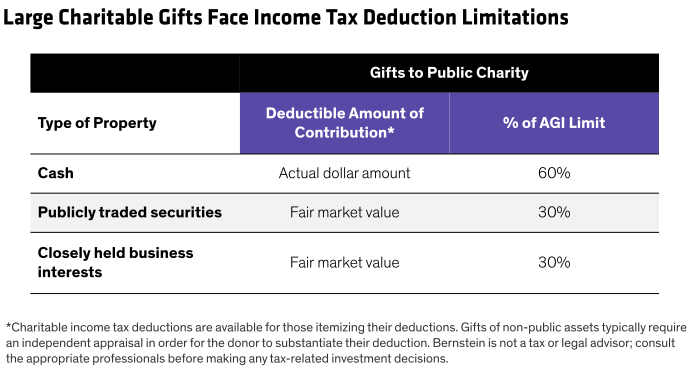
More specifically, taxpayers may only deduct up to 60% of their AGI in a given year from a gift of cash to a public charity (including a DAF), and 30% from a gift of appreciated stock. Unused deductions can be carried forward for up to five years at the federal level. But even so, substantial charitable gifts require careful income projections to determine whether donors will be able to completely leverage their deductions.
For instance, let’s revisit our founder. With a $500,000 cash gift, he came out ahead by waiting until the year after the sale. But if he applied the same strategy to a $5 million gift, he would need annual income of nearly $1.4 million to fully realize his tax benefit—even after spreading the deduction across the full carryforward period. That level of income may or may not be realistic once he is no longer working.
One note—exceeding the above-referenced AGI thresholds in a given year is the only way to trigger a carryforward of the disallowed deduction from the new 0.5% limitation. To enhance overall tax benefits, those considering gifts near applicable AGI limits might consider sizing up their gift to “pop over” such limits and carry forward their disallowed 0.5% deduction into a year with lower income levels.
Charitable Planning for Business Owners: Start Before the Sale
The old rule of thumb—give in the year you sell—no longer holds by default. For some founders, the year of sale may still be the right moment. But for others, it could cost them a meaningful share of their gift’s tax value. The difference comes down to what they give, when they give it, how much they give, and how their tax picture and income are likely to evolve long after the deal closes. That’s why charitable planning deserves a seat at the table well before a sale, and well after it. With a coordinated team of tax, financial, and legal advisors, business owners can make sure their generosity delivers its full impact for years to come.
[1] This article assumes the transaction is structured as a stock sale.
[2] OBBBA introduced a new limitation that reduces itemized deductions by 2/37 of the lesser of (i) the taxpayer’s total itemized deductions, or (ii) the amount by which their taxable income plus total itemized deductions exceeds the 37% bracket threshold (before applying the limitation, and after the application of any other limitation on the allowance of any itemized deduction).
[3] Assumes the charitable deduction on the pre-transaction gift of C-Corp stock receives a 10% ($50,000) illiquidity discount.
[4] For our purposes, we’ll assume he has no other appreciated portfolio holdings that would be attractive to gift.
[5] The gift of appreciated property close to a transaction must be carefully structured as a taxpayer may be unable to assign income tax recognition to a charity if the transfer occurs too close to the sale.
Advice for Business Owners
Learn more about our focus on entrepreneurs and the professionals advising them.