

An IPO can turn years of stock awards into life-changing wealth almost overnight. For shareholders who want to give back, that windfall raises a very personal question: “How much is enough to cover my core needs—and what can the rest make possible?”
More people may soon be asking a similar question. In the first half of 2026, the number of IPOs rose 16%—while proceeds raised jumped 400%—versus the same period last year,1 with several more high-profile companies slated to go public over the next few quarters. And while founders and senior executives often make headlines for their philanthropic intent, thousands of charitable employees and investors face the same question with far less fanfare. Those who count philanthropy among their top priorities tend to grapple with four fundamental questions:
1. How Much of My IPO Wealth Can I Afford to Give to Charity?
Before choosing a charitable vehicle or gifting strategy, shareholders should pause to put on their own oxygen mask first. Start the planning process by quantifying core capital, that is, the pool of diversified assets you’ll need to accumulate to sustain your lifestyle. This measure—particularly against the backdrop of a broader liquidity event like an IPO—lets you determine your philanthropic capacity to support the causes that matter most to you.
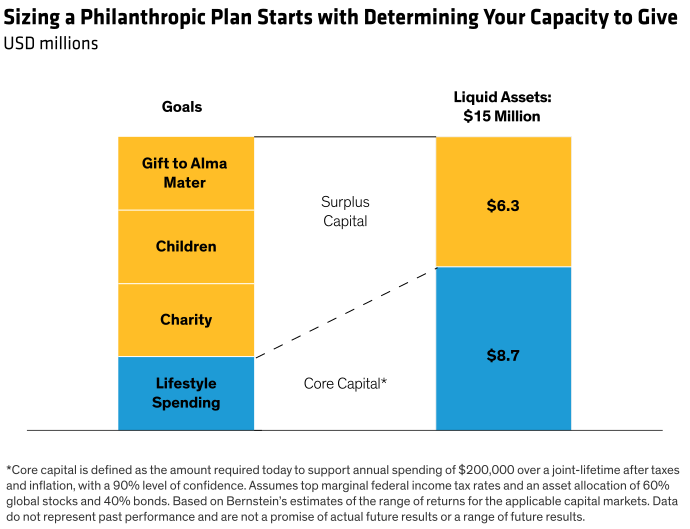
Consider Amy, a 55-year-old longtime employee of a tech company facing an imminent IPO. Through prior stock awards, Amy has amassed a substantial share count that she expects will generate roughly $12 million after selling and paying taxes, padding her existing $3 million in savings. Amy would like to better understand how this windfall impacts her ability to retire early. Once her own nest egg is secured, she’d like to help with down payments so her two children can purchase homes, then allocate the bulk of her remaining assets to several charitable causes that have proved meaningful in her life.
Amy needs $200,000 per year to cover her living expenses and plans to invest her proceeds in a diversified mix of 60% stocks and 40% bonds as soon as she can reduce her concentration risk. Based on these assumptions, her core capital requirement will be $8.7 million, leaving meaningful “surplus” capital of $6.3 million to direct toward charity and her children (Display). Seeing these projections, Amy is able to confidently move forward with next steps in her philanthropic plan.
2. Should I Donate My Stock to Charity Before or After the IPO?
After quantifying her capacity to give, Amy shifts her focus to timing. Some of her colleagues have mentioned contributing private shares to donor-advised funds (DAFs) or other charities prior to the IPO. Amy asks her financial advisor to help her think through the trade-offs of donating stock before or after the public offering.
Contributing shares once the stock becomes public is simpler while donating private shares before the IPO adds complexity and may be less cost effective. Some companies impose transfer restrictions on private shares, eliminating the choice altogether. Where transfers are allowed, shareholders are responsible for securing qualified appraisals to substantiate their income tax deduction, which may be discounted for a lack of marketability and control.
Gifting stock after the IPO eliminates the appraisal requirement, streamlining the process overall. Notably, most shareholders will face a lock-up window after their stock goes public, preventing sales for a certain period, often (though not always) 180 days. Some investors may be rightfully concerned about downward price pressure as their lock-up expiration nears: a 10-year historical analysis of IPO activity in operating companies raising more than $50 million showed that on average, shares were trading lower than their IPO price both when the lock-up ended and six months later.
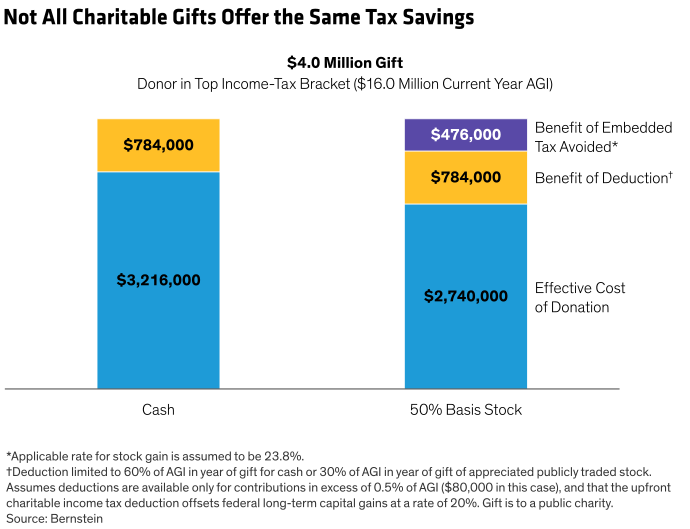
Yet despite the price risk, Amy is drawn to the ease of a post-IPO contribution once the restrictions expire. A key factor in her decision? She’ll contribute stock, rather than wait to make her gifts with cash in hand from the sale of her shares. The average cost basis of Amy’s holdings totals just 50% of the anticipated IPO price. That means donating $4.0 million of appreciated stock (versus cash) to a public charity will reduce the effective cost of her donation by $476,000, as she permanently avoids the embedded capital gains on the sale of her shares (Display).2
3. Which Giving Vehicle Is Right for Me: A Donor-Advised Fund, Private Foundation, Charitable Trust, or Endowment?
There’s no universal answer to this question. A donor-advised fund can streamline administration, while offering a flexible grantmaking timeline, more favorable deductibility rules, and anonymity, all for a relatively low cost. A private foundation may provide greater control but usually comes with heightened administration and expenses. Split-interest charitable trusts may offer income or estate tax mitigation alongside charitable support. Meanwhile, funding an endowment directly at a nonprofit can create lasting support for those with a specific charity in mind. Once the endowment is funded, the organization generally owns and invests the assets according to its policies and the gift agreement. The structure may provide permanence, but the donor typically gives up investment control.
Often, more than one strategy may be appropriate, depending on the impact you want to make, the role you’d like to play, and the complexity you’re willing to assume.
4. How Do I Decide Which Causes and Charities to Support?
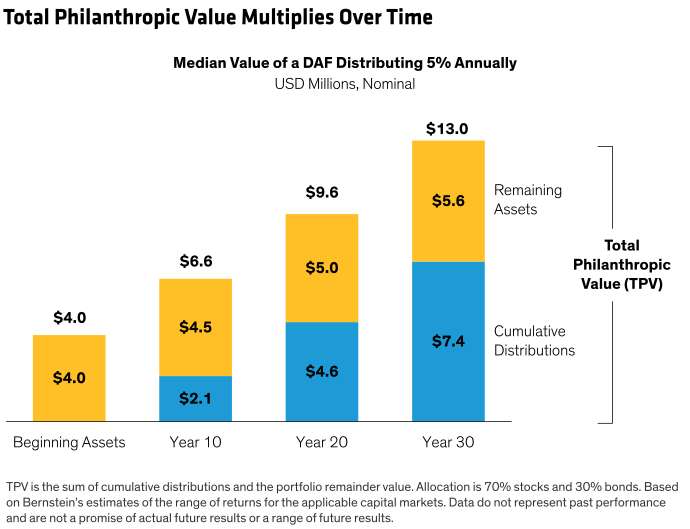
While contributing stock is a financial act, deciding what the money should accomplish is a different discipline. After the IPO, Amy funds a DAF with $4.0 million in shares, and her advisors project the gift’s potential impact over time, assuming 5% annual distributions to charity (Display). Amy is deeply gratified to see what her gift could accomplish, but she recognizes that a large DAF balance is not yet a full philanthropic strategy.
To help translate her intentions into an actionable plan, Amy’s advisory team guides her through a series of questions, including:
- Which experiences have shaped what she’s come to care about?
- Does she favor root causes, urgent needs, or both?
- Is she drawn only toward long-standing organizations, or is she open to calculated experimentation with grantees?
- Does she want to see the impact made in her local community? Or will her support be reflected on a broader national or global scale?
Her first answers needn’t be etched in stone. They simply offer a direction for her capital that can evolve into a mission, a method for selecting organizations, and a plan for deploying funds.
Start Your IPO Giving Plan Early, Then Let It Evolve
Planning for an IPO can be busy and complicated, but you don’t have to go it alone. It is critical to assemble a high-quality advisory team to thoroughly evaluate your financial plan and navigate family and charitable objectives. Engage a Bernstein Advisor to learn more about planning opportunities to help secure your financial stability and make an impact that lasts.
[2] Assumes stock carries a holding period of one year or longer.