

While the national debt crossing the $40 trillion mark makes for a striking headline, citing a single dollar figure isn’t the right measure. What matters is the debt relative to the size of the economy that supports it—and, more importantly, what the realistic paths forward mean for your portfolio.
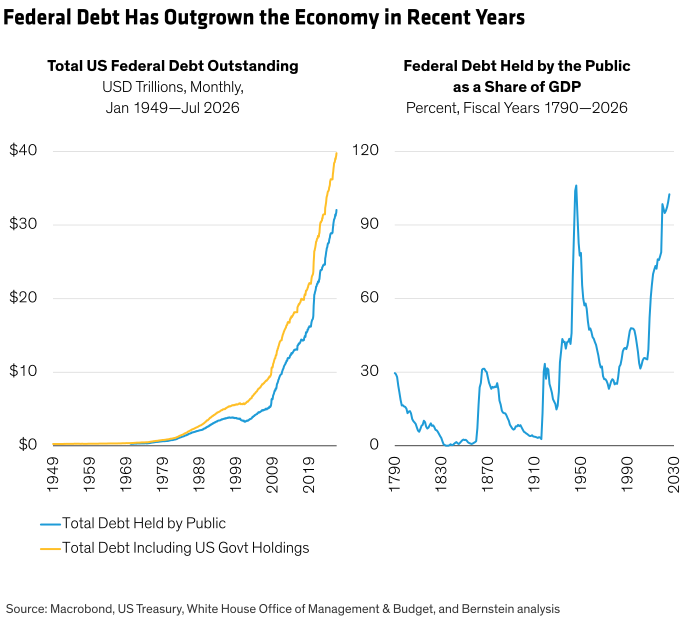
Our view hasn’t fundamentally changed in the face of this milestone: warning lights continue to flash, but alarms have yet to blare. We see real risks, but also time and workable policy solutions. Yet given the lack of appetite in DC to embrace potential solutions, we suspect it will take a mini- or full-blown crisis to catalyze action and give Congress the air cover to make tough calls. In the interim, we also foresee other policy-related risks which could affect rates.
Here’s how we’re thinking about the key questions clients are asking right now.
Should rising US debt change my investment strategy?
To put it succinctly: no wholesale changes—and that’s by design. We’ve studied a range of resolutions to the debt situation, but because each path favors different assets, a diversified portfolio remains the most effective positioning. At the margin, the debt backdrop makes us lean slightly toward stocks and some additional inflation protection relative to a completely benign environment. But we’re not making large strategic allocation shifts to bet on this theme.
We do have our eyes on the bond market and the recent rise in rates. A 10-year yield in the 4%–5% range—where we’ve mainly hovered for the past three years—seems reasonable, in our view. Growth headwinds are the key risk to the downside, while risks to the upside are largely policy related: either geopolitical issues or budget proposals that inflame the market. That calls for balance, not a complete overhaul.
Are higher Treasury yields signaling concern about US debt?
Not necessarily. Frankly, we haven’t had much “new news” on the budget front and most of the topics floating around in the press have already been priced in. Instead, after years of low interest rates, it seems that investors are finally being compensated for bearing exposure to mounting US debt loads.
Recent moves in bond yields can be primarily viewed as compensation for longer-term macroeconomic uncertainty (the Treasury term premium), with a brief step down in late June as a deal with Iran came into view and a resurgence to recent highs when the conflict re-escalated. Meanwhile, outsized investment-grade issuance by AI hyperscalers has heightened competition, pulling capital away from Treasuries.
Currently, the yields and potential capital gains in the five- to 10-year part of the Treasury yield curve remain attractive. We see less value further out and are positioned for the yield curve to steepen, which also hedges our interest rate exposure somewhat.[i]
Are Treasury buybacks enough to calm the bond market?
You may have seen the Treasury’s recent move to ramp up buybacks of long-dated bonds—perhaps most notable because it signals a greater attunement to rates from DC. However, the response is not meaningful enough to move the needle on its own. It may buy a little time, but it can’t substitute for the tax-and-spending compromise a durable fix requires. The stance also seems somewhat at cross-purposes with a Fed that has recently appeared comfortable letting higher market-driven long-term yields help do some of the work of bringing inflation back in check.
Are taxes going up in light of the trillion-dollar US national debt?
This is the most actionable question for high-income and high-net-worth families. And the honest answer is that higher taxes are a reasonable scenario to prepare for in the coming years, though they’re less likely in the next two. If anything, the 2025 tax cuts improved take-home incomes, while worsening the federal budget trajectory and adding to the eventual deficit reckoning.
Any credible long-term fix almost certainly pairs spending restraint with additional revenue. And historically, the wealthy have often been the focus of revenue-related proposals: higher top marginal and corporate rates, changes to how investment and pass-through income is taxed, estate and gift tax modifications, and more. While we can’t forecast specific legislation, directionally, this is the type of environment where proactive estate, gift, and tax planning earns its keep. It’s worth a dedicated conversation with your advisor and tax professional.
Could US debt trigger a crisis or end the US dollar’s reserve currency status?
That all boils down to one question: is the US economy safe? When answering this, it’s important to acknowledge that true crises can arise suddenly, and the US fiscal position has been unsustainable for some time. While that has not yet led to a bond buying strike that would trigger an outright crisis, that outcome remains possible. Indeed, the longer that fiscal policy remains untenable, the more likely that outcome becomes.
Still, that is not our base case, or anything close to it. The factors that have allowed the US to run large, persistent deficits remain in place. The US dollar enjoys an “exorbitant privilege” as the world’s reserve currency and preferred home for global savings, and we expect it to keep that status for the foreseeable future—even when accounting for shifting international sentiment. The AI megatrend reinforces the US dollar’s dominance: global investors need dollars to own the companies leading the wave, and if those investments pay off, the proceeds are likely to be in dollars too.
What’s more, despite growing geopolitical concerns about the dollar and efforts by international investors to hedge their exposure, demand for US financial assets is still robust. Foreign private buyers continue to invest in US fixed-income assets and foreign demand for US equities surged in 2024–2025 and remains at an all-time high.
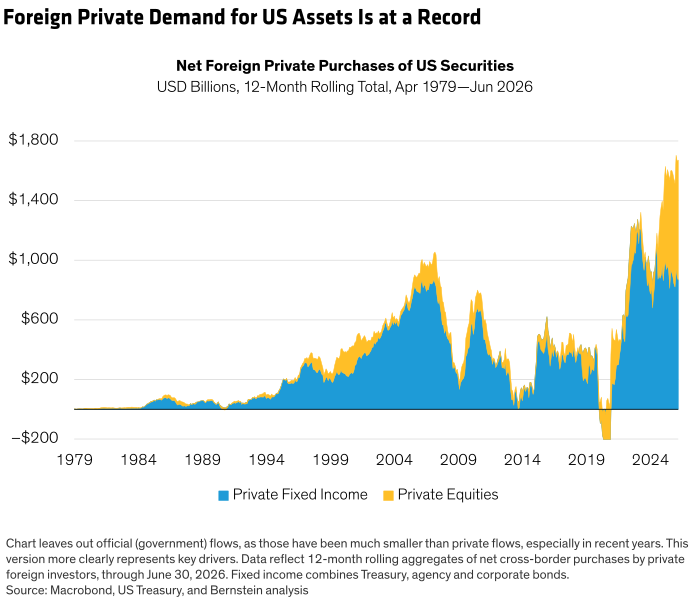
We also suspect that a full-blown crisis, akin to past emerging-market ones, is unlikely. Far more plausible is a mini-crisis that forces policymakers finally to act on fiscal policy; a roughly 50–100 basis point rise in rates could do the trick. One or more such eventual scares are likely, in our view, though open questions remain around timing, severity, cause, and the efficacy of the policy response. We’re keeping our eyes on 2029 budget discussions, but non-economic events could also serve as a catalyst. In recent years, we’ve seen geopolitical issues prompt a response in terms of yields and the bond term premium, too.
Should I use gold, bitcoin, or real assets to hedge US debt risk?
There’s no single silver-bullet hedge, which is why we favor a diversified approach over any individual “protection” trade. Real assets tend to deliver mild and steady returns across most scenarios and hold up better in a crisis or inflationary environment—so they may play a beneficial role. Yet we’d note that gold behaves more as a disaster hedge than a reliable inflation one, so we’d size it as part of a basket rather than as a cornerstone. Gold also experienced a boom-bust cycle in the past few quarters and at today’s levels, we still think a diversified portfolio is likely to outperform over the medium to long term.
We view most cryptoassets as venture-style technology bets rather than macro hedges. Bitcoin is the possible exception, resembling a wager that people in the future come to treat it like as they have gold historically—but reliability is an issue here, too. That’s why we’d treat it as a small part of a basket, not a standalone solution, and with more embedded risk. It’s not nearly as well-tested as gold and often still trades as a risk-on asset, not the ultimate risk-off asset. Put simply, when it comes to potential benefits, we wouldn’t rely on it as a macro hedge.
A $40 Trillion Debt Load Calls for Planning, Not Panic
While the $40 trillion debt mark is an enormous sum, it’s not cause for immediate alarm. Real solutions are out there, waiting for serious policymakers to craft a long-term deal. Unfortunately, compromise has become more elusive in today’s political climate.
Nonetheless, we have time and an array of workable solutions to choose from, many of which have been scored by budget planners. For investors, a deliberately diversified portfolio remains the best defense against this perpetual path of uncertainty.
One genuine wildcard? If AI delivers a meaningful productivity boost, faster growth could allow the US to effectively “kick the can” for decades more. That’s far from guaranteed—and it raises its own open questions, from what AI means for wages and tax revenues to what a greater leap toward artificial general intelligence could mean for the broader economy and society. In many ways, the AI wildcard introduces even more uncertainty, making diversification even more critical. And that diversification includes private assets whose prices may be less sensitive to headlines, as those headlines may well get worse before they get better.
[i] It’s worth noting that the municipal bond yield curve and Treasury yield curve have been rather disconnected for several quarters. So the positioning in Treasury and municipal maturities differs—in the muni market, we’re getting much better compensation further out and not so much in the middle maturities and are positioned accordingly.